Northern Black-Flycatcher

Northern Black-Flycatcher

Melaenornis edolioides

Silhouette: Martin Bulla, based on François Desbordes' illustration · PhyloPic

LCLeast ConcernNTVUENCR
Daily sighting probability <5% · Rare
at Serrekunda

In 3 days ~10% in a week ~20%

25 Verified sightings at Serrekunda
1,738 In all 10 parks From 2019 to 2026
February Best month
☀️ Diurnal When it's spotted

About the Northern Black-Flycatcher

The northern black flycatcher (Melaenornis edolioides) is a small passerine bird in the flycatcher family, Muscicapidae. This is an insectivorous species which is a resident breeder in tropical Africa from Senegal to Ethiopia and south to Zaire and Tanzania.

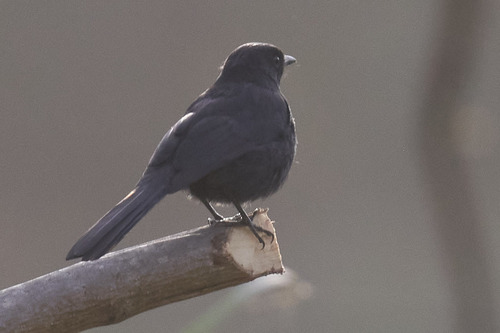
The northern black flycatcher is found in moist wooded areas and cultivation. It nests in a hole or reuses the old nest of another species, and lays two or three eggs. Breeding takes place in the wet season. The northern black flycatcher is 20 centimetres (7.9 in) long. It is a large upright long-tailed flycatcher. The adult is uniformly black. Juveniles are blackish-brown with buff scaling.

The long square-ended tail helps to distinguish this species from two other all-black insectivores, the fork-tailed drongo and the shorter-tailed and red-eyed common square-tailed drongo. This flycatcher has a simple musical song and a thin tsee-whee call. Birds of The Gambia by Barlow, Wacher and Disley, ISBN 1-873403-32-1 Wikipedia →

Sounds

Song0:24

Senegal · 2023

© Alain Malengreau · XC862670 · CC BY-NC-SA 4.0

Call0:59

Ethiopia · 2014

© Andrew Spencer · XC267180 · CC BY-NC-SA 4.0

Song0:46

Ghana · 2022

© Peter Boesman · XC719270 · CC BY-NC-ND 4.0

Global Distribution

Parks Where Found

# Park Country Daily sighting probability
1 Niokolo-Koba National Park 🇸🇳 Senegal
~50%
2 Queen Elizabeth National Park 🇺🇬 Uganda
~40%
3 Masai Mara National Reserve 🇰🇪 Kenya
~10%
4 Lake Mburo National Park 🇺🇬 Uganda
~10%
5 Kibale National Park 🇺🇬 Uganda
~10%
6 Murchison Falls National Park 🇺🇬 Uganda
~10%
7 Kidepo Valley National Park 🇺🇬 Uganda
<5%
8 Serengeti National Park 🇹🇿 Tanzania
<5%
9 Virunga National Park 🇨🇩 Democratic Republic of the Congo
<5%
10 Bwindi Impenetrable National Park 🇺🇬 Uganda
<5%

Cities Where Found

# City Country Daily sighting probability
1 Kampala 🇺🇬 Uganda
~40%
2 Yaoundé 🇨🇲 Cameroon
~30%
3 Abuja 🇳🇬 Nigeria
~20%
4 Ouagadougou 🇧🇫 Burkina Faso
~20%
5 Serrekunda 🇬🇲 Gambia
<5%

Before you go

What are the chances of seeing a Northern Black-Flycatcher in Serrekunda?

Rare

Under 5% of wildlife watchers report a Northern Black-Flycatcher sighting in Serrekunda on a given day, based on 25 verified sightings from GBIF citizen-science data. It is the 147th most-seen of the 213 birds we can rate there. Over three days the chance rises to about 10%, and over a week to about 20%, if each day is a fresh chance.

When is the best time to see a Northern Black-Flycatcher in Serrekunda?

February, April and September

In those months about 10% of wildlife watchers report a Northern Black-Flycatcher in Serrekunda on a given day, against under 5% in March, May–August and October–January, the lowest months.

What time of day is best to see a Northern Black-Flycatcher?

Between 9 am and noon

Across all the parks we cover, that three-hour window holds the most Northern Black-Flycatcher sightings with a recorded time, and about 8 in 10 of them come between 6 am and 6 pm: it is a daytime animal.

Is Serrekunda the best place to see a Northern Black-Flycatcher?

5th of 5

Of the 5 cities where we can rate Northern Black-Flycatcher sightings, Serrekunda ranks 5th at under 5%. The best odds are in Kampala (Uganda, about 40%), Yaoundé (Cameroon, about 30%) and Abuja (Nigeria, about 20%).

Which relatives of the Northern Black-Flycatcher live in Serrekunda?

Same family: Muscicapidae

The closest relatives of the Northern Black-Flycatcher that you can see in Serrekunda (family Muscicapidae, Old World Flycatchers, Robins, and Chats) are White-crowned Robin-Chat (about 20%) and Snowy-crowned Robin-Chat (about 10%), with each one's daily chance of a sighting.

Where does the Northern Black-Flycatcher sighting chance come from?

GBIF citizen-science records

It is estimated from how often the Northern Black-Flycatcher is recorded against all the birds logged in Serrekunda (25 verified sightings), calibrated against known sighting rates. Figures are rounded to the nearest 10% because citizen-science data supports honest approximations, not decimals, and months with records from fewer than five people show "—". How it works.
← Back to Serrekunda