Chinese Hwamei

Chinese Hwamei

Garrulax canorus

Silhouette: Jiekun He · PhyloPic

LCLeast ConcernNTVUENCR
Daily sighting probability ~10% · With luck
at Shanghai

In 3 days ~40% in a week ~60%

35 Verified sightings at Shanghai
54 In 1 park From 2019 to 2026
March Best month
☀️ Diurnal When it's spotted

About the Chinese Hwamei

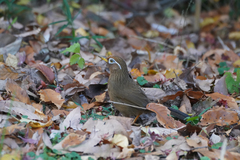
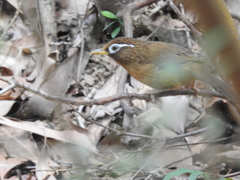
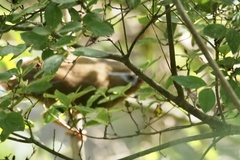
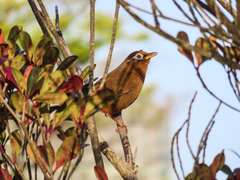
The Chinese hwamei or melodious laughingthrush (Garrulax canorus) is a passerine bird of eastern Asia in the laughingthrush family Leiothrichidae. The name "hwamei" comes from its Chinese name huà méi, which means "painted eyebrow", referring to the distinctive marking around the bird's eyes. The species is a popular cagebird because of its attractive song.

The Chinese hwamei was formally described by the Swedish naturalist Carl Linnaeus in 1758 in the tenth edition of his Systema Naturae. He placed it with the thrushes in the genus Turdus and coined the binomial name Turdus canorus. Linnaeus specified the type locality as Bengal and China but this has been restricted to Amoy (now Xiamen) in Fujian, China. The specific epithet is Latin meaning "melodious" (from canere "to sing"). The Chinese hwamei is now one of 14 laughingthrushes placed in the genus Garrulax that was introduced in 1831 by René Lesson.

The Taiwan hwamei (G. taewanum) was formerly considered to be a subspecies of the Chinese hwamei but has recently been split as a separate species. This was based... Wikipedia →

Sounds

Recording0:20

China · 2025

© 维生素 · iNaturalist · CC BY-NC 4.0

Recording0:26

Japan · 2026

© battari · iNaturalist · CC BY-NC 4.0

Recording0:27

Japan · 2026

© Ryan Durand · iNaturalist · CC BY-NC 4.0

Global Distribution

Parks Where Found

# Park Country Daily sighting probability
1 Nikko National Park 🇯🇵 Japan
~10%

More parks will be added in future updates.

Cities Where Found

# City Country Daily sighting probability
1 Sendai 🇯🇵 Japan
~70%
2 Fuzhou 🇨🇳 China
~20%
3 Changsha 🇨🇳 China
~20%
4 Zhuhai [Macau] 🇨🇳 China
~20%
5 Hangzhou 🇨🇳 China
~20%
6 Suzhou 🇨🇳 China
~20%
7 Xiamen City 🇨🇳 China
~20%
8 Shanghai 🇨🇳 China
~10%
9 Tokyo 🇯🇵 Japan
~10%
10 Guangzhou 🇨🇳 China
~10%

Zoos & Centres Where Found

# Zoo / Centre Country
1 San Diego Zoo Safari Park 🇺🇸 United States In captivity
2 Beijing Wildlife Park 🇨🇳 China In captivity
3 Columbus Zoo and Aquarium 🇺🇸 United States In captivity
4 Shanghai Zoo 🇨🇳 China In captivity
5 无锡动物园 🇨🇳 China In captivity
6 Singapore Zoo 🇸🇬 Singapore In captivity
7 Virginia Zoological Park 🇺🇸 United States In captivity
8 San Antonio Zoo 🇺🇸 United States In captivity
9 Philadelphia Zoo 🇺🇸 United States In captivity
10 Riverbanks Zoo 🇺🇸 United States In captivity
11 Lincoln Park Zoo 🇺🇸 United States In captivity
12 Hong Kong Zoological and Botanical Gardens 🇨🇳 China In captivity
13 Central Park Zoo 🇺🇸 United States In captivity
14 Edward Youde Aviary 🇭🇰 Hong Kong SAR China In captivity

Before you go

What are the chances of seeing a Chinese Hwamei in Shanghai?

With luck

About 10% of wildlife watchers report a Chinese Hwamei sighting in Shanghai on a given day, based on 35 verified sightings from GBIF citizen-science data. It is the 35th most-seen of the 202 birds we can rate there. Over three days the chance rises to about 40%, and over a week to about 60%, if each day is a fresh chance.

When is the best time to see a Chinese Hwamei in Shanghai?

March, June, August and December

In those months about 20% of wildlife watchers report a Chinese Hwamei in Shanghai on a given day, against under 5% in January, the lowest month.

What time of day is best to see a Chinese Hwamei?

Between 11 am and 2 pm

Across all the parks we cover, that three-hour window holds the most Chinese Hwamei sightings with a recorded time, and about 8 in 10 of them come between 6 am and 6 pm: it is a daytime animal.

Is Shanghai the best place to see a Chinese Hwamei?

8th of 15

Of the 15 cities where we can rate Chinese Hwamei sightings, Shanghai ranks 8th at about 10%. The best odds are in Sendai (Japan, about 70%), Fuzhou (China, about 20%) and Changsha (China, about 20%).

Where does the Chinese Hwamei sighting chance come from?

GBIF citizen-science records

It is estimated from how often the Chinese Hwamei is recorded against all the birds logged in Shanghai (35 verified sightings), calibrated against known sighting rates. Figures are rounded to the nearest 10% because citizen-science data supports honest approximations, not decimals, and months with records from fewer than five people show "—". How it works.

← Back to Shanghai