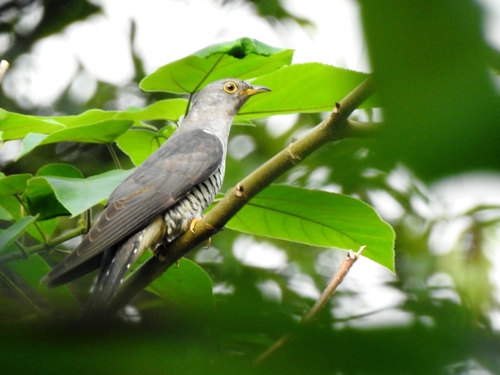
Cuculus nisicolor

Cuculus nisicolor

Cuculus nisicolor

Silhouette: Nicolas Huet le Jeune and Jean-Gabriel Prêtre (vectorized by T. Michael Keesey) · PhyloPic

Daily sighting probability <5% · Rare
at Singapore

In 3 days <5% in a week ~10%

135 Verified sightings at Singapore
54 In all 3 parks From 2019 to 2026
November Best month

About the Cuculus nisicolor

Hodgson's hawk-cuckoo (Hierococcyx nisicolor), also known as the whistling hawk-cuckoo, is a species of cuckoo found in north-eastern India, Myanmar, southern China and southeast Asia. Hodgson's hawk-cuckoo is a brood parasite. The chick evicts bona fide residents of the parasitized nest, thus becoming the sole occupant. Under normal circumstances, this would reduce the provisioning rate as the foster parents see only one gape. To counteract this, the Hodgson's hawk-cuckoo displays gape-coloured patches of skin under its wing to simulate additional gapes; the strategy appears to increase the provisioning rate. This is in contrast to other species of cuckoo (such as the common cuckoo) which increase the rapidity of high pitched hunger calls to increase the provisioning rate.

Although the skin patch is not gape shaped, it is convincing: host parents occasionally place food into the patch. Hodgson's hawk-cuckoo was formerly regarded as having four subspecies. The Philippine hawk-cuckoo is now commonly treated as a separate species, H. pectoralis. The remaining forms are also now split into three species: Malaysian hawk-cuckoo (H. fugax), Hodgson's hawk-cuckoo (H. nisicolor) and rufous hawk-cuckoo or northern hawk-cuckoo (H. hyperythrus).

The common name commemorates the British naturalist Brian Houghton Hodgson. Wikipedia →

Sounds

Recording0:17

Hong Kong SAR China · 2020

© johnallcock · iNaturalist · CC BY-NC 4.0

Recording0:13

China · 2026

© tianyang · iNaturalist · CC BY-NC 4.0

Recording0:07

Hong Kong SAR China · 2023

© Lawrence Hylton · iNaturalist · CC BY 4.0

Global Distribution

Parks Where Found

# Park Country Daily sighting probability
1 Royal Manas National Park 🇧🇹 Bhutan
<5%
2 Namdapha National Park 🇮🇳 India
<5%
3 Doi Inthanon National Park 🇹🇭 Thailand
<5%

Cities Where Found

# City Country Daily sighting probability
1 Jakarta 🇮🇩 Indonesia
~10%
2 Singapore 🇸🇬 Singapore
<5%
3 Guangzhou 🇨🇳 China
<5%

Before you go

What are the chances of seeing a Cuculus nisicolor in Singapore?

Rare

Under 5% of wildlife watchers report a Cuculus nisicolor sighting in Singapore on a given day, based on 135 verified sightings from GBIF citizen-science data. It is the 183rd most-seen of the 298 birds we can rate there. Over three days the chance rises to under 5%, and over a week to about 10%, if each day is a fresh chance.

When is the best time to see a Cuculus nisicolor in Singapore?

Any time of year

In every month with enough records, under 5% of wildlife watchers report a Cuculus nisicolor in Singapore on a given day, so our monthly data shows no clear season.

Is Singapore the best place to see a Cuculus nisicolor?

2nd of 3

Of the 3 cities where we can rate Cuculus nisicolor sightings, Singapore ranks 2nd at under 5%. The best odds are in Jakarta (Indonesia, about 10%).

Where does the Cuculus nisicolor sighting chance come from?

GBIF citizen-science records

It is estimated from how often the Cuculus nisicolor is recorded against all the birds logged in Singapore (135 verified sightings), calibrated against known sighting rates. Figures are rounded to the nearest 10% because citizen-science data supports honest approximations, not decimals, and months with records from fewer than five people show "—". How it works.

← Back to Singapore