Barking Owl

Barking Owl

Ninox connivens

Silhouette: Rachel T Mason · PhyloPic

LCLeast ConcernNTVUENCR
Daily sighting probability <5% · Rare
at Sydney

In 3 days <5%

7 Verified sightings at Sydney
266 In all 2 parks From 2019 to 2026
December Best month
☀️🌙 Day & Night When it's spotted

About the Barking Owl

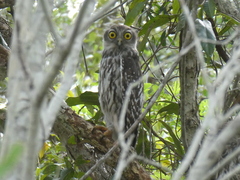
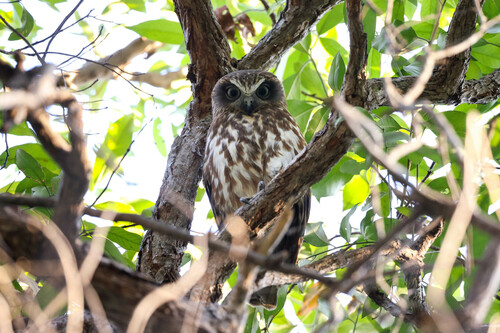
The barking owl (Ninox connivens) or barking boobook, also known as the winking owl, is a nocturnal bird species native to mainland Australia and parts of New Guinea and the Moluccas. They are medium-sized brown owls and have a characteristic voice with calls ranging from a barking dog noise to an intense human-like howl.

The owl takes its name from its characteristic barking voice. For a short period before 2016, the Red List of Threatened Species referred to this species as the "barking boobook". However, this is not used as a common name in Australia or other English speaking areas in this species' range and has now been corrected to barking owl. The Yanyuwa name for the owl is mulurrku.

The barking owl was first described by the English ornithologist John Latham in 1801 with the binomial name Falco connivens. Latham commented that the species "Inhabits New Holland, but no history annexed, further than that it has a wonderful faculty of contracting and dilating the iris: and that the native name is Goora-a-Gang." The specific epithet is the Latin connivens 'winking'.

There are five subspecies: Wikipedia →

Sounds

Begging call0:55

Australia · 2025

© Hank Bower · XC1107706 · CC BY-NC-SA 4.0

Song0:19

Australia · 2025

© Étienne Leroy · XC1072567 · CC BY-NC-SA 4.0

Song and call1:14

Australia · 2025

© Peter Boesman · XC1066759 · CC BY-NC-ND 4.0

Global Distribution

Parks Where Found

# Park Country Daily sighting probability
1 Kakadu National Park 🇦🇺 Australia
~10%
2 Nitmiluk National Park 🇦🇺 Australia
<5%

Cities Where Found

# City Country Daily sighting probability
1 Sydney 🇦🇺 Australia
<5%

Zoos & Centres Where Found

# Zoo / Centre Country
1 Australia Zoo 🇦🇺 Australia In captivity
2 Healesville Sanctuary 🇦🇺 Australia In captivity
3 Taronga Zoo 🇦🇺 Australia In captivity
4 Currumbin Wildlife Sanctuary 🇦🇺 Australia In captivity
5 Lone Pine Koala Sanctuary 🇦🇺 Australia In captivity
6 Moonlit Sanctuary Wildlife Conservation Park 🇦🇺 Australia In captivity
7 Adelaide Zoo 🇦🇺 Australia In captivity
8 Gorge Wildlife Park 🇦🇺 Australia In captivity
9 Featherdale Sydney Wildlife Park 🇦🇺 Australia In captivity
10 Wild Life Sydney 🇦🇺 Australia In captivity
11 Caversham Wildlife Park 🇦🇺 Australia In captivity
12 Central Coast Zoo 🇦🇺 Australia In captivity
13 Ranger Red’s Zoo & Conservation Park 🇦🇺 Australia In captivity

Before you go

What are the chances of seeing a Barking Owl in Sydney?

Rare

Under 5% of wildlife watchers report a Barking Owl sighting in Sydney on a given day, based on 7 verified sightings from GBIF citizen-science data. It is the 230th most-seen of the 243 birds we can rate there. Over three days the chance rises to under 5%, if each day is a fresh chance.

When is the best time to see a Barking Owl in Sydney?

Any time of year

In every month with enough records, under 5% of wildlife watchers report a Barking Owl in Sydney on a given day, so our monthly data shows no clear season.

What time of day is best to see a Barking Owl?

Between 6 and 9 pm

Across all the parks we cover, that three-hour window holds the most Barking Owl sightings with a recorded time, and about 6 in 10 of them come between 6 pm and 6 am: it is seen both by day and at night.

Where else can you see a Barking Owl?

Only Sydney, in our data

Sydney is the only city on Wallace's Line with enough records to rate Barking Owl sightings: under 5% of wildlife watchers there report one on a given day.

Where does the Barking Owl sighting chance come from?

GBIF citizen-science records

It is estimated from how often the Barking Owl is recorded against all the birds logged in Sydney (7 verified sightings), calibrated against known sighting rates. Figures are rounded to the nearest 10% because citizen-science data supports honest approximations, not decimals, and months with records from fewer than five people show "—". How it works.

← Back to Sydney