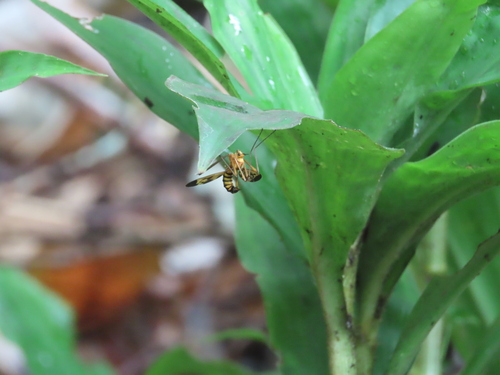
About the Oriental Fruit Fly
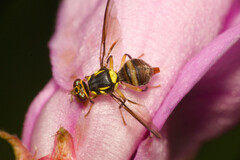
Bactrocera dorsalis, previously known as Dacus dorsalis and commonly referred to as the oriental fruit fly, is a species of tephritid fruit fly that is originally from to Southeast Asia. It is one of the major pest species in the genus Bactrocera with a broad host range of cultivated and wild fruits. Male B. dorsalis respond strongly to methyl eugenol, which is used to monitor and estimate populations, as well as to annihilate males as a form of pest control. They are also important pollinators and visitors of wild orchids, Bulbophyllum cheiri and Bulbophyllum vinaceum in Southeast Asia, which lure the flies using methyl eugenol.
The fly is similar to the closely related species B. carambolae and B. occipitalis. The species name B. dorsalis is identical to other synonyms B. papayae, B. invadens and B. philippinensis. B. dorsalis is a species of tephritid fruit fly. Flies that belong to this family are usually small to medium-sized with colorful markings. In particular, B. dorsalis belongs to a complex of physically similar flies called the Bactrocera dorsalis complex, whose defining characteristics include a mostly black thorax and dark T-shaped marking on the fly... Wikipedia →