


Completed




Northern Plains Gray Langur
Semnopithecus entellus
Silhouette: Kai R. Caspar · PhyloPic
- KingdomAnimalia (Animals)
- PhylumChordata (Chordates)
- ClassMammalia (Mammals)
- OrderPrimates
- FamilyCercopithecidae (Old World Monkeys)
- GenusSemnopithecus (Grey and Nilgiri Langurs)
- SpeciesSemnopithecus entellus (Northern Plains Gray Langur)
In 3 days >90%
7 Verified sightings at Tamluk
430 In all 5 parks From 2019 to 2026
November Best month
🌅 Crepuscular When it's spotted
About the Northern Plains Gray Langur
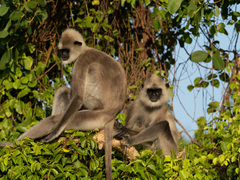
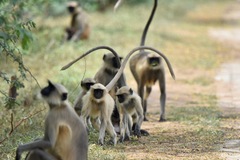
The northern plains gray langur (Semnopithecus entellus), also known as the sacred langur, Bengal sacred langur and Hanuman langur, is a species of primate in the family Cercopithecidae. The northern plains gray langur belongs to the genus Semnopithecus along with the other Indian langurs. The southern plains gray langur was once classified as a subspecies of S. entellus, i.e., S. entellus dussumieri and later regarded as a separate species, i.e., S. dussumieri, but is now regarded as an invalid taxon. Most of the specimens that had been regarded as Semnopithecus dussumieri fall within the revised range of Semnopithecus entellus.
The fur of adults is mostly light colored, with darker fur on the back and limbs, and the face, ears, hands and feet are all black. Infants are brown. Body size excluding tail ranges from 45.1 cm (17.8 in) to 78.4 cm (30.9 in) long, and the tail length is between 80.3 cm (31.6 in) and 111.8 cm (44.0 in). Adult males weigh between 16.9 kg (37 lb) and 19.5 kg (43 lb) while adult females weigh between 9.5 kg (21 lb) and 16.1 kg (35 lb).
The range of the northern plains gray langur covers a large... Wikipedia →
Recent sightings of Northern Plains Gray Langur in Tamluk
LIVEiNaturalistGlobal Distribution
Parks Where Found
| # | Park | Country | Daily sighting probability |
|---|---|---|---|
| 1 | Ranthambore National Park | 🇮🇳 India | |
| 2 | Bandhavgarh National Park | 🇮🇳 India | |
| 3 | Kanha National Park | 🇮🇳 India | |
| 4 | Gir National Park | 🇮🇳 India | |
| 5 | Satpura National Park | 🇮🇳 India |
Zoos & Centres Where Found
| # | Zoo / Centre | Country | |
|---|---|---|---|
| 1 | ZooParc de Beauval | 🇫🇷 France | |
| 2 | Ostrava Zoo | 🇨🇿 Czechia | |
| 3 | Nandankanan Zoological Park | 🇮🇳 India | |
| 4 | Silesian Zoological Garden | 🇵🇱 Poland | |
| 5 | Hanover Zoo | 🇩🇪 Germany | |
| 6 | Łódź Zoo | 🇵🇱 Poland | |
| 7 | London Zoo | 🇬🇧 United Kingdom | |
| 8 | Apenheul Primate Park | 🇳🇱 Netherlands | |
| 9 | Monkey Park | 🇪🇸 Spain | |
| 10 | Castellar Zoo | 🇪🇸 Spain | |
| 11 | Ralph Perkins II Wildlife Center and Woods Garden | 🇺🇸 United States |
Before you go
What are the chances of seeing a Northern Plains Gray Langur in Tamluk?
Very likely
About 70% of wildlife watchers report a Northern Plains Gray Langur sighting in Tamluk on a given day, based on 7 verified sightings from GBIF citizen-science data. Over three days the chance rises to over 90%, if each day is a fresh chance.
What time of day is best to see a Northern Plains Gray Langur?
Between 4 and 7 am
Across all the parks we cover, that three-hour window holds the most Northern Plains Gray Langur sightings with a recorded time, and about 6 in 10 of them come between 6 am and 6 pm: it is most active around dawn and dusk.
Is Tamluk the best place to see a Northern Plains Gray Langur?
Yes
Of the 9 cities where we can rate Northern Plains Gray Langur sightings, Tamluk has the highest daily chance: about 70%. Next come Ahmedabad (India, about 60%) and Kota (India, about 50%).
Where does the Northern Plains Gray Langur sighting chance come from?
GBIF citizen-science records
It is estimated from how often the Northern Plains Gray Langur is recorded against all the mammals logged in Tamluk (7 verified sightings), calibrated against known sighting rates. Figures are rounded to the nearest 10% because citizen-science data supports honest approximations, not decimals, and months with records from fewer than five people show "—". How it works.
