
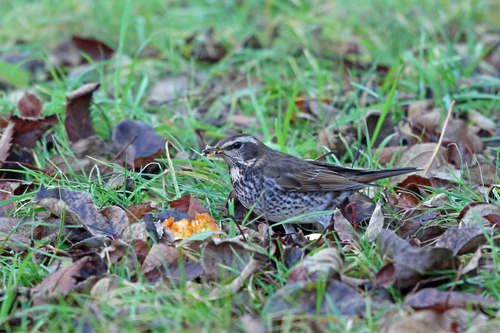
Swinhoe’s White-eye

Swinhoe’s White-eye

Zosterops simplex

Silhouette: Ferran Sayol · PhyloPic

LCLeast ConcernNTVUENCR
Daily sighting probability <5% · Rare
at Tianjin

In 3 days ~10% in a week ~30%

27 Verified sightings at Tianjin
1,272 In all 6 parks From 2019 to 2026
September Best month
🌅 Crepuscular When it's spotted

About the Swinhoe’s White-eye

Swinhoe's white-eye (Zosterops simplex) is a bird species in the white-eye family, Zosteropidae. It is found in eastern China, Taiwan, north Vietnam, the Thai-Malay Peninsula, Sumatra and Borneo. Additionally, populations have also been introduced to Southern California, where their population has been expanding rapidly.

Swinhoe's white-eye was formally described in 1861 by the English naturalist Robert Swinhoe, who assigned it the binomial name Zosterops simplex. The genus Zosterops had been introduced by the naturalists Nicholas Vigors and Thomas Horsfield in 1827. The genus name combines the Ancient Greek words zōstēros meaning "belt" or "girdle" and ōpos meaning "eye". The specific epithet simplex is Latin meaning "simple" or "plain".

This species was previously considered a subspecies group of the Japanese white-eye (Zosterops japonicus), but based on the results of a molecular phylogenetic study published in 2018, it was elevated it to full species status.

Five subspecies are recognised: Wikipedia →

Sounds

Call0:09

Vietnam · 2026

© Tim Dinh / Annambirding · XC1181674 · CC BY-NC-SA 4.0

Nocturnal flight call0:12

China · 2026

© Xiangrong Yan · XC1180658 · CC BY-NC-SA 4.0

Song0:59

China · 2004

© Geoff Carey · XC934107 · CC BY-NC-SA 4.0

Global Distribution

Parks Where Found

# Park Country Daily sighting probability
1 Taroko National Park 🇹🇼 Taiwan
~30%
2 Doi Inthanon National Park 🇹🇭 Thailand
~10%
3 Cuc Phuong National Park 🇻🇳 Vietnam
~10%
4 Khao Yai National Park 🇹🇭 Thailand
<5%
5 Jiuzhaigou National Park 🇨🇳 China
<5%
6 Kaeng Krachan National Park 🇹🇭 Thailand
<5%

Cities Where Found

# City Country Daily sighting probability
1 Hanoi 🇻🇳 Vietnam
~90%
2 Taichung 🇹🇼 Taiwan
~90%
3 Zhuhai [Macau] 🇨🇳 China
~80%
4 Hong Kong 🇨🇳 China
~80%
5 Kaohsiung 🇹🇼 Taiwan
~80%
6 Xiamen City 🇨🇳 China
~80%
7 Taipei 🇹🇼 Taiwan
~80%
8 Guangzhou 🇨🇳 China
~70%
9 Shantou 🇨🇳 China
~70%
10 Fuzhou 🇨🇳 China
~70%

Zoos & Centres Where Found

# Zoo / Centre Country
1 Leofoo Village Theme Park 🇹🇼 Taiwan In captivity
2 Hong Kong Zoological and Botanical Gardens 🇨🇳 China In captivity
3 Edward Youde Aviary 🇭🇰 Hong Kong SAR China In captivity
4 Reptile House 🇭🇰 Hong Kong SAR China In captivity

Before you go

What are the chances of seeing a Swinhoe’s White-eye in Tianjin?

Rare

Under 5% of wildlife watchers report a Swinhoe’s White-eye sighting in Tianjin on a given day, based on 27 verified sightings from GBIF citizen-science data. It is the 63rd most-seen of the 121 birds we can rate there. Over three days the chance rises to about 10%, and over a week to about 30%, if each day is a fresh chance.

When is the best time to see a Swinhoe’s White-eye in Tianjin?

September

In that month about 20% of wildlife watchers report a Swinhoe’s White-eye in Tianjin on a given day, against under 5% in June–August and November–April, the lowest months.

What time of day is best to see a Swinhoe’s White-eye?

Between 3 and 6 am

Across all the parks we cover, that three-hour window holds the most Swinhoe’s White-eye sightings with a recorded time, and about half of them come between 6 pm and 6 am: it is most active around dawn and dusk.

Is Tianjin the best place to see a Swinhoe’s White-eye?

41st of 45

Of the 45 cities where we can rate Swinhoe’s White-eye sightings, Tianjin ranks 41st at under 5%. The best odds are in Hanoi (Vietnam, about 90%), Taichung (Taiwan, about 90%) and Zhuhai [Macau] (China, about 80%).

Where does the Swinhoe’s White-eye sighting chance come from?

GBIF citizen-science records

It is estimated from how often the Swinhoe’s White-eye is recorded against all the birds logged in Tianjin (27 verified sightings), calibrated against known sighting rates. Figures are rounded to the nearest 10% because citizen-science data supports honest approximations, not decimals, and months with records from fewer than five people show "—". How it works.

← Back to Tianjin