Burrowing Ratsnake

Burrowing Ratsnake

Euprepiophis conspicillata

Silhouette: Alex Slavenko · PhyloPic

LCLeast ConcernNTVUENCR Endemic
Daily sighting probability <5% · Rare
at Tokyo

In 3 days ~10% in a week ~20%

16 Verified sightings at Tokyo
5 In 1 park From 2019 to 2026
May Best month
☀️ Diurnal When it's spotted

About the Burrowing Ratsnake

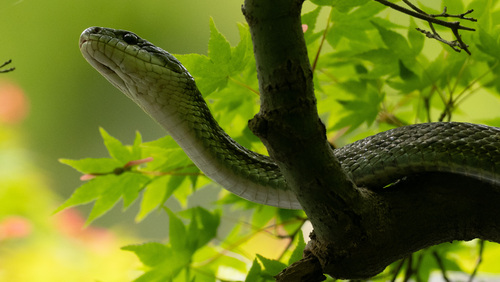
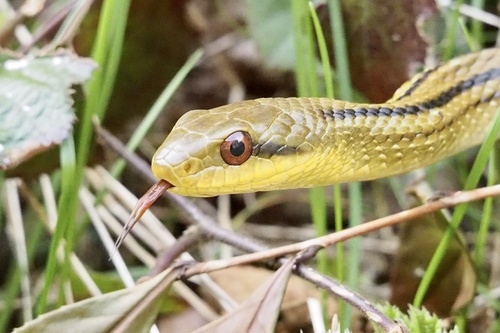
Euprepiophis conspicillata, commonly known as the Japanese forest rat snake, is a species of nonvenomous colubrid snake endemic to Japan. Its Japanese common name, jimuguri, roughly translates to "the burrower". It is closely related to Euprepiophis mandarinus, the Mandarin rat snake.

Euprepiophis conspicillata is native to all four main islands of Japan, including some smaller outlying islands, as well as Kunashir Island (territory disputed between Japan and Russia). Adults are usually 70 to 100 cm (2.3 to 3.3 ft) in total length (body + tail).

In recent years there has been some taxonomic controversy over the genera of rat snakes. Based on mitochondrial DNA, Utiger et al. (2002) argued for a splintering of the genus Elaphe and suggested a reworking of the genera.

However, all published taxonomy remains a taxonomic suggestion until ruled on by the International Commission on Zoological Nomenclature (ICZN - https://www.iczn.org/), but that body has so far not supported the change and has not addressed the taxonomic suggestion. Thus the official taxonomy remains Elaphe.

The Japanese forest rat snake can be... Wikipedia →

Global Distribution

Parks Where Found

# Park Country Daily sighting probability
1 Nikko National Park 🇯🇵 Japan
~30%

More parks will be added in future updates.

Cities Where Found

# City Country Daily sighting probability
1 Tokyo 🇯🇵 Japan
<5%

Before you go

What are the chances of seeing a Burrowing Ratsnake in Tokyo?

Rare

Under 5% of wildlife watchers report a Burrowing Ratsnake sighting in Tokyo on a given day, based on 16 verified sightings from GBIF citizen-science data. It is the 13th most-seen of the 15 reptiles we can rate there. Over three days the chance rises to about 10%, and over a week to about 20%, if each day is a fresh chance.

When is the best time to see a Burrowing Ratsnake in Tokyo?

May and October

In those months about 10% of wildlife watchers report a Burrowing Ratsnake in Tokyo on a given day, against under 5% in June–September and November–April, the lowest months.

What time of day is best to see a Burrowing Ratsnake?

Between 11 am and 2 pm

Across all the parks we cover, that three-hour window holds the most Burrowing Ratsnake sightings with a recorded time, and about 8 in 10 of them come between 6 am and 6 pm: it is a daytime animal.

Where else can you see a Burrowing Ratsnake?

Only Tokyo, in our data

Tokyo is the only city on Wallace's Line with enough records to rate Burrowing Ratsnake sightings: under 5% of wildlife watchers there report one on a given day.

Where does the Burrowing Ratsnake sighting chance come from?

GBIF citizen-science records

It is estimated from how often the Burrowing Ratsnake is recorded against all the reptiles logged in Tokyo (16 verified sightings), calibrated against known sighting rates. Figures are rounded to the nearest 10% because citizen-science data supports honest approximations, not decimals, and months with records from fewer than five people show "—". How it works.

← Back to Tokyo