King Eider

King Eider

Somateria spectabilis

Silhouette: Edwin Price · PhyloPic

LCLeast ConcernNTVUENCR
Daily sighting probability <5% · Rare
at Toronto

In 3 days <5%

210 Verified sightings at Toronto
595 In all 2 parks From 2019 to 2026
January Best month
☀️ Diurnal When it's spotted

About the King Eider

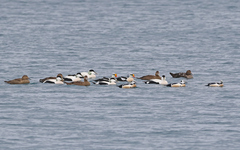
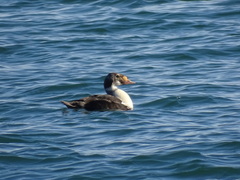
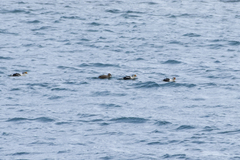
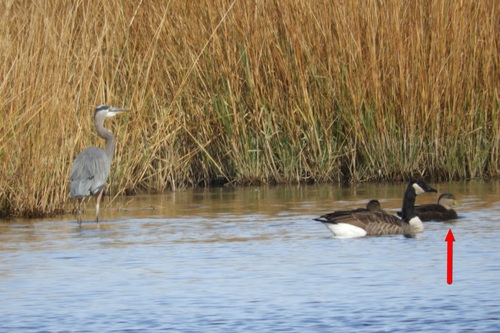
The king eider (pronounced ) (Somateria spectabilis) is a large sea duck that breeds along Northern Hemisphere Arctic coasts of northeast Europe, North America and Asia. The birds spend most of the year in coastal marine ecosystems at high latitudes, and migrate to Arctic tundra to breed in June and July. They lay four to seven eggs in a scrape on the ground lined with grass and down.

When he first described the king eider in 1758, in the 10th edition of his opus Systema Naturae, Carl Linnaeus assigned it to the genus Anas, along with the rest of the ducks. In 1819, William Elford Leach moved it and the other large eiders to the genus Somateria, where it has remained since. It is very closely related to the other members of its genus, and is known to hybridise with the common eider. Despite its very large range, it is monotypic.

The genus name Somateria is a combination of the Greek words sōma, meaning "body", and erion, meaning "wool"; the combination (i.e. "wooly body") is a reference to the eider's famously thick, soft down. The specific name spectabilis is Latin for "showy", "remarkable" or "worth seeing", a reference to the handsomeness of the adult... Wikipedia →

Sounds

Call0:23

Norway · 2019

© Stein Ø. Nilsen · XC696420 · CC BY-NC-SA 4.0

Call0:34

United States · 2014

© Andrew Spencer · XC203481 · CC BY-NC-SA 4.0

Call1:08

United States · 2017

© Patrik Åberg · XC406411 · CC BY-NC-SA 4.0

Global Distribution

Parks Where Found

# Park Country Daily sighting probability
1 Svalbard 🇳🇴 Norway
~30%
2 Great Bear Rainforest 🇨🇦 Canada
<5%

Cities Where Found

# City Country Daily sighting probability
1 Kazan 🇷🇺 Russia
<5%
2 Boston 🇺🇸 United States
<5%
3 Chicago 🇺🇸 United States
<5%
4 Moscow 🇷🇺 Russia
<5%
5 Miami 🇺🇸 United States
<5%
6 Toronto 🇨🇦 Canada
<5%
7 Los Angeles 🇺🇸 United States
<5%
8 Helsinki 🇫🇮 Finland
<5%
9 San Francisco 🇺🇸 United States
<5%
10 New York City 🇺🇸 United States
<5%

Zoos & Centres Where Found

# Zoo / Centre Country
1 Saint Louis Zoo 🇺🇸 United States In captivity
2 Tierpark Hagenbeck 🇩🇪 Germany In captivity
3 Alaska SeaLife Center 🇺🇸 United States In captivity
4 Montreal Biodome 🇨🇦 Canada In captivity

Before you go

What are the chances of seeing a King Eider in Toronto?

Rare

Under 5% of wildlife watchers report a King Eider sighting in Toronto on a given day, based on 210 verified sightings from GBIF citizen-science data. It is the 206th most-seen of the 288 birds we can rate there. Over three days the chance rises to under 5%, if each day is a fresh chance.

When is the best time to see a King Eider in Toronto?

January

In that month about 10% of wildlife watchers report a King Eider in Toronto on a given day, against under 5% in February to December, the lowest months.

What time of day is best to see a King Eider?

Between 10 am and 1 pm

Across all the parks we cover, that three-hour window holds the most King Eider sightings with a recorded time, and about 7 in 10 of them come between 6 am and 6 pm: it is a daytime animal.

Is Toronto the best place to see a King Eider?

Among the best

Of the 10 cities where we can rate King Eider sightings, Toronto ranks 6th at under 5%, level with the leaders once rounded. The best odds are in Kazan (Russia, under 5%), Boston (United States, under 5%) and Chicago (United States, under 5%).

Which relatives of the King Eider live in Toronto?

Same family: Anatidae

The closest relatives of the King Eider that you can see in Toronto (family Anatidae, Ducks, Geese, and Swans) are Mallard (about 70%), Canada Goose (about 50%) and Mute Swan (about 30%), with each one's daily chance of a sighting.

Where does the King Eider sighting chance come from?

GBIF citizen-science records

It is estimated from how often the King Eider is recorded against all the birds logged in Toronto (210 verified sightings), calibrated against known sighting rates. Figures are rounded to the nearest 10% because citizen-science data supports honest approximations, not decimals, and months with records from fewer than five people show "—". How it works.

← Back to Toronto