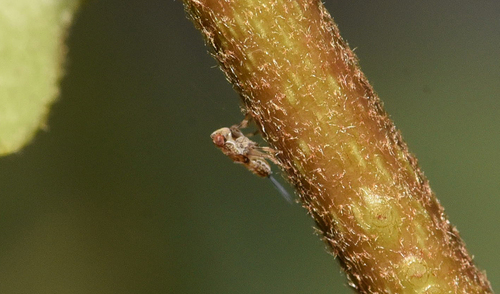
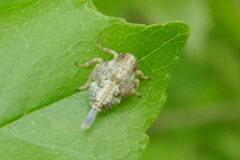
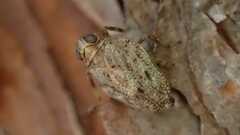
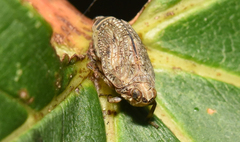

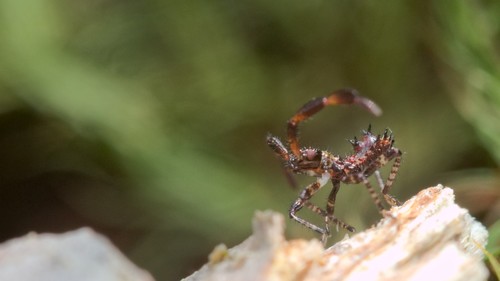
Issus coleoptratus

Issus coleoptratus

Issus coleoptratus

Daily sighting probability ~10% · With luck
at Vienna

In 3 days ~20% in a week ~50%

129 Verified sightings at Vienna
26 In all 2 parks From 2019 to 2026
June Best month
☀️ Diurnal When it's spotted

About the Issus coleoptratus

Issus coleoptratus is a species of planthopper belonging to the family Issidae, named by the Danish zoologist Johan Christian Fabricius in 1781. This common species can be found in the western Palearctic realm, in the Near East, and in North Africa. These insects live on shrubbery and on foliage of various woody plants and common deciduous trees and in mixed forests (forest edges and parks).

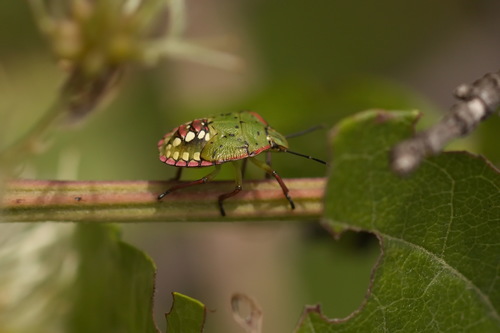
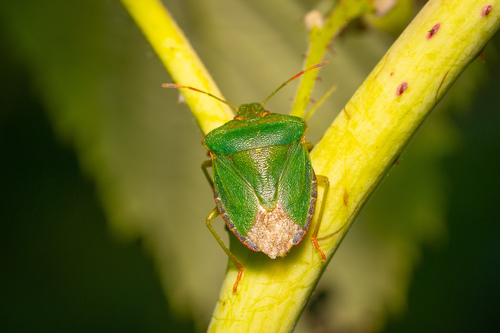
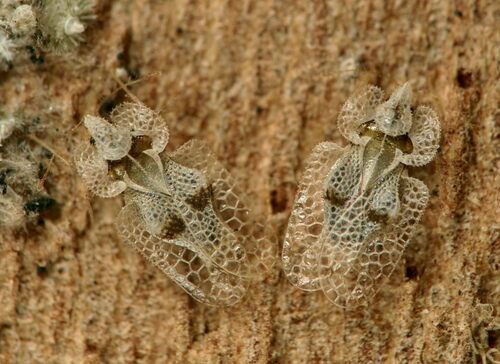
Issus coleoptratus can reach a length of 5.5–7.0 millimetres (0.22–0.28 in). The coloration of these planthoppers can vary from light brown and olive to nearly black. The head, including the eyes, is narrower than the pronotum. The forehead is usually dark brown to black in the upper third, with lighter spots. In the lower area it is greenish, yellowish or brownish. The leathery wings usually show a huge number of dark brown cross-veins with a dark brown discal spot and some evidence of banding. The forewing veins of males and females differs (sexual dimorphism), as they are effaced distally in the female, while in males they are throughout prominent. This species is very similar to the much rarer Issus muscaeformis.

These insects are... Wikipedia →

Global Distribution

Parks Where Found

# Park Country Daily sighting probability
1 Cévennes National Park 🇫🇷 France
~10%
2 Bavarian Forest National Park 🇩🇪 Germany
~10%

Cities Where Found

# City Country Daily sighting probability
1 Berlin 🇩🇪 Germany
~20%
2 Hamburg 🇩🇪 Germany
~10%
3 Vienna 🇦🇹 Austria
~10%
4 Brussels 🇧🇪 Belgium
~10%
5 Paris 🇫🇷 France
~10%
6 London 🇬🇧 United Kingdom
~10%
7 Essen 🇩🇪 Germany
~10%
8 Cologne 🇩🇪 Germany
~10%
9 Rotterdam [The Hague] 🇳🇱 Netherlands
~10%
10 Copenhagen 🇩🇰 Denmark
~10%

Before you go

What are the chances of seeing an Issus coleoptratus in Vienna?

With luck

About 10% of wildlife watchers report an Issus coleoptratus sighting in Vienna on a given day, based on 129 verified sightings from GBIF citizen-science data. It is the 119th most-seen of the 1406 insects we can rate there. Over three days the chance rises to about 20%, and over a week to about 50%, if each day is a fresh chance.

When is the best time to see an Issus coleoptratus in Vienna?

June

In that month about 20% of wildlife watchers report an Issus coleoptratus in Vienna on a given day, against under 5% in January–March and September–October, the lowest months. That is one of Vienna's wettest months, with about 90 mm of rain against 40 mm in February.

What time of day is best to see an Issus coleoptratus?

Between 4 and 7 pm

Across all the parks we cover, that three-hour window holds the most Issus coleoptratus sightings with a recorded time, and about 8 in 10 of them come between 6 am and 6 pm: it is a daytime animal.

Is Vienna the best place to see an Issus coleoptratus?

3rd of 16

Of the 16 cities where we can rate Issus coleoptratus sightings, Vienna ranks 3rd at about 10%. The best odds are in Berlin (Germany, about 20%) and Hamburg (Germany, about 10%).

Where does the Issus coleoptratus sighting chance come from?

GBIF citizen-science records

It is estimated from how often the Issus coleoptratus is recorded against all the insects logged in Vienna (129 verified sightings), calibrated against known sighting rates. Figures are rounded to the nearest 10% because citizen-science data supports honest approximations, not decimals, and months with records from fewer than five people show "—". How it works.

← Back to Vienna