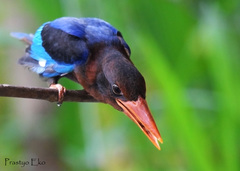
Javan Kingfisher

Javan Kingfisher

Halcyon cyanoventris

Silhouette: Andy Wilson · PhyloPic

LCLeast ConcernNTVUENCR Endemic
Daily sighting probability ~30% · Possible
at Yogyakarta

In 3 days ~60% in a week ~90%

12 Verified sightings at Yogyakarta
6 In 1 park From 2019 to 2026
June Best month
🌅 Crepuscular When it's spotted

About the Javan Kingfisher

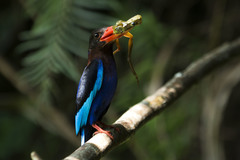
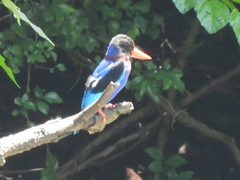
The Javan kingfisher (Halcyon cyanoventris), sometimes called the blue-bellied kingfisher or Java kingfisher, is a medium-sized kingfisher (subfamily Halcyoninae) endemic to the Indonesian islands of Java and Bali. The brightly-colored Javan kingfisher has the large head and bill typical of kingfishers, although the species is less suited for aquatic hunting than many of its relatives and catches much of its prey on land or near the water's edge. The highly territorial bird lays its round white eggs in burrows excavated from earthen walls and riverbanks.

The Javan kingfisher was first described in 1818 by the French ornithologist Louis Pierre Vieillot, who gave it the scientific name Alcedo cyanoventris. In 1821, William Swainson created the genus Halcyon for some of kingfishers — primarily those with stronger, thicker, more rounded beaks. The bird is today listed under the genus Halcyon, referring to the "Halcyon" bird of Greek legend, which contains 11 species of large, heavy-billed kingfishers. Halcyon kingfishers generally prefer woodlands and primarily consume small terrestrial animals rather than fish. H. cyanoventris forms a superspecies with the white-throated... Wikipedia →

Sounds

Recording0:15

Indonesia · 2025

© M Nur Yahya · iNaturalist · CC BY-NC 4.0

Recording0:19

Indonesia · 2019

© Naufal Urfi Dhiya'ulhaq · iNaturalist · CC BY-NC 4.0

Recording0:21

Indonesia · 2022

© bimadiwanata0108 · iNaturalist · CC BY-NC 4.0

Global Distribution

Parks Where Found

# Park Country Daily sighting probability
1 Bali Barat National Park 🇮🇩 Indonesia
~20%

More parks will be added in future updates.

Cities Where Found

# City Country Daily sighting probability
1 Yogyakarta 🇮🇩 Indonesia
~30%
2 Jakarta 🇮🇩 Indonesia
~20%
3 Bandung 🇮🇩 Indonesia
~20%

Zoos & Centres Where Found

# Zoo / Centre Country
1 Bali Bird Park 🇮🇩 Indonesia In captivity

Before you go

What are the chances of seeing a Javan Kingfisher in Yogyakarta?

Possible

About 30% of wildlife watchers report a Javan Kingfisher sighting in Yogyakarta on a given day, based on 12 verified sightings from GBIF citizen-science data. It is the 23rd most-seen of the 42 birds we can rate there. Over three days the chance rises to about 60%, and over a week to about 90%, if each day is a fresh chance.

When is the best time to see a Javan Kingfisher in Yogyakarta?

June

In that month about 50% of wildlife watchers report a Javan Kingfisher in Yogyakarta on a given day, against under 5% in January and August–November, the lowest months. That is one of Yogyakarta's driest months, with about 95 mm of rain against 350 mm in January.

What time of day is best to see a Javan Kingfisher?

Between 1 and 4 am

Across all the parks we cover, that three-hour window holds the most Javan Kingfisher sightings with a recorded time, and about 6 in 10 of them come between 6 pm and 6 am: it is most active around dawn and dusk.

Is Yogyakarta the best place to see a Javan Kingfisher?

Yes

Of the 3 cities where we can rate Javan Kingfisher sightings, Yogyakarta has the highest daily chance: about 30%. Next come Jakarta (Indonesia, about 20%) and Bandung (Indonesia, about 20%).

Which relatives of the Javan Kingfisher live in Yogyakarta?

Same family: Alcedinidae

The closest relatives of the Javan Kingfisher that you can see in Yogyakarta (family Alcedinidae, Kingfishers) are Collared Kingfisher (about 30%) and Blue-eared Kingfisher (about 20%), with each one's daily chance of a sighting.

Where does the Javan Kingfisher sighting chance come from?

GBIF citizen-science records

It is estimated from how often the Javan Kingfisher is recorded against all the birds logged in Yogyakarta (12 verified sightings), calibrated against known sighting rates. Figures are rounded to the nearest 10% because citizen-science data supports honest approximations, not decimals, and months with records from fewer than five people show "—". How it works.

← Back to Yogyakarta