Crab-Plover

Crab-Plover

Dromas ardeola

Silhouette: Sheatherius · PhyloPic

LCLeast ConcernNTVUENCR
Daily sighting probability ~40% · Likely
at Zanzibar City

In 3 days ~80% in a week >90%

114 Verified sightings at Zanzibar City
12 In 1 park From 2019 to 2026
February Best month
☀️ Diurnal When it's spotted

About the Crab-Plover

The crab-plover or crab plover (Dromas ardeola) is a coastal wader (shorebird). It is the only member of the genus Dromas and the family Dromadidae. It is unique among waders in making use of ground warmth to aid the incubation of its eggs. The crab-plover is classified in the suborder Lari in a group together with the Glareolidae (pratincoles and coursers), and next most closely related to the Laridae (gulls and terns), rather than to most other waders such as plovers (suborder Charadrii) and sandpipers (suborder Scolopaci).

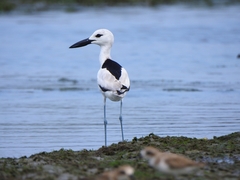
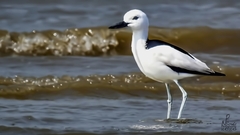
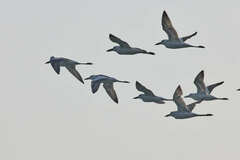
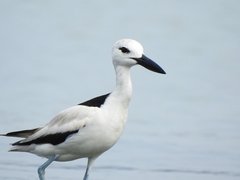
This bird resembles a plover, but has very long bluish-grey legs and a strong heavy black bill. Its pied plumage and long-necked upright posture with heavy bill makes it distinctive and unmistakable; apart from the massive bill, the plumage pattern is most reminiscent of a pied avocet. Its bill is unique among waders, and specialised for eating crabs. It has partially webbed toes. The plumage is white except for black on its back and in the primary feathers of the wings; in breeding plumage, the head is white apart from the small black eye patch, while in non-breeding plumage, the head is streaked grey. They are noisy birds, calling frequently... Wikipedia →

Sounds

Call1:08

Kenya · 2024

© Peter Boesman · XC948167 · CC BY-NC-ND 4.0

Flight call0:09

Saudi Arabia · 2014

© Guido O. Keijl · XC292752 · CC BY-NC-SA 4.0

Begging call0:21

Oman · 2012

© Thijs Fijen · XC118119 · CC BY-NC-SA 3.0

Global Distribution

Parks Where Found

# Park Country Daily sighting probability
1 iSimangaliso Wetland Park 🇿🇦 South Africa
<5%

More parks will be added in future updates.

Cities Where Found

# City Country Daily sighting probability
1 Zanzibar City 🇹🇿 Tanzania
~40%
2 Kuwait City 🇰🇼 Kuwait
~20%
3 Dar es-Salaam 🇹🇿 Tanzania
~10%
4 Abu Dhabi 🇦🇪 United Arab Emirates
<5%
5 Kollam 🇮🇳 India
<5%

Before you go

What are the chances of seeing a Crab-Plover in Zanzibar City?

Likely

About 40% of wildlife watchers report a Crab-Plover sighting in Zanzibar City on a given day, based on 114 verified sightings from GBIF citizen-science data. It is the 20th most-seen of the 86 birds we can rate there. Over three days the chance rises to about 80%, and over a week to over 90%, if each day is a fresh chance.

When is the best time to see a Crab-Plover in Zanzibar City?

February

In that month about 70% of wildlife watchers report a Crab-Plover in Zanzibar City on a given day, against about 20% in May and July–September, the lowest months.

What time of day is best to see a Crab-Plover?

Between 7 and 10 am

Across all the parks we cover, that three-hour window holds the most Crab-Plover sightings with a recorded time, and about 9 in 10 of them come between 6 am and 6 pm: it is a daytime animal.

Is Zanzibar City the best place to see a Crab-Plover?

Yes

Of the 5 cities where we can rate Crab-Plover sightings, Zanzibar City has the highest daily chance: about 40%. Next come Kuwait City (Kuwait, about 20%) and Dar es-Salaam (Tanzania, about 10%).

Which relatives of the Crab-Plover live in Zanzibar City?

Same order: Charadriiformes

The closest relatives of the Crab-Plover that you can see in Zanzibar City (order Charadriiformes, Shorebirds and Allies) are Common Sandpiper (about 70%), Whimbrel (about 70%) and Gull-billed Tern (about 60%), with each one's daily chance of a sighting.

Where does the Crab-Plover sighting chance come from?

GBIF citizen-science records

It is estimated from how often the Crab-Plover is recorded against all the birds logged in Zanzibar City (114 verified sightings), calibrated against known sighting rates. Figures are rounded to the nearest 10% because citizen-science data supports honest approximations, not decimals, and months with records from fewer than five people show "—". How it works.

← Back to Zanzibar City