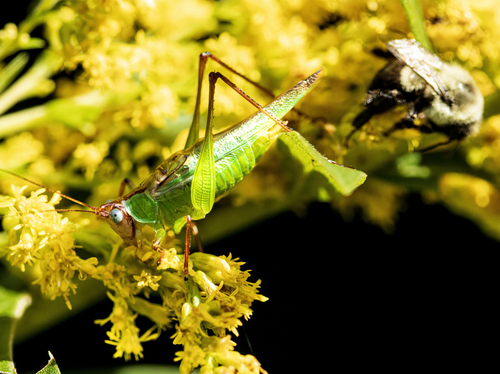

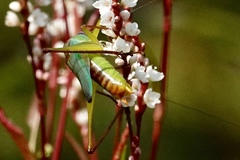
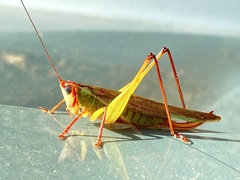
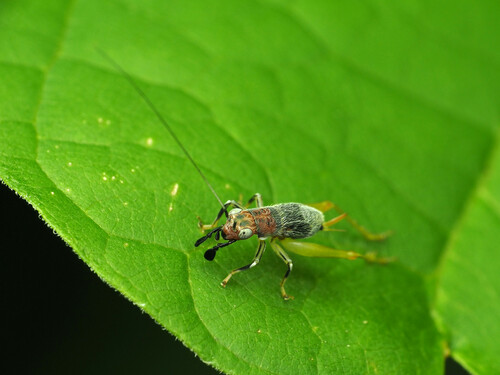
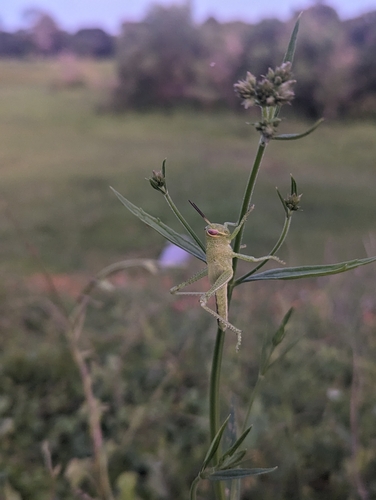
Handsome Meadow Katydid

Handsome Meadow Katydid

Orchelimum pulchellum

Endemic
Daily sighting probability ~10% · With luck
at Congaree National Park

In 3 days ~30% in a week ~50%

7 Verified sightings at Congaree National Park From 2019 to 2026
7 In 1 park
September Best month
☀️ Diurnal When it's spotted

About the Handsome Meadow Katydid

Orchelimum pulchellum, the handsome meadow katydid, is a species of meadow katydid in the family Tettigoniidae. It is found in North America. The body length of the handsome meadow katydid is 18 to 23 millimetres (0.71 to 0.91 in). This katydid is distinguished from Orchelimum nigripes, its western relative, by the shape of the caudal portion of its lateral pronotum, which is arcuate inferior to the humeral sinus in O. pulchellum, while the same portion is sinuate or sub-sinuate in O. nigripes. The medial tooth on each of the paired male cerci in O. pulchellum is positioned at a less acute angle to the sinuate sinus of the cercus compared to that of O. nigripes. In females, the ovipositor is long and sickle shaped. The tibiae are brown in O. pulchellum, while they are typically black in O. nigripes. O. pulchellum typically has no spines on the inner carinae of the hind femora, which distinguishes it from another relative, O. carinatum. It is distinguished from its Texas relative, O. bullatum, by virtue of its narrower fastigium and by having spines on the outer ventral carinae of the hind femora, generally numbering at least six total when both legs are counted... Wikipedia →

Global Distribution

Parks Where Found

# Park Country Daily sighting probability
1 Congaree National Park 🇺🇸 United States
~10%

More parks will be added in future updates.

Cities Where Found

# City Country Daily sighting probability
1 Washington 🇺🇸 United States
~10%
2 Philadelphia 🇺🇸 United States
<5%
3 New York City 🇺🇸 United States
<5%

Before you go

What are the chances of seeing a Handsome Meadow Katydid in Congaree National Park?

With luck

About 10% of wildlife watchers report a Handsome Meadow Katydid sighting in Congaree National Park on a given day, based on 7 verified sightings from GBIF citizen-science data from 2019 to 2026. It is the 99th most-seen of the 145 insects we can rate there. Over three days the chance rises to about 30%, and over a week to about 50%, if each day is a fresh chance.

When is the best time to see a Handsome Meadow Katydid in Congaree National Park?

September and November

In those months about 30% of wildlife watchers report a Handsome Meadow Katydid in Congaree National Park on a given day, against under 5% in October and December–July, the lowest months.

What time of day is best to see a Handsome Meadow Katydid?

Between 10 am and 1 pm

Across all the parks we cover, that three-hour window holds the most Handsome Meadow Katydid sightings with a recorded time, and about 9 in 10 of them come between 6 am and 6 pm: it is a daytime animal.

Where else can you see a Handsome Meadow Katydid?

Only Congaree National Park, in our data

Congaree National Park is the only park on Wallace's Line with enough records to rate Handsome Meadow Katydid sightings: about 10% of wildlife watchers there report one on a given day.

Which relatives of the Handsome Meadow Katydid live in Congaree National Park?

Same order: Orthoptera

The closest relatives of the Handsome Meadow Katydid that you can see in Congaree National Park (order Orthoptera, Grasshoppers, Crickets, and Katydids) are Red-Headed Bush Cricket (about 10%) and American Bird Grasshopper (about 10%), with each one's daily chance of a sighting.

Where does the Handsome Meadow Katydid sighting chance come from?

GBIF citizen-science records

It is estimated from how often the Handsome Meadow Katydid is recorded against all the insects logged in Congaree National Park (7 verified sightings from 2019 to 2026), calibrated against known sighting rates. Figures are rounded to the nearest 10% because citizen-science data supports honest approximations, not decimals, and months with records from fewer than five people show "—". How it works.

← Back to Congaree National Park