Red-Headed Bush Cricket

Red-Headed Bush Cricket

Phyllopalpus pulchellus

Daily sighting probability ~10% · With luck
at Congaree National Park

In 3 days ~30% in a week ~60%

9 Verified sightings at Congaree National Park From 2019 to 2026
32 In all 3 parks
July Best month
☀️ Diurnal When it's spotted

About the Red-Headed Bush Cricket

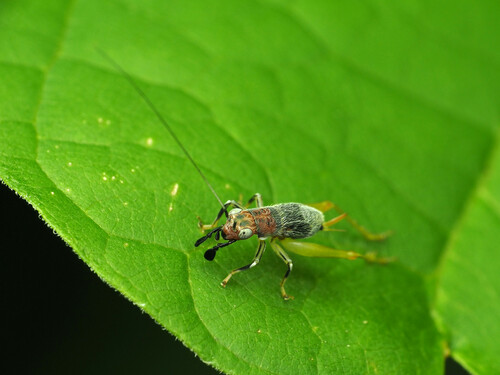
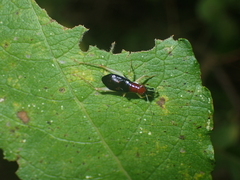
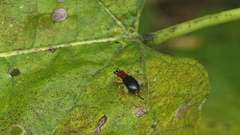
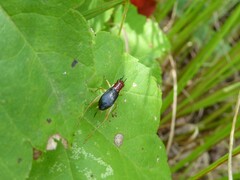
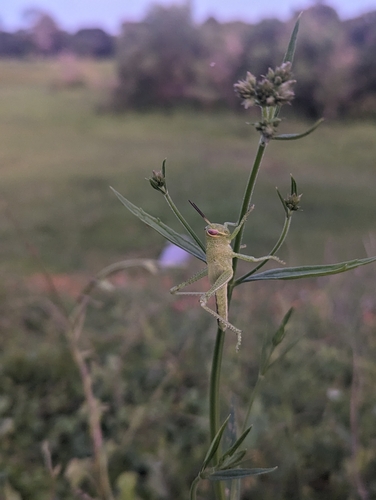
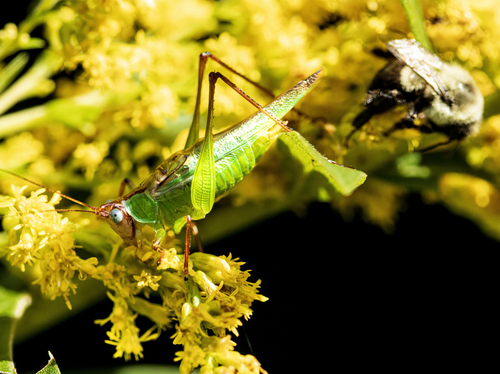
Phyllopalpus pulchellus, known generally as the red headed bush cricket, handsome trig or handsome bush cricket, is a species of winged bush cricket in the family Trigonidiidae. It is found in the eastern United States. The adult has a red head and thorax. Its abodomen and wings are black. Its legs are translucent green to pale yellow. The forewings of females are convex and beetle-like, and the male's wings look like that of a typical cricket's. The male's left wing is clear. The average length of Phyllopalpus pulchellus is 7–9mm.

Its song sounds like a rattling trill. It is described as being quite loud. P. pulchellus is found in the eastern United States. It can be found as north as New Hampshire and as far south as northern Florida. Its range goes as far west as Houston, Texas.

The males position their bodies in between a curved leaf or two leaves to amplify the sound of their chirps to find a mate. During courtship, males first provide females a nuptial gift before transferring a larger spermatophore. If the female does not accept the nuptial gift, the male will eat it.

The females deposit their eggs in the trunks of trees... Wikipedia →

Global Distribution

Parks Where Found

# Park Country Daily sighting probability
1 Congaree National Park 🇺🇸 United States
~10%
2 Great Smoky Mountains National Park 🇺🇸 United States
~10%
3 Shenandoah National Park 🇺🇸 United States
~10%

Cities Where Found

# City Country Daily sighting probability
1 Boston 🇺🇸 United States
~20%
2 Detroit 🇺🇸 United States
~10%
3 Washington 🇺🇸 United States
~10%
4 Baltimore 🇺🇸 United States
~10%
5 Philadelphia 🇺🇸 United States
~10%
6 New York City 🇺🇸 United States
<5%
7 Chicago 🇺🇸 United States
<5%
8 Dallas 🇺🇸 United States
<5%

Before you go

What are the chances of seeing a Red-Headed Bush Cricket in Congaree National Park?

With luck

About 10% of wildlife watchers report a Red-Headed Bush Cricket sighting in Congaree National Park on a given day, based on 9 verified sightings from GBIF citizen-science data from 2019 to 2026. It is the 84th most-seen of the 145 insects we can rate there. Over three days the chance rises to about 30%, and over a week to about 60%, if each day is a fresh chance.

When is the best time to see a Red-Headed Bush Cricket in Congaree National Park?

July

In that month about 30% of wildlife watchers report a Red-Headed Bush Cricket in Congaree National Park on a given day, against under 5% in October to May, the lowest months.

What time of day is best to see a Red-Headed Bush Cricket?

Between 9 am and noon

Across all the parks we cover, that three-hour window holds the most Red-Headed Bush Cricket sightings with a recorded time, and nearly all of them come between 6 am and 6 pm: it is a daytime animal.

Is Congaree National Park the best place to see a Red-Headed Bush Cricket?

Yes

Of the 3 parks where we can rate Red-Headed Bush Cricket sightings, Congaree National Park has the highest daily chance: about 10%. Next come Great Smoky Mountains National Park (United States, about 10%) and Shenandoah National Park (United States, about 10%).

Which relatives of the Red-Headed Bush Cricket live in Congaree National Park?

Same order: Orthoptera

The closest relatives of the Red-Headed Bush Cricket that you can see in Congaree National Park (order Orthoptera, Grasshoppers, Crickets, and Katydids) are American Bird Grasshopper (about 10%) and Handsome Meadow Katydid (about 10%), with each one's daily chance of a sighting.

Where does the Red-Headed Bush Cricket sighting chance come from?

GBIF citizen-science records

It is estimated from how often the Red-Headed Bush Cricket is recorded against all the insects logged in Congaree National Park (9 verified sightings from 2019 to 2026), calibrated against known sighting rates. Figures are rounded to the nearest 10% because citizen-science data supports honest approximations, not decimals, and months with records from fewer than five people show "—". How it works.

← Back to Congaree National Park