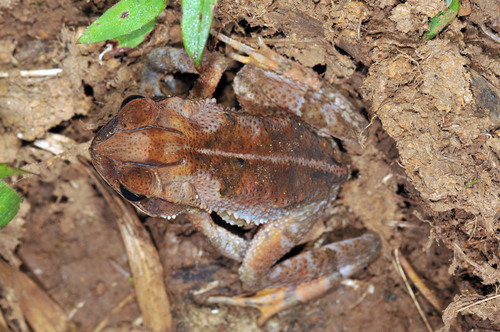
Granular Poison Frog

Granular Poison Frog

Oophaga granulifera

Silhouette: Steven Traver · PhyloPic

LCNTVUVulnerableENCR
Daily sighting probability ~30% · Possible
at Corcovado National Park

In 3 days ~60% in a week ~90%

133 Verified sightings at Corcovado National Park From 2019 to 2026
255 In all 3 parks
September Best month
🌅 Crepuscular When it's spotted

About the Granular Poison Frog

The granular poison frog or granular poison arrow frog (Oophaga granulifera) is a species of frog in the family Dendrobatidae, found in Costa Rica and Panama. Originally described as Dendrobates granuliferus, it was moved to Oophaga in 1994. Its natural habitats are tropical humid lowland forests; it is threatened by habitat loss.

The granular poison frog is a small frog with slender limbs growing to about 20 mm (0.8 in). Its skin is finely granulated and its colour is typically bright orange head, body and upper arms and bluish-green underparts, legs and lower arms. In the vicinity of Quepos, Costa Rica, there is a colour morph in which the orange colour is replaced with olive green.

The granular poison frog is native to Costa Rica and Panama. Its range extends from southwestern Costa Rica through the adjacent area of south-western Panama at heights of up to 100 m (328 ft) above sea level. It also occurs in Piedras Blancas National Park in south-eastern Costa Rica. It inhabits the leaf litter of the floor of humid low altitude forests.

The granular poison frog is a diurnal terrestrial species. Breeding takes place in... Wikipedia →

Global Distribution

Parks Where Found

# Park Country Daily sighting probability
1 Corcovado National Park 🇨🇷 Costa Rica
~30%
2 Piedras Blancas National Park 🇨🇷 Costa Rica
~20%
3 Marino Ballena National Park 🇨🇷 Costa Rica
~20%

Zoos & Centres Where Found

# Zoo / Centre Country
1 Parque Zoológico Nacional Simón Bolívar 🇨🇷 Costa Rica In captivity
2 Monteverde Theme Park 🇨🇷 Costa Rica In captivity

Before you go

What are the chances of seeing a Granular Poison Frog in Corcovado National Park?

Possible

About 30% of wildlife watchers report a Granular Poison Frog sighting in Corcovado National Park on a given day, based on 133 verified sightings from GBIF citizen-science data from 2019 to 2026. It is the 7th most-seen of the 27 amphibians we can rate there. Over three days the chance rises to about 60%, and over a week to about 90%, if each day is a fresh chance.

When is the best time to see a Granular Poison Frog in Corcovado National Park?

June–July and September

In those months about 40% of wildlife watchers report a Granular Poison Frog in Corcovado National Park on a given day, against about 20% in February–April and December, the lowest months.

What time of day is best to see a Granular Poison Frog?

Between 6 and 9 pm

Across all the parks we cover, that three-hour window holds the most Granular Poison Frog sightings with a recorded time, and about 6 in 10 of them come between 6 pm and 6 am: it is most active around dawn and dusk.

Is Corcovado National Park the best place to see a Granular Poison Frog?

Yes

Of the 3 parks where we can rate Granular Poison Frog sightings, Corcovado National Park has the highest daily chance: about 30%. Next come Piedras Blancas National Park (Costa Rica, about 20%) and Marino Ballena National Park (Costa Rica, about 20%).

Where does the Granular Poison Frog sighting chance come from?

GBIF citizen-science records

It is estimated from how often the Granular Poison Frog is recorded against all the amphibians logged in Corcovado National Park (133 verified sightings from 2019 to 2026), calibrated against known sighting rates. Figures are rounded to the nearest 10% because citizen-science data supports honest approximations, not decimals, and months with records from fewer than five people show "—". How it works.

← Back to Corcovado National Park