Yellow-bellied Sea Snake

Yellow-bellied Sea Snake

Hydrophis platurus

Silhouette: Dr Christina Zdenek · PhyloPic

LCLeast ConcernNTVUENCR
Daily sighting probability ~10% · With luck
at Corcovado National Park

In 3 days ~20% in a week ~40%

16 Verified sightings at Corcovado National Park From 2019 to 2026
42 In all 3 parks
September Best month
☀️ Diurnal When it's spotted

About the Yellow-bellied Sea Snake

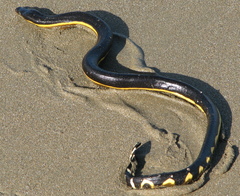
The yellow-bellied sea snake (Hydrophis platurus) is an extremely venomous species of snake from the subfamily Hydrophiinae (the sea snakes) found in tropical oceanic waters around the world except for the Atlantic Ocean. For many years, it was placed in the monotypic genus Pelamis, but recent molecular evidence indicates it lies within the genus Hydrophis.

In 1766, Linnaeus published the original description of the yellow-bellied sea snake, naming it Anguis platura (Anguis meaning snake). In 1803, François Marie Daudin created the new genus Pelamis and assigned this species to it, referring to it as Pelamis platuros. In 1842, Gray described what he thought was a new species and called it Pelamis ornata (subsequently P. ornata became a synonym of P. platura). The commonly used genus name Pelamis is derived from the Ancient Greek word for "tunny fish", which presumably refers to the habitat or what Daudin thought they ate. The specific name platurus is a combination of the Ancient Greek words platys "flat" and oura "tail", referring to the flattened tail. The word Pelamis is a feminine noun and means young or small tunny fish. In 1872, Stoliczka introduced the name Pelamis... Wikipedia →

Global Distribution

Parks Where Found

# Park Country Daily sighting probability
1 Las Baulas Marine National Park 🇨🇷 Costa Rica
~20%
2 Piedras Blancas National Park 🇨🇷 Costa Rica
~10%
3 Corcovado National Park 🇨🇷 Costa Rica
~10%

Cities Where Found

# City Country Daily sighting probability
1 Sydney 🇦🇺 Australia
<5%

Zoos & Centres Where Found

# Zoo / Centre Country
1 Two Oceans Aquarium 🇿🇦 South Africa In captivity

Before you go

What are the chances of seeing a Yellow-bellied Sea Snake in Corcovado National Park?

With luck

About 10% of wildlife watchers report a Yellow-bellied Sea Snake sighting in Corcovado National Park on a given day, based on 16 verified sightings from GBIF citizen-science data from 2019 to 2026. It is the 40th most-seen of the 41 reptiles we can rate there. Over three days the chance rises to about 20%, and over a week to about 40%, if each day is a fresh chance.

When is the best time to see a Yellow-bellied Sea Snake in Corcovado National Park?

April, July, September and November–February

In those months about 10% of wildlife watchers report a Yellow-bellied Sea Snake in Corcovado National Park on a given day, against under 5% in March, May–June, August and October, the lowest months.

What time of day is best to see a Yellow-bellied Sea Snake?

Between 9 am and noon

Across all the parks we cover, that three-hour window holds the most Yellow-bellied Sea Snake sightings with a recorded time, and about 9 in 10 of them come between 6 am and 6 pm: it is a daytime animal.

Is Corcovado National Park the best place to see a Yellow-bellied Sea Snake?

3rd of 3

Of the 3 parks where we can rate Yellow-bellied Sea Snake sightings, Corcovado National Park ranks 3rd at about 10%. The best odds are in Las Baulas Marine National Park (Costa Rica, about 20%) and Piedras Blancas National Park (Costa Rica, about 10%).

Where does the Yellow-bellied Sea Snake sighting chance come from?

GBIF citizen-science records

It is estimated from how often the Yellow-bellied Sea Snake is recorded against all the reptiles logged in Corcovado National Park (16 verified sightings from 2019 to 2026), calibrated against known sighting rates. Figures are rounded to the nearest 10% because citizen-science data supports honest approximations, not decimals, and months with records from fewer than five people show "—". How it works.

← Back to Corcovado National Park