


Completed


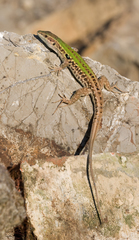

Italian Wall Lizard
Podarcis siculus
Silhouette: Alex Slavenko · PhyloPic
- KingdomAnimalia (Animals)
- PhylumChordata (Chordates)
- ClassSquamata
- FamilyLacertidae (Wall Lizards)
- GenusPodarcis
- SpeciesPodarcis siculus (Italian Wall Lizard)
In 3 days ~70% in a week ~90%
85 Verified sightings at Corsica Regional Natural Park (Parc naturel régional de Corse) From 2019 to 2026
85 In 1 park
February Best month
☀️ Diurnal When it's spotted
About the Italian Wall Lizard
The Italian wall lizard or ruin lizard (Podarcis siculus, from the Greek meaning foot and agile), is a species of lizard in the family Lacertidae. P. siculus is native to southern and southeastern Europe, but has also been introduced elsewhere in the continent, as well as North America, where it is a possible invasive species. P. siculus is a habitat generalist and can thrive in natural and human-modified environments. Similarly, P. siculus has a generalized diet as well, allowing it to have its large range.
P. siculus is notable for having many subspecies within its large range. Studies evidence how rapidly P. siculus subspecies can become distinguishable from larger populations given geographic isolation. A 2008 study detailed distinct morphological and behavioral changes in a P. siculus population indicative of "rapid evolution".
P. siculus is a sexually dimorphic lizard species whose physical description varies across its subspecies, but it generally has a green or brown back and white or green belly. It is also oviparous, meaning females lay eggs, and they lay 3 or 4 clutches per year.
P. siculus contains dozens of subspecies. Many...
Recent sightings of Italian Wall Lizard in Corsica Regional Natural Park (Parc naturel régional de Corse)
LIVEiNaturalistGlobal Distribution
Parks Where Found
| # | Park | Country | Daily sighting probability |
|---|---|---|---|
| 1 | Corsica Regional Natural Park (Parc naturel régional de Corse) | 🇫🇷 France |
More parks will be added in future updates.
Cities Where Found
| # | City | Country | Daily sighting probability |
|---|---|---|---|
| 1 | Naples | 🇮🇹 Italy | |
| 2 | Rome | 🇮🇹 Italy | |
| 3 | Bursa | 🇹🇷 Turkey | |
| 4 | Istanbul | 🇹🇷 Turkey | |
| 5 | New York City | 🇺🇸 United States | |
| 6 | Bucharest | 🇷🇴 Romania | |
| 7 | Vienna | 🇦🇹 Austria | |
| 8 | Boston | 🇺🇸 United States | |
| 9 | Lisbon | 🇵🇹 Portugal | |
| 10 | Los Angeles | 🇺🇸 United States |
Closest Relatives at Corsica Regional Natural Park (Parc naturel régional de Corse)



Before you go
What are the chances of seeing an Italian Wall Lizard in Corsica Regional Natural Park (Parc naturel régional de Corse)?
Possible
About 30% of wildlife watchers report an Italian Wall Lizard sighting in Corsica Regional Natural Park (Parc naturel régional de Corse) on a given day, based on 85 verified sightings from GBIF citizen-science data from 2019 to 2026. It is the 5th most-seen of the 9 reptiles we can rate there. Over three days the chance rises to about 70%, and over a week to about 90%, if each day is a fresh chance.
When is the best time to see an Italian Wall Lizard in Corsica Regional Natural Park (Parc naturel régional de Corse)?
February
In that month about 50% of wildlife watchers report an Italian Wall Lizard in Corsica Regional Natural Park (Parc naturel régional de Corse) on a given day, against under 5% in January, the lowest month.
What time of day is best to see an Italian Wall Lizard?
Between 10 am and 1 pm
Across all the parks we cover, that three-hour window holds the most Italian Wall Lizard sightings with a recorded time, and about 9 in 10 of them come between 6 am and 6 pm: it is a daytime animal.
Where else can you see an Italian Wall Lizard?
Only Corsica Regional Natural Park (Parc naturel régional de Corse), in our data
Corsica Regional Natural Park (Parc naturel régional de Corse) is the only park on Wallace's Line with enough records to rate Italian Wall Lizard sightings: about 30% of wildlife watchers there report one on a given day.
Where does the Italian Wall Lizard sighting chance come from?
GBIF citizen-science records
It is estimated from how often the Italian Wall Lizard is recorded against all the reptiles logged in Corsica Regional Natural Park (Parc naturel régional de Corse) (85 verified sightings from 2019 to 2026), calibrated against known sighting rates. Figures are rounded to the nearest 10% because citizen-science data supports honest approximations, not decimals, and months with records from fewer than five people show "—". How it works.
