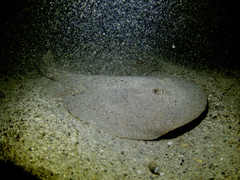
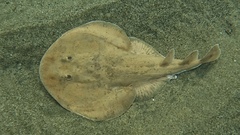
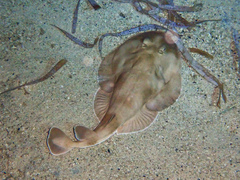
Caribbean numbfish

Caribbean numbfish

Narcine bancroftii

Silhouette: PhyloPic

Daily sighting probability ~20% · Possible
at Arrecifes de Cozumel National Park

In 3 days ~40% in a week ~70%

6 Verified sightings at Arrecifes de Cozumel National Park From 2019 to 2026
6 In 1 park
December Best month
☀️ Diurnal When it's spotted

About the Caribbean numbfish

The lesser electric ray (Narcine bancroftii), also known as the Brazilian electric ray, small electric ray, spotted torpedo ray, torpedofish or trembler, is a species of numbfish in the family Narcinidae found on the western coastal fringes of the Atlantic Ocean and Caribbean Sea. It is a small slow-moving fish, living in the surf zone of sandy or muddy beaches. Here it is easily caught as bycatch by shrimp fisheries and seine netters. The International Union for Conservation of Nature has rated it as being of "least concern".

This species of ray has a near-circular body and a short tail. It grows to approximately 45 centimeters (18 in) long, and 20 cm (8 in) wide, with colouration ranging from dark brown to reddish orange. It has irregular rings, sometimes oval in shape. The ventral surface ranges from white to greenish. It has tooth rows that vary in number from 17 to 34 in each jaw. This depends on the size of the specimen.

It has two electric organs, elongate in shape, that run from the front of the eyes, down to the rear end of the disc. These organs can generate a peak voltage of about 14 to 37 volts, which they use to stun prey and to defend themselves.

��2... Wikipedia →
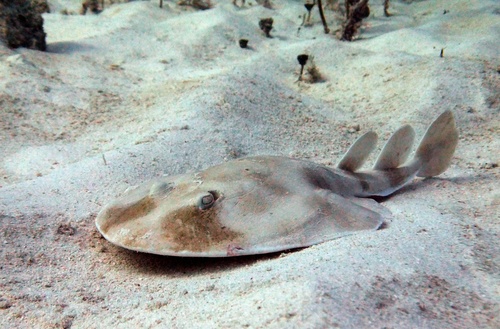
Global Distribution

Parks Where Found

# Park Country Daily sighting probability
1 Arrecifes de Cozumel National Park 🇲🇽 Mexico
~20%

More parks will be added in future updates.

Zoos & Centres Where Found

# Zoo / Centre Country
1 Gulf Specimen Public Aquarium 🇺🇸 United States In captivity

Before you go

What are the chances of seeing a Caribbean numbfish in Arrecifes de Cozumel National Park?

Possible

About 20% of wildlife watchers report a Caribbean numbfish sighting in Arrecifes de Cozumel National Park on a given day, based on 6 verified sightings from GBIF citizen-science data from 2019 to 2026. It is the 6th most-seen of the 6 sharks and rays we can rate there. Over three days the chance rises to about 40%, and over a week to about 70%, if each day is a fresh chance.

When is the best time to see a Caribbean numbfish in Arrecifes de Cozumel National Park?

December

In that month about 60% of wildlife watchers report a Caribbean numbfish in Arrecifes de Cozumel National Park on a given day, against under 5% in January–May, August–September and November, the lowest months.

What time of day is best to see a Caribbean numbfish?

Between 3 and 6 pm

Across all the parks we cover, that three-hour window holds the most Caribbean numbfish sightings with a recorded time, and about 7 in 10 of them come between 6 am and 6 pm: it is a daytime animal.

Where else can you see a Caribbean numbfish?

Only Arrecifes de Cozumel National Park, in our data

Arrecifes de Cozumel National Park is the only park on Wallace's Line with enough records to rate Caribbean numbfish sightings: about 20% of wildlife watchers there report one on a given day.

Where does the Caribbean numbfish sighting chance come from?

GBIF citizen-science records

It is estimated from how often the Caribbean numbfish is recorded against all the sharks and rays logged in Arrecifes de Cozumel National Park (6 verified sightings from 2019 to 2026), calibrated against known sighting rates. Figures are rounded to the nearest 10% because citizen-science data supports honest approximations, not decimals, and months with records from fewer than five people show "—". How it works.

← Back to Arrecifes de Cozumel National Park