
Scrubtit

Scrubtit

Acanthornis magna

Silhouette: Sheatherius · PhyloPic

LCLeast ConcernNTVUENCR Endemic
Daily sighting probability ~50% · Likely
at Cradle Mountain-Lake St Clair National Park

In 3 days ~80% in a week >90%

236 Verified sightings at Cradle Mountain-Lake St Clair National Park From 2019 to 2026
236 In 1 park
May Best month
🌙 Nocturnal When it's spotted

About the Scrubtit

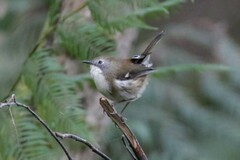
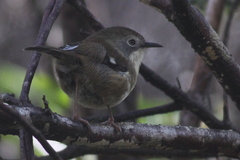
The scrubtit (Acanthornis magna) is a species of bird in the thornbill family Acanthizidae. It is endemic to Tasmania and King Island in Australia. Its natural habitat is the temperate rainforest, Nothofagus beech forest and eucalypt woodland. It is a small species that resembles the Sericornis scrubwrens (with which it was once placed).

The scrubtit belongs to the monotypic genus Acanthornis. A 2017 genetic study using both mitochondrial and nuclear DNA found the ancestor of the scrubtit diverged from that of the three whitefaces of the genus Aphelocephala around 7 million years ago. The combined lineage had diverged from the thornbill lineage around 13 million years ago.

The scrubtit is 11 to 12 centimetres (4.33 to 4.72 in) long and weighs around 10 grams (0.35 oz). The plumage consists of a white throat and belly, a brown back, crown, flank and tail, black wings and grey on the face. The eye is pale and the bill is short, black and slightly curved. The species is often silent, but makes quite loud contact calls and has a song described as "sweet [and] musical".

The scrubtit forages individually, in pairs or in small family groups... Wikipedia →

Sounds

Call0:52

Australia · 2026

© Ramit Singal · XC1102449 · CC BY-NC-SA 4.0

Song0:10

Australia · 2014

© Marc Anderson · XC540925 · CC BY-NC-ND 4.0

Song?1:25

Australia · 2009

© Mark Harper · XC40853 · CC BY-NC-ND 2.5

Global Distribution

Parks Where Found

# Park Country Daily sighting probability
1 Cradle Mountain-Lake St Clair National Park 🇦🇺 Australia
~50%

More parks will be added in future updates.

Before you go

What are the chances of seeing a Scrubtit in Cradle Mountain-Lake St Clair National Park?

Likely

About 50% of wildlife watchers report a Scrubtit sighting in Cradle Mountain-Lake St Clair National Park on a given day, based on 236 verified sightings from GBIF citizen-science data from 2019 to 2026. It is the 14th most-seen of the 49 birds we can rate there. Over three days the chance rises to about 80%, and over a week to over 90%, if each day is a fresh chance.

When is the best time to see a Scrubtit in Cradle Mountain-Lake St Clair National Park?

May and October–November

In those months about 60% of wildlife watchers report a Scrubtit in Cradle Mountain-Lake St Clair National Park on a given day, against about 20% in August, the lowest month.

What time of day is best to see a Scrubtit?

Between 3 and 6 am

Across all the parks we cover, that three-hour window holds the most Scrubtit sightings with a recorded time, and about 7 in 10 of them come between 6 pm and 6 am: it is mostly seen at night.

Where else can you see a Scrubtit?

Only Cradle Mountain-Lake St Clair National Park, in our data

Cradle Mountain-Lake St Clair National Park is the only park on Wallace's Line with enough records to rate Scrubtit sightings: about 50% of wildlife watchers there report one on a given day.

Which relatives of the Scrubtit live in Cradle Mountain-Lake St Clair National Park?

Same family: Acanthizidae

The closest relatives of the Scrubtit that you can see in Cradle Mountain-Lake St Clair National Park (family Acanthizidae, Thornbills and Allies) are Tasmanian Scrubwren (about 80%), Tasmanian Thornbill (about 70%) and Brown Thornbill (about 30%), with each one's daily chance of a sighting.

Where does the Scrubtit sighting chance come from?

GBIF citizen-science records

It is estimated from how often the Scrubtit is recorded against all the birds logged in Cradle Mountain-Lake St Clair National Park (236 verified sightings from 2019 to 2026), calibrated against known sighting rates. Figures are rounded to the nearest 10% because citizen-science data supports honest approximations, not decimals, and months with records from fewer than five people show "—". How it works.

← Back to Cradle Mountain-Lake St Clair National Park