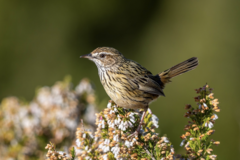
Striated Fieldwren

Striated Fieldwren

Calamanthus fuliginosus

Silhouette: Sheatherius · PhyloPic

LCLeast ConcernNTVUENCR Endemic
Daily sighting probability ~20% · Possible
at Cradle Mountain-Lake St Clair National Park

In 3 days ~40% in a week ~70%

116 Verified sightings at Cradle Mountain-Lake St Clair National Park From 2019 to 2026
376 In all 3 parks
August Best month
☀️ Diurnal When it's spotted

About the Striated Fieldwren

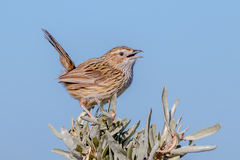
The striated fieldwren (Calamanthus fuliginosus) is a species of bird in the family Acanthizidae, endemic to Australia. The striated fieldwren is a small bird, 140mm in size. It is light brown and olive-colored, with a white stomach, and black streaks all over. Its tail is cocked and whitish with black and brown streaks.

The striated fieldwren's front is buff with dark gray and brown streaks; their wings are also brown and gray but with darker and bolder streaks. The bird's flight feathers, however, do not have streaks. Instead, they have fine light gray edges. A whitish line over the eye can also be found on the striated fieldwren.

Striated fieldwrens can be difficult to spot as they forage quietly in thick vegetation or on the ground. If approached, the bird's tail will elevate and sometimes move side to side, while continuing its song until it feels trapped, then it will fly away and relocate.

During the springtime, the striated fieldwren is easier to spot as they perch up in vegetation, and the male fieldwrens will sing. Striated fieldwrens have a unique sound that can be described as a song, sounding strong and whirring. Their song... Wikipedia →

Sounds

Song0:32

Australia · 2024

© nick talbot · XC871038 · CC BY-NC-SA 4.0

Imitation0:15

Australia · 2020

© Marc Anderson · XC608819 · CC BY-NC-ND 4.0

Call0:15

Australia · 2019

© Ramit Singal · XC501666 · CC BY-NC-SA 4.0

Global Distribution

Parks Where Found

# Park Country Daily sighting probability
1 Cradle Mountain-Lake St Clair National Park 🇦🇺 Australia
~20%
2 Great Otway National Park 🇦🇺 Australia
~10%
3 Wilsons Promontory National Park 🇦🇺 Australia
~10%

Cities Where Found

# City Country Daily sighting probability
1 Melbourne 🇦🇺 Australia
<5%

Before you go

What are the chances of seeing a Striated Fieldwren in Cradle Mountain-Lake St Clair National Park?

Possible

About 20% of wildlife watchers report a Striated Fieldwren sighting in Cradle Mountain-Lake St Clair National Park on a given day, based on 116 verified sightings from GBIF citizen-science data from 2019 to 2026. It is the 23rd most-seen of the 49 birds we can rate there. Over three days the chance rises to about 40%, and over a week to about 70%, if each day is a fresh chance.

When is the best time to see a Striated Fieldwren in Cradle Mountain-Lake St Clair National Park?

March and August

In those months about 30% of wildlife watchers report a Striated Fieldwren in Cradle Mountain-Lake St Clair National Park on a given day, against about 10% in February, April, October and December, the lowest months.

What time of day is best to see a Striated Fieldwren?

Between 9 am and noon

Across all the parks we cover, that three-hour window holds the most Striated Fieldwren sightings with a recorded time, and about 9 in 10 of them come between 6 am and 6 pm: it is a daytime animal.

Is Cradle Mountain-Lake St Clair National Park the best place to see a Striated Fieldwren?

Yes

Of the 3 parks where we can rate Striated Fieldwren sightings, Cradle Mountain-Lake St Clair National Park has the highest daily chance: about 20%. Next come Great Otway National Park (Australia, about 10%) and Wilsons Promontory National Park (Australia, about 10%).

Which relatives of the Striated Fieldwren live in Cradle Mountain-Lake St Clair National Park?

Same family: Acanthizidae

The closest relatives of the Striated Fieldwren that you can see in Cradle Mountain-Lake St Clair National Park (family Acanthizidae, Thornbills and Allies) are Tasmanian Scrubwren (about 80%), Tasmanian Thornbill (about 70%) and Scrubtit (about 50%), with each one's daily chance of a sighting.

Where does the Striated Fieldwren sighting chance come from?

GBIF citizen-science records

It is estimated from how often the Striated Fieldwren is recorded against all the birds logged in Cradle Mountain-Lake St Clair National Park (116 verified sightings from 2019 to 2026), calibrated against known sighting rates. Figures are rounded to the nearest 10% because citizen-science data supports honest approximations, not decimals, and months with records from fewer than five people show "—". How it works.

← Back to Cradle Mountain-Lake St Clair National Park