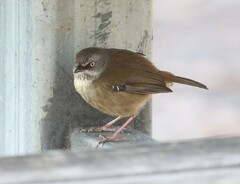

Tasmanian Scrubwren

Tasmanian Scrubwren

Sericornis humilis

Silhouette: Sheatherius · PhyloPic

LCLeast ConcernNTVUENCR Endemic
Daily sighting probability ~80% · Very likely
at Cradle Mountain-Lake St Clair National Park

In 3 days >90%

450 Verified sightings at Cradle Mountain-Lake St Clair National Park From 2019 to 2026
782 In all 3 parks
June Best month
🌙 Nocturnal When it's spotted

About the Tasmanian Scrubwren

The Tasmanian scrubwren or brown scrubwren (Sericornis humilis) is a bird species endemic to the temperate forests of Tasmania and nearby King Island. It lives in the understory of rainforest, woodland, dry forest, swamps and coastal scrublands.

Placed in the family Pardalotidae in the Sibley-Ahlquist taxonomy, this has met with opposition and indeed is now no longer accepted; they instead are currently placed in the independent family Acanthizidae. It is alternately considered a subspecies of the smaller white-browed scrubwren, and further research is needed to understand the relationships between the two species.

There are two subspecies of Tasmanian scrubwren: S. h. humilis – nominate subspecies; Tasmania Wikipedia →

Sounds

Call0:24

Australia · 2023

© Peter Boesman · XC860176 · CC BY-NC-ND 4.0

Song0:17

Australia · 2022

© Eddy Smith · XC749540 · CC BY-NC-SA 4.0

Alarm call0:28

Australia · 2014

© Marc Anderson · XC204457 · CC BY-NC-ND 4.0

Global Distribution

Parks Where Found

# Park Country Daily sighting probability
1 Cradle Mountain-Lake St Clair National Park 🇦🇺 Australia
~80%
2 Freycinet National Park 🇦🇺 Australia
~40%
3 Maria Island National Park 🇦🇺 Australia
~40%

Cities Where Found

# City Country Daily sighting probability
1 Hobart 🇦🇺 Australia
<5%

Before you go

What are the chances of seeing a Tasmanian Scrubwren in Cradle Mountain-Lake St Clair National Park?

Very likely

About 80% of wildlife watchers report a Tasmanian Scrubwren sighting in Cradle Mountain-Lake St Clair National Park on a given day, based on 450 verified sightings from GBIF citizen-science data from 2019 to 2026. It is the 3rd most-seen of the 49 birds we can rate there. Over three days the chance rises to over 90%, if each day is a fresh chance.

When is the best time to see a Tasmanian Scrubwren in Cradle Mountain-Lake St Clair National Park?

January and June

In those months about 90% of wildlife watchers report a Tasmanian Scrubwren in Cradle Mountain-Lake St Clair National Park on a given day, against about 50% in July, the lowest month.

What time of day is best to see a Tasmanian Scrubwren?

Between 1 and 4 am

Across all the parks we cover, that three-hour window holds the most Tasmanian Scrubwren sightings with a recorded time, and about 8 in 10 of them come between 6 pm and 6 am: it is mostly seen at night.

Is Cradle Mountain-Lake St Clair National Park the best place to see a Tasmanian Scrubwren?

Yes

Of the 3 parks where we can rate Tasmanian Scrubwren sightings, Cradle Mountain-Lake St Clair National Park has the highest daily chance: about 80%. Next come Freycinet National Park (Australia, about 40%) and Maria Island National Park (Australia, about 40%).

Which relatives of the Tasmanian Scrubwren live in Cradle Mountain-Lake St Clair National Park?

Same family: Acanthizidae

The closest relatives of the Tasmanian Scrubwren that you can see in Cradle Mountain-Lake St Clair National Park (family Acanthizidae, Thornbills and Allies) are Tasmanian Thornbill (about 70%), Scrubtit (about 50%) and Brown Thornbill (about 30%), with each one's daily chance of a sighting.

Where does the Tasmanian Scrubwren sighting chance come from?

GBIF citizen-science records

It is estimated from how often the Tasmanian Scrubwren is recorded against all the birds logged in Cradle Mountain-Lake St Clair National Park (450 verified sightings from 2019 to 2026), calibrated against known sighting rates. Figures are rounded to the nearest 10% because citizen-science data supports honest approximations, not decimals, and months with records from fewer than five people show "—". How it works.

← Back to Cradle Mountain-Lake St Clair National Park