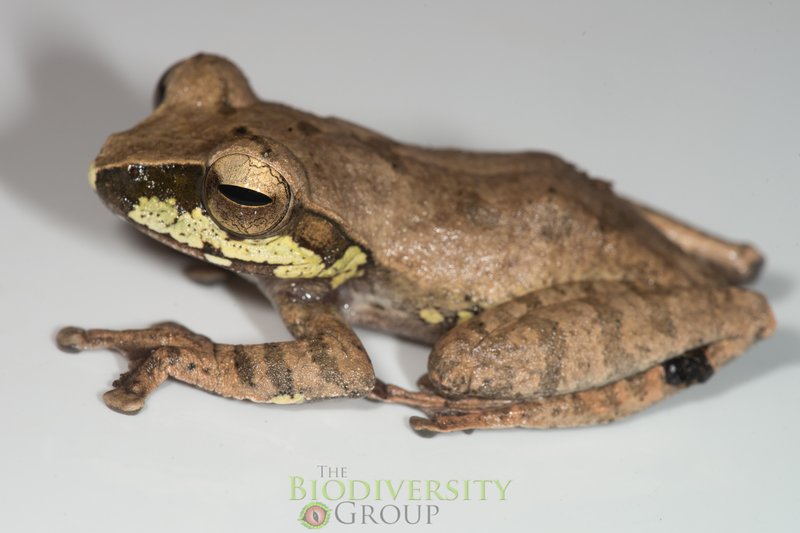

Arcuate-spotted Pygmy Frog

Arcuate-spotted Pygmy Frog

Microhyla heymonsi

Silhouette: Vijay Karthick · PhyloPic

LCLeast ConcernNTVUENCR
Daily sighting probability ~40% · Likely
at Cuc Phuong National Park

In 3 days ~70% in a week >90%

9 Verified sightings at Cuc Phuong National Park From 2019 to 2026
84 In all 6 parks
July Best month
☀️ Diurnal When it's spotted

About the Arcuate-spotted Pygmy Frog

Microhyla heymonsi, also known as the dark-sided chorus frog or the Taiwan rice frog, is a species of narrow-mouthed frog found in northeastern India, southern China, Taiwan, and Southeast Asia south to the Malay Peninsula and Sumatra as well as the Great Nicobar Island. It was originally described from Taiwan.

As microhylids in general, Microhyla heymonsi is a small frog: males reach 16–21 mm (0.6–0.8 in) and females 22–26 mm (0.9–1.0 in) in snout-vent length. The dorsal colour is pinkish or greyish above with a black lateral band extending from the snout tip to the groin and entirely covering the sides of the head. It inhabits a variety of disturbed areas as well as secondary vegetation. It breeds in temporary rain puddles, paddy fields, ditches, marshes and slow-flowing streams. Wikipedia →

Sounds

Advertisement call0:15

Thailand · 2014

© Marc Anderson · XC1102619 · CC BY-NC-ND 4.0

Uncertain0:31

Malaysia · 2025

© Ding Li Yong · XC1045695 · CC BY-NC-ND 4.0

Advertisement call0:46

India · 2002

© Olivier SWIFT · XC980902 · CC BY-NC-SA 4.0

Global Distribution

Parks Where Found

# Park Country Daily sighting probability
1 Cuc Phuong National Park 🇻🇳 Vietnam
~40%
2 Cat Tien National Park 🇻🇳 Vietnam
~20%
3 Doi Inthanon National Park 🇹🇭 Thailand
~20%
4 Khao Yai National Park 🇹🇭 Thailand
~20%
5 Kaeng Krachan National Park 🇹🇭 Thailand
~10%
6 Khao Sok National Park 🇹🇭 Thailand
~10%

Cities Where Found

# City Country Daily sighting probability
1 Nanjing 🇨🇳 China
~20%
2 Hangzhou 🇨🇳 China
~10%
3 Kuala Lumpur 🇲🇾 Malaysia
~10%
4 Bangkok 🇹🇭 Thailand
~10%
5 Singapore 🇸🇬 Singapore
<5%

Before you go

What are the chances of seeing an Arcuate-spotted Pygmy Frog in Cuc Phuong National Park?

Likely

About 40% of wildlife watchers report an Arcuate-spotted Pygmy Frog sighting in Cuc Phuong National Park on a given day, based on 9 verified sightings from GBIF citizen-science data from 2019 to 2026. It is the 4th most-seen of the 8 amphibians we can rate there. Over three days the chance rises to about 70%, and over a week to over 90%, if each day is a fresh chance.

When is the best time to see an Arcuate-spotted Pygmy Frog in Cuc Phuong National Park?

July

In that month about 60% of wildlife watchers report an Arcuate-spotted Pygmy Frog in Cuc Phuong National Park on a given day, against under 5% in March, the lowest month. That is one of Cuc Phuong National Park's wettest months, with about 350 mm of rain against 40 mm in December.

What time of day is best to see an Arcuate-spotted Pygmy Frog?

Between 1 and 4 pm

Across all the parks we cover, that three-hour window holds the most Arcuate-spotted Pygmy Frog sightings with a recorded time, and about 9 in 10 of them come between 6 am and 6 pm: it is a daytime animal.

Is Cuc Phuong National Park the best place to see an Arcuate-spotted Pygmy Frog?

Yes

Of the 6 parks where we can rate Arcuate-spotted Pygmy Frog sightings, Cuc Phuong National Park has the highest daily chance: about 40%. Next come Cat Tien National Park (Vietnam, about 20%) and Doi Inthanon National Park (Thailand, about 20%).

Which relatives of the Arcuate-spotted Pygmy Frog live in Cuc Phuong National Park?

Same order: Anura

The closest relatives of the Arcuate-spotted Pygmy Frog that you can see in Cuc Phuong National Park (order Anura, Frogs and Toads) are Common Indian Toad (about 70%), Orlov's Treefrog (about 40%) and Chinese Flying Frog (about 40%), with each one's daily chance of a sighting.

Where does the Arcuate-spotted Pygmy Frog sighting chance come from?

GBIF citizen-science records

It is estimated from how often the Arcuate-spotted Pygmy Frog is recorded against all the amphibians logged in Cuc Phuong National Park (9 verified sightings from 2019 to 2026), calibrated against known sighting rates. Figures are rounded to the nearest 10% because citizen-science data supports honest approximations, not decimals, and months with records from fewer than five people show "—". How it works.

← Back to Cuc Phuong National Park