Malayan Night Heron

Malayan Night Heron

Gorsachius melanolophus

Silhouette: Sheatherius · PhyloPic

LCLeast ConcernNTVUENCR
Daily sighting probability ~10% · With luck
at Cuc Phuong National Park

In 3 days ~20% in a week ~40%

21 Verified sightings at Cuc Phuong National Park From 2019 to 2026
195 In all 6 parks
April Best month
☀️ Diurnal When it's spotted

About the Malayan Night Heron

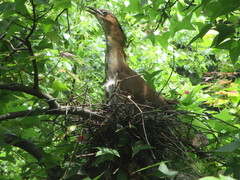
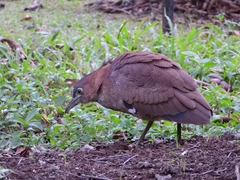
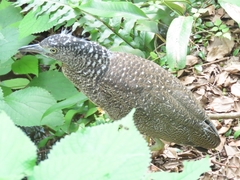
The Malayan night heron (Gorsachius melanolophus), also known as Malaysian night heron and tiger bittern, is a medium-sized heron. It is distributed in southern and eastern Asia. The Malayan night heron has been found in India, Sri Lanka, Brunei, Nepal, Bangladesh, Myanmar, Cambodia, Laos, Vietnam, Thailand, Malaysia, Singapore, China, Indonesia, the Philippines, Taiwan and Japan. It is a vagrant in Palau and Korea. Its range size is estimated at 1,240,000 km2. One roadkilled bird was discovered on Christmas Island, Australia where it is likely a vagrant. This bird occurs in forests, streams, and marshes. In Japan, population densities of the herons increased as undisturbed forest cover on islands increased.

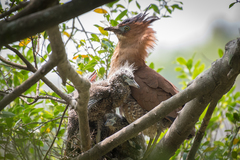
The Malayan night heron is about 48 cm (19 in) long. The wingspan is about 86 cm (34 in). It is stocky, with a short beak. Its neck and breast are rufous. There are streaks going down the centre of the neck to the breast. The upperparts are chestnut and vermiculated. The flight feathers are blackish. The crown is black, the chin is white, and the eyes are yellow. The beak is black and the legs are greenish. The juvenile is greyish... Wikipedia →

Sounds

Call0:11

Taiwan · 2021

© Sunny Tseng · XC631378 · CC BY-NC-SA 4.0

Begging call0:15

Taiwan · 2026

© Joan Theng · XC1156284 · CC BY-NC-SA 4.0

Uncertain0:29

Taiwan · 2020

© Tunyu Chen 陳惇聿 · XC688787 · CC BY-NC-SA 4.0

Global Distribution

Parks Where Found

# Park Country Daily sighting probability
1 Cuc Phuong National Park 🇻🇳 Vietnam
~10%
2 Manas National Park 🇮🇳 India
<5%
3 Taroko National Park 🇹🇼 Taiwan
<5%
4 Way Kambas National Park 🇮🇩 Indonesia
<5%
5 Kaeng Krachan National Park 🇹🇭 Thailand
<5%
6 Periyar National Park 🇮🇳 India
<5%

Cities Where Found

# City Country Daily sighting probability
1 Taipei 🇹🇼 Taiwan
~40%
2 Taichung 🇹🇼 Taiwan
~30%
3 Kaohsiung 🇹🇼 Taiwan
~20%
4 Tainan 🇹🇼 Taiwan
~10%
5 Guangzhou 🇨🇳 China
<5%
6 Bangkok 🇹🇭 Thailand
<5%
7 Singapore 🇸🇬 Singapore
<5%
8 Chennai 🇮🇳 India
<5%

Before you go

What are the chances of seeing a Malayan Night Heron in Cuc Phuong National Park?

With luck

About 10% of wildlife watchers report a Malayan Night Heron sighting in Cuc Phuong National Park on a given day, based on 21 verified sightings from GBIF citizen-science data from 2019 to 2026. It is the 85th most-seen of the 159 birds we can rate there. Over three days the chance rises to about 20%, and over a week to about 40%, if each day is a fresh chance.

When is the best time to see a Malayan Night Heron in Cuc Phuong National Park?

April

In that month about 30% of wildlife watchers report a Malayan Night Heron in Cuc Phuong National Park on a given day, against under 5% in May–June, August and October–February, the lowest months. July has too few records to rate.

What time of day is best to see a Malayan Night Heron?

Between 3 and 6 pm

Across all the parks we cover, that three-hour window holds the most Malayan Night Heron sightings with a recorded time, and about 9 in 10 of them come between 6 am and 6 pm: it is a daytime animal.

Is Cuc Phuong National Park the best place to see a Malayan Night Heron?

Yes

Of the 6 parks where we can rate Malayan Night Heron sightings, Cuc Phuong National Park has the highest daily chance: about 10%. Next come Manas National Park (India, under 5%) and Taroko National Park (Taiwan, under 5%).

Where does the Malayan Night Heron sighting chance come from?

GBIF citizen-science records

It is estimated from how often the Malayan Night Heron is recorded against all the birds logged in Cuc Phuong National Park (21 verified sightings from 2019 to 2026), calibrated against known sighting rates. Figures are rounded to the nearest 10% because citizen-science data supports honest approximations, not decimals, and months with records from fewer than five people show "—". How it works.

← Back to Cuc Phuong National Park