Baird's Ratsnake

Baird's Ratsnake

Pantherophis bairdi

Silhouette: Alex Slavenko · PhyloPic

LCLeast ConcernNTVUENCR
Daily sighting probability ~10% · With luck
at Cumbres de Monterrey National Park

In 3 days ~40% in a week ~60%

49 Verified sightings at Cumbres de Monterrey National Park From 2019 to 2026
80 In all 2 parks
April Best month
☀️🌙 Day & Night When it's spotted

About the Baird's Ratsnake

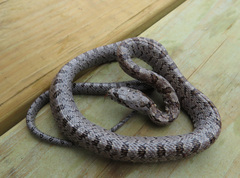
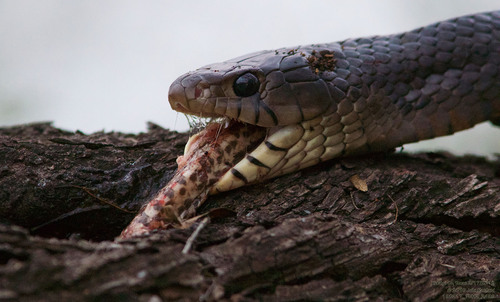
Pantherophis bairdi is a species of harmless snake in the family Colubridae. The species is native to the southwestern United States and adjacent northeastern Mexico. No subspecies are recognized as being valid. P. bairdi is found in the United States in the Big Bend region of western Texas, as well as in northern Mexico in the Mexican states of Coahuila, Nuevo León, and Tamaulipas. It is known to be elusive and hard to find in the wild.

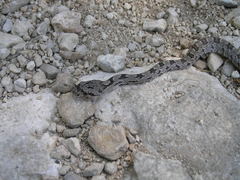
P. bairdi prefers semi-arid, rocky habitats. The specific name, bairdi, as well as several of the common names, are in honor of American zoologist Spencer Fullerton Baird. Common names include: Baird's rat snake, Baird's ratsnake, Baird's pilot snake, Baird's Coluber, and Great Bend rat snake.

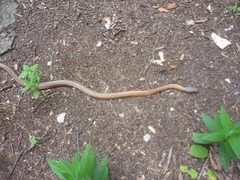
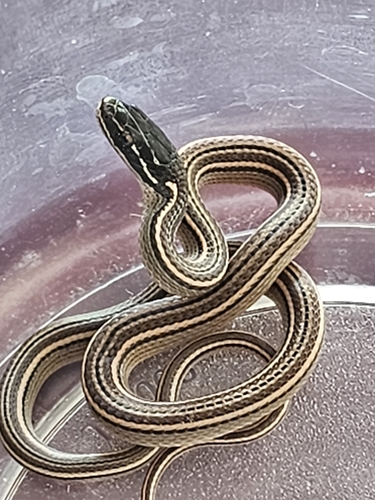
Adults of P. bairdi may reach 64 to 140 cm (25 to 55 in) in total length (including tail). The dorsal color pattern consists of an orange-yellow to bright yellow, or a darker salmon ground color, overlaid with four stripes that run from the neck to the tail. The belly is generally gray to yellow, darkening near the tail.

The primary diet of P. bairdi consists of... Wikipedia →

Global Distribution

Parks Where Found

# Park Country Daily sighting probability
1 Big Bend National Park 🇺🇸 United States
~20%
2 Cumbres de Monterrey National Park 🇲🇽 Mexico
~10%

Zoos & Centres Where Found

# Zoo / Centre Country
1 Caldwell Zoo 🇺🇸 United States In captivity
2 Siam Serpentarium 🇹🇭 Thailand In captivity

Before you go

What are the chances of seeing a Baird's Ratsnake in Cumbres de Monterrey National Park?

With luck

About 10% of wildlife watchers report a Baird's Ratsnake sighting in Cumbres de Monterrey National Park on a given day, based on 49 verified sightings from GBIF citizen-science data from 2019 to 2026. It is the 10th most-seen of the 43 reptiles we can rate there. Over three days the chance rises to about 40%, and over a week to about 60%, if each day is a fresh chance.

When is the best time to see a Baird's Ratsnake in Cumbres de Monterrey National Park?

April, June and September

In those months about 20% of wildlife watchers report a Baird's Ratsnake in Cumbres de Monterrey National Park on a given day, against about 10% in May, July–August and October–March, the lowest months. Those are among Cumbres de Monterrey National Park's wettest months, with about 150 mm of rain a month against 20 mm in December.

What time of day is best to see a Baird's Ratsnake?

Between 9 am and noon

Across all the parks we cover, that three-hour window holds the most Baird's Ratsnake sightings with a recorded time, and about 6 in 10 of them come between 6 am and 6 pm: it is seen both by day and at night.

Is Cumbres de Monterrey National Park the best place to see a Baird's Ratsnake?

2nd of 2

Of the 2 parks where we can rate Baird's Ratsnake sightings, Cumbres de Monterrey National Park ranks 2nd at about 10%. The best odds are in Big Bend National Park (United States, about 20%).

Where does the Baird's Ratsnake sighting chance come from?

GBIF citizen-science records

It is estimated from how often the Baird's Ratsnake is recorded against all the reptiles logged in Cumbres de Monterrey National Park (49 verified sightings from 2019 to 2026), calibrated against known sighting rates. Figures are rounded to the nearest 10% because citizen-science data supports honest approximations, not decimals, and months with records from fewer than five people show "—". How it works.

← Back to Cumbres de Monterrey National Park