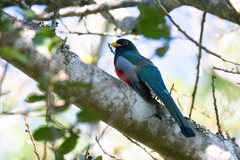
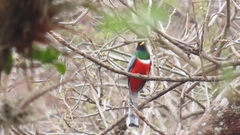
Elegant Trogon

Elegant Trogon

Trogon elegans

Silhouette: Keith Murdock (photo), John E. McCormack, Michael G. Harvey, Brant C. Faircloth, Nicholas G. Crawford, Travis C. Glenn, Robb T. Brumfield & T. Michael Keesey · PhyloPic

LCLeast ConcernNTVUENCR
Daily sighting probability ~30% · Possible
at Cumbres de Monterrey National Park

In 3 days ~60% in a week ~90%

573 Verified sightings at Cumbres de Monterrey National Park From 2019 to 2026
1,185 In all 6 parks
July Best month
☀️ Diurnal When it's spotted

About the Elegant Trogon

The elegant trogon (Trogon elegans), formerly considered as conspecific with the coppery-tailed trogon, is a species of bird in the trogon family Trogonidae that is native to Central America. The elegant trogon was formally described in 1834 by the English ornithologist John Gould based on specimens collected in Guatemala. He coined the current binomial name Trogon elegans.

Two subspecies are recognised: Trogon elegans elegans Gould, J, 1834 – southeastern Guatemala Trogon elegans lubricus Peters, JL, 1945 – Honduras, Nicaragua, and northwestern Costa Rica Phylogenetic research suggests a monophyly with T. rufus, T. mexicanus, T. personatus, T. aurantiiventris, and T. collaris. The distribution of their ancestors was restricted to the new world. However, the presence of trogons in the old world has led to debate on their true origin, which remains unknown to this day.

This species is a medium-sized bird, measuring 28–30 centimetres (11–12 in) long and weighing 60–78 grams (2.1–2.8 oz) (average 68 grams (2.4 oz)). Like other trogons, elegant trogons display sexual dimorphism, where males and females have different plumages.

Males are often brightly colored... Wikipedia →

Sounds

Song1:03

Mexico · 2026

© Richard E. Webster · XC1183832 · CC BY-NC-SA 4.0

Call0:39

Costa Rica · 2024

© Johan Chaves · XC916790 · CC BY-NC-SA 4.0

Alarm call0:32

Mexico · 2013

© Micah Riegner · XC158395 · CC BY-NC-SA 3.0

Global Distribution

Parks Where Found

# Park Country Daily sighting probability
1 Santa Rosa National Park 🇨🇷 Costa Rica
~50%
2 Cumbres de Monterrey National Park 🇲🇽 Mexico
~30%
3 Ostional Wildlife Refuge 🇨🇷 Costa Rica
~10%
4 Las Baulas Marine National Park 🇨🇷 Costa Rica
<5%
5 Rincón de la Vieja National Park 🇨🇷 Costa Rica
<5%
6 Palo Verde National Park 🇨🇷 Costa Rica
<5%

Cities Where Found

# City Country Daily sighting probability
1 San Salvador 🇸🇻 El Salvador
<5%
2 Mexico City 🇲🇽 México
<5%

Before you go

What are the chances of seeing an Elegant Trogon in Cumbres de Monterrey National Park?

Possible

About 30% of wildlife watchers report an Elegant Trogon sighting in Cumbres de Monterrey National Park on a given day, based on 573 verified sightings from GBIF citizen-science data from 2019 to 2026. It is the 26th most-seen of the 275 birds we can rate there. Over three days the chance rises to about 60%, and over a week to about 90%, if each day is a fresh chance.

When is the best time to see an Elegant Trogon in Cumbres de Monterrey National Park?

July

In that month about 60% of wildlife watchers report an Elegant Trogon in Cumbres de Monterrey National Park on a given day, against about 10% in September and December–January, the lowest months.

What time of day is best to see an Elegant Trogon?

Between 8 and 11 am

Across all the parks we cover, that three-hour window holds the most Elegant Trogon sightings with a recorded time, and about 9 in 10 of them come between 6 am and 6 pm: it is a daytime animal.

Is Cumbres de Monterrey National Park the best place to see an Elegant Trogon?

2nd of 6

Of the 6 parks where we can rate Elegant Trogon sightings, Cumbres de Monterrey National Park ranks 2nd at about 30%. The best odds are in Santa Rosa National Park (Costa Rica, about 50%).

Where does the Elegant Trogon sighting chance come from?

GBIF citizen-science records

It is estimated from how often the Elegant Trogon is recorded against all the birds logged in Cumbres de Monterrey National Park (573 verified sightings from 2019 to 2026), calibrated against known sighting rates. Figures are rounded to the nearest 10% because citizen-science data supports honest approximations, not decimals, and months with records from fewer than five people show "—". How it works.

← Back to Cumbres de Monterrey National Park