Mountain Horned Lizard

Mountain Horned Lizard

Phrynosoma orbiculare

Silhouette: Jose Carlos Arenas-Monroy · PhyloPic

LCLeast ConcernNTVUENCR Endemic
Daily sighting probability ~10% · With luck
at Cumbres de Monterrey National Park

In 3 days ~20% in a week ~30%

9 Verified sightings at Cumbres de Monterrey National Park From 2019 to 2026
9 In 1 park
August Best month
☀️ Diurnal When it's spotted

About the Mountain Horned Lizard

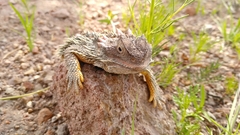
The Mexican Plateau horned lizard (Phrynosoma orbiculare) is a species of horned lizard in the family Phrynosomatidae. The species, also known commonly as the Chihuahua Desert horned lizard, is endemic to Mexico. There are five recognized subspecies. The specific epithet, orbiculare, comes from the Latin adjective orbis, meaning "circular".

The subspecific name, cortezii, is in honor of Spanish conquistador Hernán Cortés. The subspecific name, dugesii, is in honor of French-born Mexican naturalist Alfredo Dugès, who is considered the "father" of Mexican herpetology.

P. orbiculare is found only in the high plateau country of central Mexico. Specifically, it is found in the Mexican states of Chihuahua, Durango, Morelos, Nuevo León, Puebla, and Veracruz. Five subspecies of P. orbiculare are recognized as being valid, including the nominotypical subspecies.

Phrynosoma orbiculare bradti Horowitz, 1955 Phrynosoma orbiculare cortezii (A.H.A. Duméril & Bocourt, 1870) Phrynosoma orbiculare dugesii (A.H.A. Duméril & Bocourt, 1870) Phrynosoma orbiculare orbiculare (Linnaeus, 1758)

Phrynosoma orbiculare orientale Horowitz, 1955 Nota bene: A trinomial... Wikipedia →

Global Distribution

Parks Where Found

# Park Country Daily sighting probability
1 Cumbres de Monterrey National Park 🇲🇽 Mexico
~10%

More parks will be added in future updates.

Cities Where Found

# City Country Daily sighting probability
1 Toluca 🇲🇽 México
~30%
2 Mexico City 🇲🇽 México
~10%

Zoos & Centres Where Found

# Zoo / Centre Country
1 Virginia Zoological Park 🇺🇸 United States In captivity

Before you go

What are the chances of seeing a Mountain Horned Lizard in Cumbres de Monterrey National Park?

With luck

About 10% of wildlife watchers report a Mountain Horned Lizard sighting in Cumbres de Monterrey National Park on a given day, based on 9 verified sightings from GBIF citizen-science data from 2019 to 2026. It is the 31st most-seen of the 43 reptiles we can rate there. Over three days the chance rises to about 20%, and over a week to about 30%, if each day is a fresh chance.

When is the best time to see a Mountain Horned Lizard in Cumbres de Monterrey National Park?

May–August and October

In those months about 10% of wildlife watchers report a Mountain Horned Lizard in Cumbres de Monterrey National Park on a given day, against under 5% in September and November–April, the lowest months.

What time of day is best to see a Mountain Horned Lizard?

Between 11 am and 2 pm

Across all the parks we cover, that three-hour window holds the most Mountain Horned Lizard sightings with a recorded time, and about 9 in 10 of them come between 6 am and 6 pm: it is a daytime animal.

Where else can you see a Mountain Horned Lizard?

Only Cumbres de Monterrey National Park, in our data

Cumbres de Monterrey National Park is the only park on Wallace's Line with enough records to rate Mountain Horned Lizard sightings: about 10% of wildlife watchers there report one on a given day.

Which relatives of the Mountain Horned Lizard live in Cumbres de Monterrey National Park?

Same family: Phrynosomatidae

The closest relatives of the Mountain Horned Lizard that you can see in Cumbres de Monterrey National Park (family Phrynosomatidae, Phrynosomatid Lizards) are Rose-bellied Lizard (about 30%), West Gulf Rough-scaled Lizard (about 20%) and Texas Spiny Lizard (about 20%), with each one's daily chance of a sighting.

Where does the Mountain Horned Lizard sighting chance come from?

GBIF citizen-science records

It is estimated from how often the Mountain Horned Lizard is recorded against all the reptiles logged in Cumbres de Monterrey National Park (9 verified sightings from 2019 to 2026), calibrated against known sighting rates. Figures are rounded to the nearest 10% because citizen-science data supports honest approximations, not decimals, and months with records from fewer than five people show "—". How it works.

← Back to Cumbres de Monterrey National Park