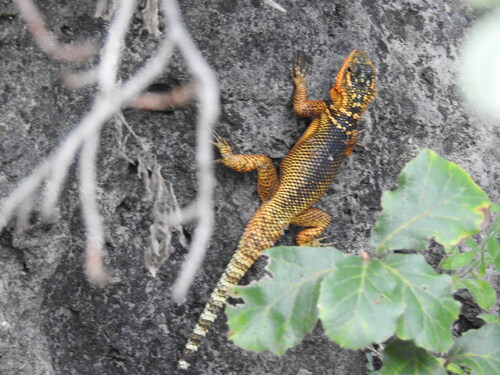
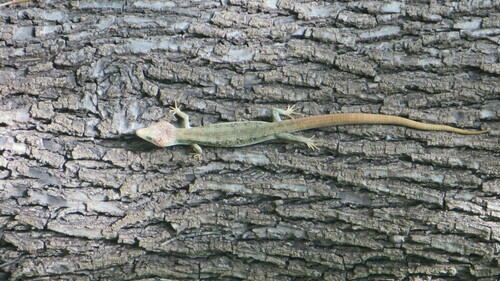
Graphic Spiny Lizard

Graphic Spiny Lizard

Sceloporus grammicus

Silhouette: SeismicShrimp · PhyloPic

LCLeast ConcernNTVUENCR
Daily sighting probability ~10% · With luck
at Cumbres de Monterrey National Park

In 3 days ~30% in a week ~60%

49 Verified sightings at Cumbres de Monterrey National Park From 2019 to 2026
60 In all 2 parks
August Best month
☀️ Diurnal When it's spotted

About the Graphic Spiny Lizard

Sceloporus grammicus is a species of lizard from Mexico and the southern United States. It is sometimes referred to as the mesquite lizard or graphic spiny lizard. Sceloporus grammicus is native to the southern United States in the state of Texas, and to Mexico in the states of Chihuahua, Durango, Zacatecas, Coahuila, San Luis Potosí, Nuevo León, Tamaulipas, Oaxaca, Guerrero, Querétaro, and Aguascalientes.

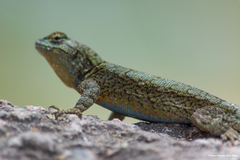
Sceloporus grammicus is a flat-bodied lizard with a tail that is slightly longer than head-body length. Adult total body length varies between 10 and 17.5 cm (3.9 and 6.9 in). The dorsum is mottled olive or gray and has a pattern consisting of 3–6 dark crossbars. The forelegs and tail have narrow crossbars. Males differ from females by having blue patches and black mottling on throat, a dark line on each shoulder, and blue patches on sides of belly, sometimes bordered in black.

Sceloporus grammicus is viviparous. Litter size varies between 2 and 12. Females become sexually mature between 34 and 74 mm (1.3 and 2.9 in) in snout–vent length. There are four recognized subspecies of Sceloporus grammicus including... Wikipedia →

Global Distribution

Parks Where Found

# Park Country Daily sighting probability
1 Reserva de la Biosfera Mariposa Monarca 🇲🇽 Mexico
~40%
2 Cumbres de Monterrey National Park 🇲🇽 Mexico
~10%

Cities Where Found

# City Country Daily sighting probability
1 Puebla 🇲🇽 México
~50%
2 Mexico City 🇲🇽 México
~30%
3 Toluca 🇲🇽 México
~30%
4 León 🇲🇽 México
~20%
5 San Luis Potosí 🇲🇽 México
~20%

Before you go

What are the chances of seeing a Graphic Spiny Lizard in Cumbres de Monterrey National Park?

With luck

About 10% of wildlife watchers report a Graphic Spiny Lizard sighting in Cumbres de Monterrey National Park on a given day, based on 49 verified sightings from GBIF citizen-science data from 2019 to 2026. It is the 11th most-seen of the 43 reptiles we can rate there. Over three days the chance rises to about 30%, and over a week to about 60%, if each day is a fresh chance.

When is the best time to see a Graphic Spiny Lizard in Cumbres de Monterrey National Park?

June and August–November

In those months about 20% of wildlife watchers report a Graphic Spiny Lizard in Cumbres de Monterrey National Park on a given day, against under 5% in March and December, the lowest months.

What time of day is best to see a Graphic Spiny Lizard?

Between 10 am and 1 pm

Across all the parks we cover, that three-hour window holds the most Graphic Spiny Lizard sightings with a recorded time, and nearly all of them come between 6 am and 6 pm: it is a daytime animal.

Is Cumbres de Monterrey National Park the best place to see a Graphic Spiny Lizard?

2nd of 2

Of the 2 parks where we can rate Graphic Spiny Lizard sightings, Cumbres de Monterrey National Park ranks 2nd at about 10%. The best odds are in Reserva de la Biosfera Mariposa Monarca (Mexico, about 40%).

Which relatives of the Graphic Spiny Lizard live in Cumbres de Monterrey National Park?

Same genus: Sceloporus

The closest relatives of the Graphic Spiny Lizard that you can see in Cumbres de Monterrey National Park (genus Sceloporus, Spiny Lizards) are Rose-bellied Lizard (about 30%), West Gulf Rough-scaled Lizard (about 20%) and Texas Spiny Lizard (about 20%), with each one's daily chance of a sighting.

Where does the Graphic Spiny Lizard sighting chance come from?

GBIF citizen-science records

It is estimated from how often the Graphic Spiny Lizard is recorded against all the reptiles logged in Cumbres de Monterrey National Park (49 verified sightings from 2019 to 2026), calibrated against known sighting rates. Figures are rounded to the nearest 10% because citizen-science data supports honest approximations, not decimals, and months with records from fewer than five people show "—". How it works.

← Back to Cumbres de Monterrey National Park