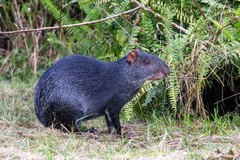
Black Agouti

Black Agouti

Dasyprocta fuliginosa

Silhouette: Margot Michaud · PhyloPic

LCLeast ConcernNTVUENCR
Daily sighting probability ~20% · Possible
at Cuyabeno Wildlife Reserve

In 3 days ~40% in a week ~70%

7 Verified sightings at Cuyabeno Wildlife Reserve From 2019 to 2026
28 In all 3 parks
May Best month
☀️ Diurnal When it's spotted

About the Black Agouti

The black agouti (Dasyprocta fuliginosa) is a South American species of agouti from the family Dasyproctidae. It is found in the northwestern Amazon in southern Venezuela, eastern Colombia, eastern Ecuador, western Brazil and northeastern Peru. There is also a disjunct population in the Magdalena River Valley of northern Colombia. They are found in forests, thick brush, savannas, and cultivated areas. In Peru, they are confined to the Amazonian region where they are found in all parts of the low selva zone and many parts of the high selva zone. It is found at altitudes of 2,000 metres (6,600 ft) and above. Agoutis live in close proximity to water, being found on the banks of all types of streams.

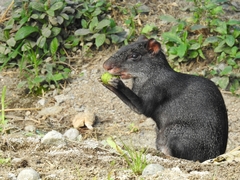
It is overall black grizzled white, and the throat is white. The black agouti weighs 3.5–6 kg (7.7–13.2 lb). Like other agoutis, the black agouti is diurnal, lives alone or in pairs, and feeds on fruits and nuts. In some areas, they construct burrows among limestone boulders, along river banks, or under the roots of trees.

The female black agouti is capable of breeding year-round. Also, they are considered... Wikipedia →

Global Distribution

Parks Where Found

# Park Country Daily sighting probability
1 Podocarpus National Park 🇪🇨 Ecuador
~20%
2 Cuyabeno Wildlife Reserve 🇪🇨 Ecuador
~20%
3 Yasuní National Park 🇪🇨 Ecuador
~10%

Cities Where Found

# City Country Daily sighting probability
1 Manaus 🇧🇷 Brazil
~20%

Zoos & Centres Where Found

# Zoo / Centre Country
1 Terra Natura Benidorm 🇪🇸 Spain In captivity
2 Amaru 🇪🇨 Ecuador In captivity
3 Santacruz zoo 🇨🇴 Colombia In captivity
4 Selva Viva Park 🇵🇪 Peru In captivity
5 Zoológico do Acre 🇧🇷 Brazil In captivity
6 Cali Zoo 🇨🇴 Colombia In captivity
7 Wiwa Quito 🇪🇨 Ecuador In captivity

Before you go

What are the chances of seeing a Black Agouti in Cuyabeno Wildlife Reserve?

Possible

About 20% of wildlife watchers report a Black Agouti sighting in Cuyabeno Wildlife Reserve on a given day, based on 7 verified sightings from GBIF citizen-science data from 2019 to 2026. It is the 17th most-seen of the 19 mammals we can rate there. Over three days the chance rises to about 40%, and over a week to about 70%, if each day is a fresh chance.

When is the best time to see a Black Agouti in Cuyabeno Wildlife Reserve?

May–July and September

In those months about 30% of wildlife watchers report a Black Agouti in Cuyabeno Wildlife Reserve on a given day, against under 5% in August and October–April, the lowest months.

What time of day is best to see a Black Agouti?

Between 6 and 9 am

Across all the parks we cover, that three-hour window holds the most Black Agouti sightings with a recorded time, and about 8 in 10 of them come between 6 am and 6 pm: it is a daytime animal.

Is Cuyabeno Wildlife Reserve the best place to see a Black Agouti?

Among the best

Of the 3 parks where we can rate Black Agouti sightings, Cuyabeno Wildlife Reserve ranks 2nd at about 20%, level with the leaders once rounded. The best odds are in Podocarpus National Park (Ecuador, about 20%).

Which relatives of the Black Agouti live in Cuyabeno Wildlife Reserve?

Same order: Rodentia

The closest relatives of the Black Agouti that you can see in Cuyabeno Wildlife Reserve (order Rodentia, Rodents) are Capybara (about 30%) and Long-tailed Porcupine (about 20%), with each one's daily chance of a sighting.

Where does the Black Agouti sighting chance come from?

GBIF citizen-science records

It is estimated from how often the Black Agouti is recorded against all the mammals logged in Cuyabeno Wildlife Reserve (7 verified sightings from 2019 to 2026), calibrated against known sighting rates. Figures are rounded to the nearest 10% because citizen-science data supports honest approximations, not decimals, and months with records from fewer than five people show "—". How it works.

← Back to Cuyabeno Wildlife Reserve