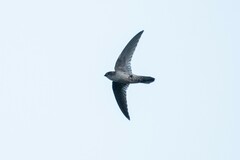
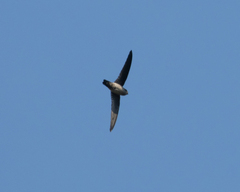
Australian Swiftlet

Australian Swiftlet

Aerodramus terraereginae

Silhouette: Aviceda (vectorized by T. Michael Keesey) · PhyloPic

LCLeast ConcernNTVUENCR Endemic
Daily sighting probability ~50% · Likely
at Daintree National Park

In 3 days ~90% in a week >90%

1,052 Verified sightings at Daintree National Park From 2019 to 2026
1,052 In 1 park
November Best month
🌅 Crepuscular When it's spotted

About the Australian Swiftlet

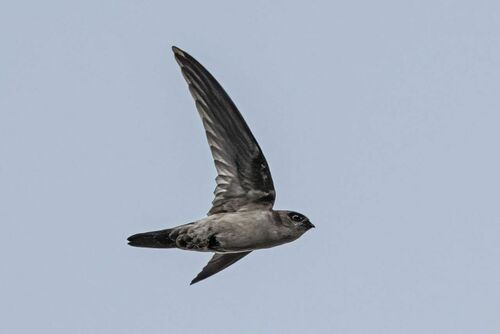
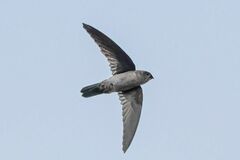
The Australian swiftlet (Aerodramus terraereginae) is a small bird belonging to the genus Aerodramus in the swift family, Apodidae. It is endemic to Queensland in north-eastern Australia. It was formerly included in the white-rumped swiftlet (Aerodramus spodiopygius) but is now commonly treated as a separate species.

It is 11–12 centimetres (4.3–4.7 in) long with a wing length of 107–118.2 millimetres (4.21–4.65 in) and a weight of 10.5–12.5 grams (0.37–0.44 oz). The upperparts are dark grey-brown while the underparts are a uniform greyish. There are pale feathers on the forehead and lores. The rump is normally pale greyish but can occasionally be darker. The tail is slightly forked. The form chillagoensis is smaller and paler with a weight of around 9.39 grams (0.33 oz).

It has a high-pitched flight call. In its breeding caves, it utters a metallic clicking call, used for echolocation. A. t. terraereginae occurs in tropical north-east Queensland from the Claudie River on the Cape York Peninsula south as... Wikipedia →

Sounds

Call0:27

Australia · 2025

© Peter Boesman · XC1066340 · CC BY-NC-ND 4.0

Aberrant0:38

Australia · 2022

© Eddy Smith · XC748059 · CC BY-NC-SA 4.0

Global Distribution

Parks Where Found

# Park Country Daily sighting probability
1 Daintree National Park 🇦🇺 Australia
~50%

More parks will be added in future updates.

Before you go

What are the chances of seeing an Australian Swiftlet in Daintree National Park?

Likely

About 50% of wildlife watchers report an Australian Swiftlet sighting in Daintree National Park on a given day, based on 1,052 verified sightings from GBIF citizen-science data from 2019 to 2026. It is the 11th most-seen of the 208 birds we can rate there. Over three days the chance rises to about 90%, and over a week to over 90%, if each day is a fresh chance.

When is the best time to see an Australian Swiftlet in Daintree National Park?

July–August and November–December

In those months about 60% of wildlife watchers report an Australian Swiftlet in Daintree National Park on a given day, against about 30% in February, the lowest month.

What time of day is best to see an Australian Swiftlet?

Between 10 pm and 1 am

Across all the parks we cover, that three-hour window holds the most Australian Swiftlet sightings with a recorded time, and about 6 in 10 of them come between 6 pm and 6 am: it is most active around dawn and dusk.

Where else can you see an Australian Swiftlet?

Only Daintree National Park, in our data

Daintree National Park is the only park on Wallace's Line with enough records to rate Australian Swiftlet sightings: about 50% of wildlife watchers there report one on a given day.

Where does the Australian Swiftlet sighting chance come from?

GBIF citizen-science records

It is estimated from how often the Australian Swiftlet is recorded against all the birds logged in Daintree National Park (1,052 verified sightings from 2019 to 2026), calibrated against known sighting rates. Figures are rounded to the nearest 10% because citizen-science data supports honest approximations, not decimals, and months with records from fewer than five people show "—". How it works.
← Back to Daintree National Park