Orange-footed Scrubfowl

Orange-footed Scrubfowl

Megapodius reinwardt

Silhouette: Rachel T Mason · PhyloPic

LCLeast ConcernNTVUENCR
Daily sighting probability ~60% · Likely
at Daintree National Park

In 3 days ~90% in a week >90%

1,576 Verified sightings at Daintree National Park From 2019 to 2026
2,235 In all 4 parks
October Best month
☀️ Diurnal When it's spotted

About the Orange-footed Scrubfowl

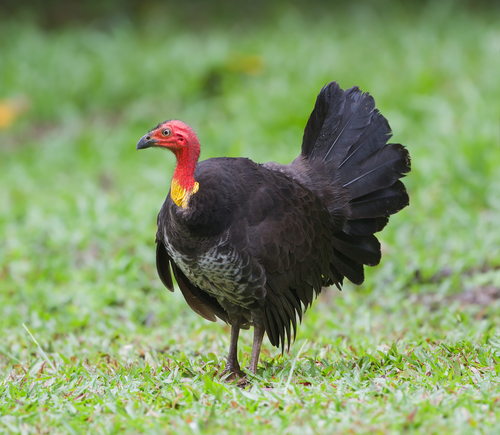
The orange-footed scrubfowl (Megapodius reinwardt), also known as orange-footed megapode or just scrubfowl, is a small megapode of the family Megapodiidae native to many islands in the Lesser Sunda Islands as well as southern New Guinea and northern Australia.

It is a terrestrial bird the size of a domestic chicken and dark-coloured with strong orange legs and a pointed crest at the back of the head. It utilises a range of forest and scrub habitats and has colonised many small islands throughout its range. It is prolific in suburban Darwin gardens, where people refer to it as a bush chook, bush chicken, bush turkey, or most commonly, the bush boiby

In general, populations seem to be stable and the conservation status of the species is considered to be of Least Concern. The orange-footed scrubfowl feeds on seeds, fallen fruit and terrestrial invertebrates. As with other megapodes, it nests in large mounds of sand, leaf litter and other debris where the heat generated by the decomposition of organic material serves to incubate the eggs. Construction and maintenance of the mounds, which may reach 4.5 m (15 ft) in height... Wikipedia →

Sounds

Song0:34

Australia · 2025

© Étienne Leroy · XC1072791 · CC BY-NC-SA 4.0

Call0:30

Australia · 2025

© Peter Boesman · XC1066673 · CC BY-NC-ND 4.0

Dawn song0:50

Australia · 2023

© James Lambert · XC791418 · CC BY-NC-ND 4.0

Global Distribution

Parks Where Found

# Park Country Daily sighting probability
1 Komodo National Park 🇮🇩 Indonesia
~80%
2 Daintree National Park 🇦🇺 Australia
~60%
3 Litchfield National Park 🇦🇺 Australia
~20%
4 Kakadu National Park 🇦🇺 Australia
~20%

Before you go

What are the chances of seeing an Orange-footed Scrubfowl in Daintree National Park?

Likely

About 60% of wildlife watchers report an Orange-footed Scrubfowl sighting in Daintree National Park on a given day, based on 1,576 verified sightings from GBIF citizen-science data from 2019 to 2026. It is the 7th most-seen of the 208 birds we can rate there. Over three days the chance rises to about 90%, and over a week to over 90%, if each day is a fresh chance.

When is the best time to see an Orange-footed Scrubfowl in Daintree National Park?

October

In that month about 70% of wildlife watchers report an Orange-footed Scrubfowl in Daintree National Park on a given day, against about 40% in January to March, the lowest months. That is one of Daintree National Park's driest months, with about 50 mm of rain against 380 mm in January.

What time of day is best to see an Orange-footed Scrubfowl?

Between 9 am and noon

Across all the parks we cover, that three-hour window holds the most Orange-footed Scrubfowl sightings with a recorded time, and about 9 in 10 of them come between 6 am and 6 pm: it is a daytime animal.

Is Daintree National Park the best place to see an Orange-footed Scrubfowl?

2nd of 4

Of the 4 parks where we can rate Orange-footed Scrubfowl sightings, Daintree National Park ranks 2nd at about 60%. The best odds are in Komodo National Park (Indonesia, about 80%). All parks ranked.

Where does the Orange-footed Scrubfowl sighting chance come from?

GBIF citizen-science records

It is estimated from how often the Orange-footed Scrubfowl is recorded against all the birds logged in Daintree National Park (1,576 verified sightings from 2019 to 2026), calibrated against known sighting rates. Figures are rounded to the nearest 10% because citizen-science data supports honest approximations, not decimals, and months with records from fewer than five people show "—". How it works.

← Back to Daintree National Park