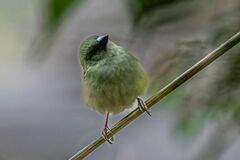
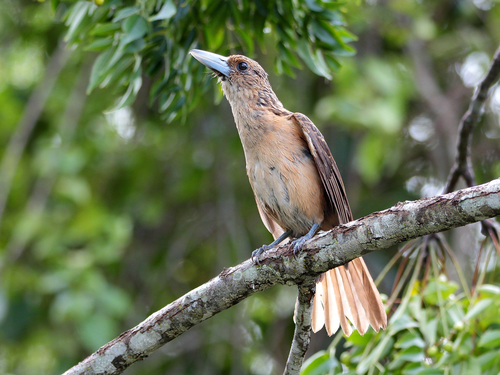
Blue-faced Parrotfinch

Blue-faced Parrotfinch

Erythrura trichroa

Silhouette: Sheatherius · PhyloPic

LCLeast ConcernNTVUENCR
Daily sighting probability ~10% · With luck
at Daintree National Park

In 3 days ~30% in a week ~60%

22 Verified sightings at Daintree National Park From 2019 to 2026
22 In 1 park
January Best month
☀️ Diurnal When it's spotted

About the Blue-faced Parrotfinch

The blue-faced parrotfinch (Erythrura trichroa) is a locally common species of estrildid finch found in north-eastern Australia, eastern Indonesia, Papua New Guinea, the Solomon Islands, Vanuatu and New Caledonia, with disjunct populations in Micronesia and Palau. It has an estimated global extent of occurrence of 10,000,000 km2.

It is found in subtropical and tropical zones in both montane and lowland moist forest areas, where it is most often associated with forest edges and disturbed habitat. It feeds largely on seeds of grasses, including in Australia several exotic genera especially Brachiaria. The IUCN has classified the species as being of least concern.

The blue-faced parrotfinch was formally described and illustrated in 1833 by German naturalist Heinrich von Kittlitz based on a specimen collected on the island of Ualan (now Kosrae), one of the Caroline Islands which lie to the north of New Guinea. Kittlitz coined the binomial name Fringilla trichroa where the specific epithet combines the Ancient Greek ρι-/tri- meaning "three-" with χροα/khroa, χροας/khroas meaning "colour" or "appearance". The blue-faced parrotfinch is now one of the 12 species placed in the... Wikipedia →

Sounds

Uncertain0:35

Papua New Guinea · 2019

© Jonathan Bryant · XC672053 · CC BY-NC-SA 4.0

Call0:12

Papua New Guinea · 2013

© Iain Woxvold · XC561220 · CC BY-NC-SA 4.0

Begging call0:45

Palau · 2012

© Todd Mark · XC113832 · CC BY-NC-SA 3.0

Global Distribution

Parks Where Found

# Park Country Daily sighting probability
1 Daintree National Park 🇦🇺 Australia
~10%

More parks will be added in future updates.

Zoos & Centres Where Found

# Zoo / Centre Country
1 Bronx Zoo 🇺🇸 United States In captivity
2 Taronga Zoo 🇦🇺 Australia In captivity
3 Featherdale Sydney Wildlife Park 🇦🇺 Australia In captivity
4 Zoo Lagos 🇵🇹 Portugal In captivity

Before you go

What are the chances of seeing a Blue-faced Parrotfinch in Daintree National Park?

With luck

About 10% of wildlife watchers report a Blue-faced Parrotfinch sighting in Daintree National Park on a given day, based on 22 verified sightings from GBIF citizen-science data from 2019 to 2026. It is the 70th most-seen of the 208 birds we can rate there. Over three days the chance rises to about 30%, and over a week to about 60%, if each day is a fresh chance.

When is the best time to see a Blue-faced Parrotfinch in Daintree National Park?

January

In that month about 30% of wildlife watchers report a Blue-faced Parrotfinch in Daintree National Park on a given day, against under 5% in May and June, the lowest months. That is one of Daintree National Park's wettest months, with about 380 mm of rain against 50 mm in September.

What time of day is best to see a Blue-faced Parrotfinch?

Between 8 and 11 am

Across all the parks we cover, that three-hour window holds the most Blue-faced Parrotfinch sightings with a recorded time, and about 8 in 10 of them come between 6 am and 6 pm: it is a daytime animal.

Where else can you see a Blue-faced Parrotfinch?

Only Daintree National Park, in our data

Daintree National Park is the only park on Wallace's Line with enough records to rate Blue-faced Parrotfinch sightings: about 10% of wildlife watchers there report one on a given day.

Where does the Blue-faced Parrotfinch sighting chance come from?

GBIF citizen-science records

It is estimated from how often the Blue-faced Parrotfinch is recorded against all the birds logged in Daintree National Park (22 verified sightings from 2019 to 2026), calibrated against known sighting rates. Figures are rounded to the nearest 10% because citizen-science data supports honest approximations, not decimals, and months with records from fewer than five people show "—". How it works.

← Back to Daintree National Park