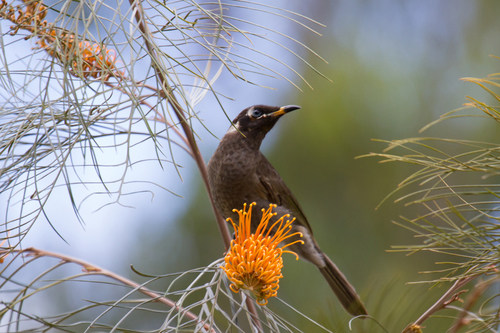
Yellow-spotted Honeyeater

Yellow-spotted Honeyeater

Meliphaga notata

Silhouette: Rachael Joakim · PhyloPic

LCLeast ConcernNTVUENCR Endemic
Daily sighting probability ~50% · Likely
at Daintree National Park

In 3 days ~90% in a week >90%

1,217 Verified sightings at Daintree National Park From 2019 to 2026
1,217 In 1 park
February Best month
🌅 Crepuscular When it's spotted

About the Yellow-spotted Honeyeater

The yellow-spotted honeyeater (Meliphaga notata) is a species of bird in the family Meliphagidae. It is also known as the lesser lewin. The bird is endemic to northern Queensland. The bird's common name refers to the yellow patch that members of the species have behind their eyes.

The yellow-spotted honeyeater is olive, brown, and gray in colour. The bird's weight ranges from around 23 to 30 grams, and the wingspan ranges from about 8 to 9 centimeters. The species contains two subspecies, which are known as Meliphaga notata notata and Meliphaga notata mixta. Yellow-spotted honeyeaters are aggressive and have a loud and metallic call.

The yellow-spotted honeyeater belongs to the order Passeriformes and the family Meliphagidae. The species may consist of two subspecies: Meliphaga notata notata and Meliphaga notata mixta. The former was described by Gould in 1867 and the latter by Matthews in 1912. The specific epithet notata derives from the Latin notatus, meaning 'spotted' or 'marked'.

A bird similar to the yellow-spotted honeyeater was described in 1844. The yellow-spotted honeyeater is olive-brown on the top and olive-gray below. However, there are... Wikipedia →

Sounds

Song0:05

Australia · 2025

© Étienne Leroy · XC1096184 · CC BY-NC-SA 4.0

Call0:21

Australia · 2024

© Andrew McCafferty · XC1038546 · CC BY-NC-SA 4.0

Uncertain0:05

Australia · 2022

© nick talbot · XC753955 · CC BY-NC-SA 4.0

Global Distribution

Parks Where Found

# Park Country Daily sighting probability
1 Daintree National Park 🇦🇺 Australia
~50%

More parks will be added in future updates.

Before you go

What are the chances of seeing a Yellow-spotted Honeyeater in Daintree National Park?

Likely

About 50% of wildlife watchers report a Yellow-spotted Honeyeater sighting in Daintree National Park on a given day, based on 1,217 verified sightings from GBIF citizen-science data from 2019 to 2026. It is the 15th most-seen of the 208 birds we can rate there. Over three days the chance rises to about 90%, and over a week to over 90%, if each day is a fresh chance.

When is the best time to see a Yellow-spotted Honeyeater in Daintree National Park?

February

In that month about 70% of wildlife watchers report a Yellow-spotted Honeyeater in Daintree National Park on a given day, against about 40% in May, the lowest month. That is one of Daintree National Park's wettest months, with about 240 mm of rain against 50 mm in September.

What time of day is best to see a Yellow-spotted Honeyeater?

Between 2 and 5 am

Across all the parks we cover, that three-hour window holds the most Yellow-spotted Honeyeater sightings with a recorded time, and about 6 in 10 of them come between 6 pm and 6 am: it is most active around dawn and dusk.

Where else can you see a Yellow-spotted Honeyeater?

Only Daintree National Park, in our data

Daintree National Park is the only park on Wallace's Line with enough records to rate Yellow-spotted Honeyeater sightings: about 50% of wildlife watchers there report one on a given day.

Where does the Yellow-spotted Honeyeater sighting chance come from?

GBIF citizen-science records

It is estimated from how often the Yellow-spotted Honeyeater is recorded against all the birds logged in Daintree National Park (1,217 verified sightings from 2019 to 2026), calibrated against known sighting rates. Figures are rounded to the nearest 10% because citizen-science data supports honest approximations, not decimals, and months with records from fewer than five people show "—". How it works.

← Back to Daintree National Park