Double-eyed Fig-Parrot

Double-eyed Fig-Parrot

Cyclopsitta diophthalma

Silhouette: Farelli (photo), John E. McCormack, Michael G. Harvey, Brant C. Faircloth, Nicholas G. Crawford, Travis C. Glenn, Robb T. Brumfield & T. Michael Keesey · PhyloPic

LCLeast ConcernNTVUENCR
Daily sighting probability ~30% · Possible
at Daintree National Park

In 3 days ~60% in a week ~90%

510 Verified sightings at Daintree National Park From 2019 to 2026
520 In all 2 parks
November Best month
🌅 Crepuscular When it's spotted

About the Double-eyed Fig-Parrot

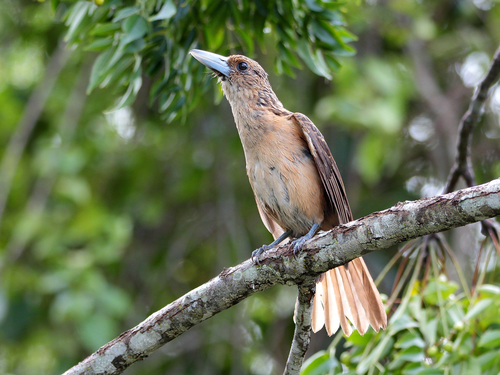
The double-eyed fig parrot (Cyclopsitta diophthalma), also known as the blue-faced fig parrot, red-faced fig parrot, dwarf fig parrot, and the two-eyed fig parrot, primarily inhabits forests on New Guinea and nearby islands, but is also found in isolated communities along the tropical Australian coast, east of the Great Dividing Range. With an average total length of about 14 cm (5+1⁄2 in), it is the smallest parrot in Australia.

Most subspecies of the double-eyed fig parrot are sexually dimorphic, with males having more red (less silvery and blue) to the face than the females. It is predominantly green with a very short tail, a disproportionately large head and bill, and red and blue facial markings. Its name is derived from a blue spot on the lores, which in New Guinean birds is roughly the same size as the eyes.

Although assessed as of Least Concern by the IUCN, certain subspecies are under threat. Wikipedia →

Global Distribution

Parks Where Found

# Park Country Daily sighting probability
1 Daintree National Park 🇦🇺 Australia
~30%
2 Raja Ampat 🇮🇩 Indonesia
<5%

Zoos & Centres Where Found

# Zoo / Centre Country
1 Walsrode World Bird Park 🇩🇪 Germany In captivity
2 Taronga Zoo 🇦🇺 Australia In captivity
3 Currumbin Wildlife Sanctuary 🇦🇺 Australia In captivity
4 Hartley’s Crocodile Adventures 🇦🇺 Australia In captivity
5 Rainforestation Nature Park 🇦🇺 Australia In captivity
6 Birdworld Kuranda 🇦🇺 Australia In captivity
7 Kuranda Koala Gardens 🇦🇺 Australia In captivity

Before you go

What are the chances of seeing a Double-eyed Fig-Parrot in Daintree National Park?

Possible

About 30% of wildlife watchers report a Double-eyed Fig-Parrot sighting in Daintree National Park on a given day, based on 510 verified sightings from GBIF citizen-science data from 2019 to 2026. It is the 37th most-seen of the 208 birds we can rate there. Over three days the chance rises to about 60%, and over a week to about 90%, if each day is a fresh chance.

When is the best time to see a Double-eyed Fig-Parrot in Daintree National Park?

November to February

In those months about 40% of wildlife watchers report a Double-eyed Fig-Parrot in Daintree National Park on a given day, against about 10% in March and May, the lowest months. Those are among Daintree National Park's wettest months, with about 250 mm of rain a month against 50 mm in September.

What time of day is best to see a Double-eyed Fig-Parrot?

Between midnight and 3 am

Across all the parks we cover, that three-hour window holds the most Double-eyed Fig-Parrot sightings with a recorded time, and about 7 in 10 of them come between 6 pm and 6 am: it is most active around dawn and dusk.

Is Daintree National Park the best place to see a Double-eyed Fig-Parrot?

Yes

Of the 2 parks where we can rate Double-eyed Fig-Parrot sightings, Daintree National Park has the highest daily chance: about 30%. Next come Raja Ampat (Indonesia, under 5%).

Which relatives of the Double-eyed Fig-Parrot live in Daintree National Park?

Same family: Psittacidae

The closest relatives of the Double-eyed Fig-Parrot that you can see in Daintree National Park (family Psittacidae, New World and African Parrots) are Coconut Lorikeet (about 50%) and Sulphur-crested Cockatoo (about 50%), with each one's daily chance of a sighting.

Where does the Double-eyed Fig-Parrot sighting chance come from?

GBIF citizen-science records

It is estimated from how often the Double-eyed Fig-Parrot is recorded against all the birds logged in Daintree National Park (510 verified sightings from 2019 to 2026), calibrated against known sighting rates. Figures are rounded to the nearest 10% because citizen-science data supports honest approximations, not decimals, and months with records from fewer than five people show "—". How it works.

← Back to Daintree National Park