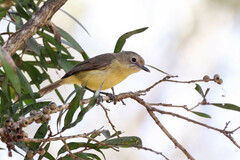
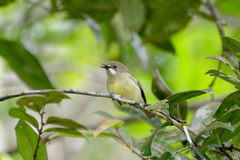
Fairy Gerygone

Fairy Gerygone

Gerygone palpebrosa

Silhouette: Sheatherius · PhyloPic

LCLeast ConcernNTVUENCR
Daily sighting probability ~10% · With luck
at Daintree National Park

In 3 days ~40% in a week ~60%

267 Verified sightings at Daintree National Park From 2019 to 2026
400 In all 3 parks
August Best month
☀️ Diurnal When it's spotted

About the Fairy Gerygone

The fairy gerygone (Gerygone palpebrosa), previously known as the fairy warbler, is a species of bird in the family Acanthizidae native to New Guinea and Queensland, Australia. Alfred Russel Wallace described the species as Gerygone palpebrosa in 1865, from a specimen from the Aru Islands. The species name is derived from the Latin palpebra "eyelid", for the bird's facial markings. A taxon known commonly as the fairy warbler, Gerygone flavida was described from the Herbert River in Queensland and initially treated as a separate species. However, birds further north along the Queensland coastline became gradually more like Gerygone palpebrosa, indicating there was no delineation between the two forms. This and the similarity of their songs indicated they were a single species.

Other common names recorded include black-throated, black-headed or masked gerygone, warbler or flyeater, hornet-nest bird, from a propensity to nest near wasp nests. These names were applied to what was thought a separate species—Gerygone personata described by John Gould in 1866—from far north Queensland which has been sunk into this one. What was described as Gerygone flavida was given the names... Wikipedia →

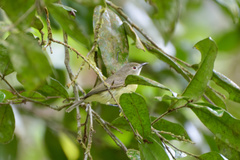
Sounds

Song0:18

Australia · 2025

© Étienne Leroy · XC1070859 · CC BY-NC-SA 4.0

Call0:07

Papua New Guinea · 2009

© Iain Woxvold · XC557681 · CC BY-NC-SA 4.0

Song1:03

Australia · 2025

© Peter Boesman · XC1066588 · CC BY-NC-ND 4.0

Global Distribution

Parks Where Found

# Park Country Daily sighting probability
1 Daintree National Park 🇦🇺 Australia
~10%
2 Raja Ampat 🇮🇩 Indonesia
~10%
3 Noosa National Park 🇦🇺 Australia
~10%

Before you go

What are the chances of seeing a Fairy Gerygone in Daintree National Park?

With luck

About 10% of wildlife watchers report a Fairy Gerygone sighting in Daintree National Park on a given day, based on 267 verified sightings from GBIF citizen-science data from 2019 to 2026. It is the 68th most-seen of the 208 birds we can rate there. Over three days the chance rises to about 40%, and over a week to about 60%, if each day is a fresh chance.

When is the best time to see a Fairy Gerygone in Daintree National Park?

May and August

In those months about 20% of wildlife watchers report a Fairy Gerygone in Daintree National Park on a given day, against under 5% in February to April, the lowest months. Those are among Daintree National Park's driest months, with about 85 mm of rain a month against 380 mm in January.

What time of day is best to see a Fairy Gerygone?

Between 8 and 11 am

Across all the parks we cover, that three-hour window holds the most Fairy Gerygone sightings with a recorded time, and about 9 in 10 of them come between 6 am and 6 pm: it is a daytime animal.

Is Daintree National Park the best place to see a Fairy Gerygone?

Yes

Of the 3 parks where we can rate Fairy Gerygone sightings, Daintree National Park has the highest daily chance: about 10%. Next come Raja Ampat (Indonesia, about 10%) and Noosa National Park (Australia, about 10%).

Where does the Fairy Gerygone sighting chance come from?

GBIF citizen-science records

It is estimated from how often the Fairy Gerygone is recorded against all the birds logged in Daintree National Park (267 verified sightings from 2019 to 2026), calibrated against known sighting rates. Figures are rounded to the nearest 10% because citizen-science data supports honest approximations, not decimals, and months with records from fewer than five people show "—". How it works.

← Back to Daintree National Park