
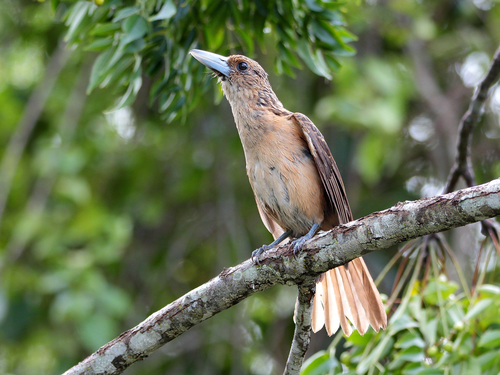
Rufous Shrikethrush

Rufous Shrikethrush

Colluricincla rufogaster

Silhouette: Sheatherius · PhyloPic

Daily sighting probability ~30% · Possible
at Daintree National Park

In 3 days ~70% in a week ~90%

590 Verified sightings at Daintree National Park From 2019 to 2026
824 In all 4 parks
September Best month
☀️ Diurnal When it's spotted

About the Rufous Shrikethrush

The little shrikethrush or little shrike-thrush (Colluricincla megarhyncha) is a species of passerine bird in the family Pachycephalidae that is found in New Guinea as well as in north and east Australia. The little shrikethrush was formally described and illustrated in 1832 as Muscicapa megarhyncha by the French naturalists Jean Quoy and Joseph Gaimard based on a specimen collected near Manokwari in the Bird's Head Peninsula of New Guinea. The specific epithet combines the Ancient Greek μεγα/mega meaning "much" with ῥυγχος/rhunkhos meaning "bill". The little shrikethrush is now placed in the genus Colluricincla that was introduced in 1827 by the naturalists Nicholas Vigors and Thomas Horsfield.

Molecular genetic studies of New Guinea populations of the little shrikethrush indicate high levels of genetic divergence, suggesting it may comprise more than one species. With at least eight separate clades identified as potential species splits, further research may lead to the re-classification of several new species. Alternate names for the little shrikethrush include the brown shrike-flycatcher and rufous shrike-thrush.

Sixteen subspecies are recognised: Wikipedia →

Sounds

Call0:38

Australia · 2025

© Étienne Leroy · XC1157760 · CC BY-NC-SA 4.0

Song1:03

Australia · 2025

© Colin Reid · XC1033962 · CC BY-NC-SA 4.0

Song1:27

Australia · 2023

© Sreekar · XC838571 · CC BY-NC-SA 4.0

Global Distribution

Parks Where Found

# Park Country Daily sighting probability
1 Daintree National Park 🇦🇺 Australia
~30%
2 Noosa National Park 🇦🇺 Australia
~20%
3 Springbrook National Park 🇦🇺 Australia
~20%
4 Lamington National Park 🇦🇺 Australia
<5%

Cities Where Found

# City Country Daily sighting probability
1 Brisbane 🇦🇺 Australia
<5%

Before you go

What are the chances of seeing a Rufous Shrikethrush in Daintree National Park?

Possible

About 30% of wildlife watchers report a Rufous Shrikethrush sighting in Daintree National Park on a given day, based on 590 verified sightings from GBIF citizen-science data from 2019 to 2026. It is the 35th most-seen of the 208 birds we can rate there. Over three days the chance rises to about 70%, and over a week to about 90%, if each day is a fresh chance.

When is the best time to see a Rufous Shrikethrush in Daintree National Park?

August and September

In those months about 40% of wildlife watchers report a Rufous Shrikethrush in Daintree National Park on a given day, against about 20% in January and March–April, the lowest months. Those are among Daintree National Park's driest months, with about 55 mm of rain a month against 380 mm in January.

What time of day is best to see a Rufous Shrikethrush?

Between 9 am and noon

Across all the parks we cover, that three-hour window holds the most Rufous Shrikethrush sightings with a recorded time, and about 9 in 10 of them come between 6 am and 6 pm: it is a daytime animal.

Is Daintree National Park the best place to see a Rufous Shrikethrush?

Yes

Of the 4 parks where we can rate Rufous Shrikethrush sightings, Daintree National Park has the highest daily chance: about 30%. Next come Noosa National Park (Australia, about 20%) and Springbrook National Park (Australia, about 20%).

Where does the Rufous Shrikethrush sighting chance come from?

GBIF citizen-science records

It is estimated from how often the Rufous Shrikethrush is recorded against all the birds logged in Daintree National Park (590 verified sightings from 2019 to 2026), calibrated against known sighting rates. Figures are rounded to the nearest 10% because citizen-science data supports honest approximations, not decimals, and months with records from fewer than five people show "—". How it works.

← Back to Daintree National Park