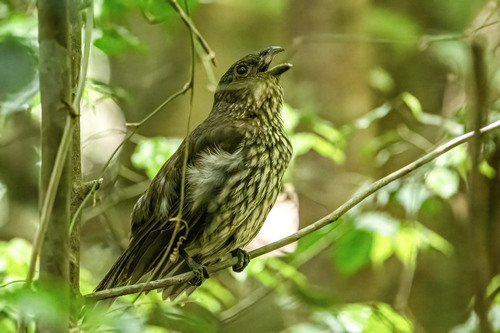
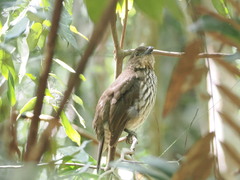
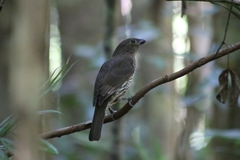
Tooth-billed Catbird

Tooth-billed Catbird

Scenopoeetes dentirostris

Silhouette: Ferran Sayol · PhyloPic

LCNTNear ThreatenedVUENCR Endemic
Daily sighting probability <5% · Rare
at Daintree National Park

In 3 days <5%

13 Verified sightings at Daintree National Park From 2019 to 2026
13 In 1 park
November Best month
☀️ Diurnal When it's spotted

About the Tooth-billed Catbird

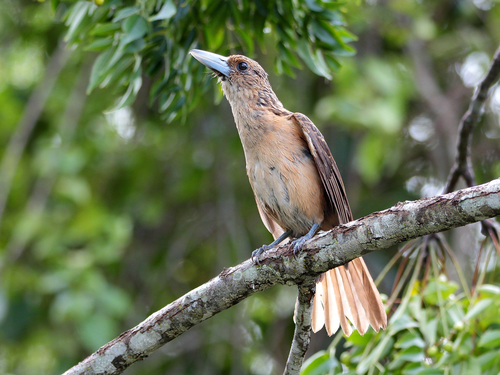
The tooth-billed bowerbird (Scenopoeetes dentirostris), also known as the stagemaker bowerbird or tooth-billed catbird, is a species of passerine bird in the bowerbird family Ptilonorhynchidae. It is the only species placed in the genus Scenopoeetes. It is found in the Cape York Peninsula and northeast Queensland of northeast Australia.

The tooth-billed bowerbird was formally described in 1876 by the Australian zoologist Edward Pierson Ramsay. He introduced a new genus Scenopoeus and coined the binomial name Scenopoeus dentirostris. Unfortunately the name Scenopoeus had earlier been used by Louis Agassiz for a genus of insects and in 1891 the American ornithologist Elliott Coues introduced a replacement name, Scenopoeetes. The genus name Scenopoeetes combines the Ancient Greek σκηνη/skēnē meaning "stage" or "tent" with ποιητης/poiētēs meaning "maker". The specific epithet dentirostris is derived from Latin dens, dentis meaning "tooth" and "-rostris" meaning "-billed". The tooth-billed bowerbird is monotypic: no subspecies are recognised.

The tooth-billed bowerbird is a medium-sized (approximately 27 centimetres (11 in) long) bowerbird. It is a stocky... Wikipedia →

Sounds

Song1:26

Australia · 2025

© Peter Boesman · XC1066942 · CC BY-NC-ND 4.0

Call0:30

Australia · 2000

© Arnoud B van den Berg · XC649713 · CC BY-NC-SA 4.0

Imitation1:20

Australia · 2020

© Marc Anderson · XC527714 · CC BY-NC-ND 4.0

Global Distribution

Parks Where Found

# Park Country Daily sighting probability
1 Daintree National Park 🇦🇺 Australia
<5%

More parks will be added in future updates.

Before you go

What are the chances of seeing a Tooth-billed Catbird in Daintree National Park?

Rare

Under 5% of wildlife watchers report a Tooth-billed Catbird sighting in Daintree National Park on a given day, based on 13 verified sightings from GBIF citizen-science data from 2019 to 2026. It is the 176th most-seen of the 208 birds we can rate there. Over three days the chance rises to under 5%, if each day is a fresh chance.

When is the best time to see a Tooth-billed Catbird in Daintree National Park?

Any time of year

In every month with enough records, under 5% of wildlife watchers report a Tooth-billed Catbird in Daintree National Park on a given day, so our monthly data shows no clear season.

What time of day is best to see a Tooth-billed Catbird?

Between 9 am and noon

Across all the parks we cover, that three-hour window holds the most Tooth-billed Catbird sightings with a recorded time, and about 9 in 10 of them come between 6 am and 6 pm: it is a daytime animal.

Where else can you see a Tooth-billed Catbird?

Only Daintree National Park, in our data

Daintree National Park is the only park on Wallace's Line with enough records to rate Tooth-billed Catbird sightings: under 5% of wildlife watchers there report one on a given day.

Where does the Tooth-billed Catbird sighting chance come from?

GBIF citizen-science records

It is estimated from how often the Tooth-billed Catbird is recorded against all the birds logged in Daintree National Park (13 verified sightings from 2019 to 2026), calibrated against known sighting rates. Figures are rounded to the nearest 10% because citizen-science data supports honest approximations, not decimals, and months with records from fewer than five people show "—". How it works.

← Back to Daintree National Park