Victoria's Riflebird

Victoria's Riflebird

Ptiloris victoriae

Silhouette: Federico Pelliccioni · PhyloPic

Endemic
Daily sighting probability ~10% · With luck
at Daintree National Park

In 3 days ~30% in a week ~60%

260 Verified sightings at Daintree National Park From 2019 to 2026
260 In 1 park
September Best month
☀️ Diurnal When it's spotted

About the Victoria's Riflebird

Victoria's riflebird (Ptiloris victoriae), also known as the lesser riflebird, Queen Victoria riflebird, Queen Victoria's riflebird, or Victoria riflebird, is a bird-of-paradise endemic to the Atherton Tableland region of northeastern Queensland, Australia where it resides year-round.

The Victoria's riflebird was discovered by John Macgillivray for John Gould in 1848 and is named after Queen Victoria of the United Kingdom. The common name "riflebird" comes from the likeness of their black velvety plumage to the uniform of the British Army Rifle Brigade.

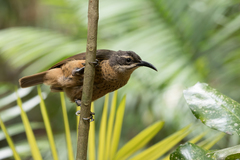
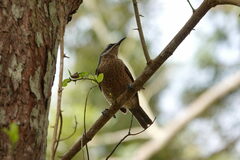
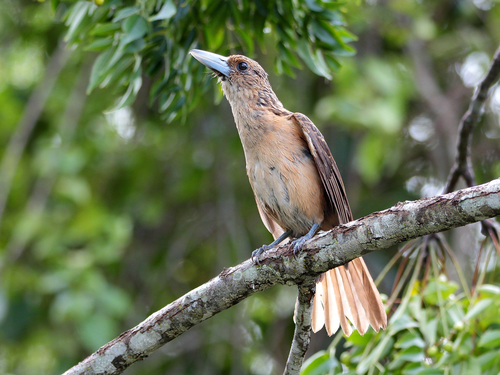
The smallest riflebird, it measures between 23–25 cm. Males have an iridescent purple sheen plumage, which becomes more blue-green on the head and more bronze on the lower breast. The throat is velvety black with a metallic green and blue triangular patch in the center. Females have a pale eyebrow, and the buff underparts are faintly barred with brown.

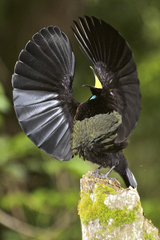
When the male begins to display, he erects the feathers of his throat and sides to accentuate the bright colours of his plumage in the shafts of sunlight that pierce the dimness of the rainforest. He curves... Wikipedia →

Sounds

Song0:07

Australia · 2025

© Étienne Leroy · XC1074098 · CC BY-NC-SA 4.0

Call0:55

Australia · 2025

© Peter Boesman · XC1066891 · CC BY-NC-ND 4.0

Alarm call0:14

Australia · 2016

© Phil Gregory · XC334915 · CC BY-NC-SA 4.0

Global Distribution

Parks Where Found

# Park Country Daily sighting probability
1 Daintree National Park 🇦🇺 Australia
~10%

More parks will be added in future updates.

Before you go

What are the chances of seeing a Victoria's Riflebird in Daintree National Park?

With luck

About 10% of wildlife watchers report a Victoria's Riflebird sighting in Daintree National Park on a given day, based on 260 verified sightings from GBIF citizen-science data from 2019 to 2026. It is the 74th most-seen of the 208 birds we can rate there. Over three days the chance rises to about 30%, and over a week to about 60%, if each day is a fresh chance.

When is the best time to see a Victoria's Riflebird in Daintree National Park?

June–July and September

In those months about 20% of wildlife watchers report a Victoria's Riflebird in Daintree National Park on a given day, against under 5% in November to January, the lowest months. Those are among Daintree National Park's driest months, with about 65 mm of rain a month against 380 mm in January.

What time of day is best to see a Victoria's Riflebird?

Between 9 am and noon

Across all the parks we cover, that three-hour window holds the most Victoria's Riflebird sightings with a recorded time, and about 8 in 10 of them come between 6 am and 6 pm: it is a daytime animal.

Where else can you see a Victoria's Riflebird?

Only Daintree National Park, in our data

Daintree National Park is the only park on Wallace's Line with enough records to rate Victoria's Riflebird sightings: about 10% of wildlife watchers there report one on a given day.

Which relatives of the Victoria's Riflebird live in Daintree National Park?

Same order: Passeriformes

The closest relatives of the Victoria's Riflebird that you can see in Daintree National Park (order Passeriformes, Perching Birds) are Black Butcherbird (about 70%), Green Oriole (about 60%) and Shining Flycatcher (about 60%), with each one's daily chance of a sighting.

Where does the Victoria's Riflebird sighting chance come from?

GBIF citizen-science records

It is estimated from how often the Victoria's Riflebird is recorded against all the birds logged in Daintree National Park (260 verified sightings from 2019 to 2026), calibrated against known sighting rates. Figures are rounded to the nearest 10% because citizen-science data supports honest approximations, not decimals, and months with records from fewer than five people show "—". How it works.

← Back to Daintree National Park