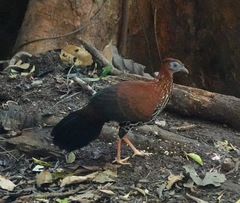
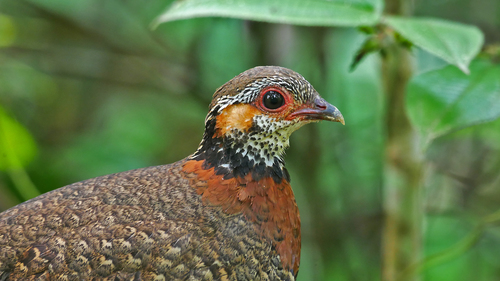
Bornean Crested Fireback

Bornean Crested Fireback

Lophura ignita

Silhouette: Sheatherius · PhyloPic

LCNTVUVulnerableENCR
Daily sighting probability ~20% · Possible
at Danum Valley Conservation Area

In 3 days ~50% in a week ~80%

396 Verified sightings at Danum Valley Conservation Area From 2019 to 2026
1,038 In all 4 parks
January Best month
🌅 Crepuscular When it's spotted

About the Bornean Crested Fireback

The Bornean crested fireback, Lophura ignita, is a large, sexually dimorphic, and distinctly-coloured pheasant of the family Galliformes endemic to the rainforests of Borneo and the surrounding islands. It is a non-migrating omnivorous species, often seen in groups of 5–6 in the rainforest lowlands. As of 2020 they were classified as Vulnerable by the IUCN due to population decline from habitat loss and deforestation, hunting, and trapping for the cage bird trade.

The Bornean crested fireback maintains a similar body plan to most other species in Galliformes (heavy bodied ground-dwellers). Similar to other species in the genus Lophura, L. ignita has strong coloration, with a dark plumage contrasting vibrant accents.

Before sex-specific coloration appears, juvenile females may be distinguished from males by their overall lighter plumage. The juveniles' plumage is like that of adult females, although they lack the crest seen on adults and have large black spots on the upper wing coverts. The adult female of related species, L. bulweri, often look like juvenile L. ignitia, but they can be distinguished by the black covert spots seen in L. ignitia. As well... Wikipedia →

Global Distribution

Parks Where Found

# Park Country Daily sighting probability
1 Way Kambas National Park 🇮🇩 Indonesia
~40%
2 Taman Negara National Park 🇲🇾 Malaysia
~20%
3 Danum Valley Conservation Area 🇲🇾 Malaysia
~20%
4 Kinabatangan Wildlife Sanctuary 🇲🇾 Malaysia
<5%

Zoos & Centres Where Found

# Zoo / Centre Country
1 Bronx Zoo 🇺🇸 United States In captivity
2 Toledo Zoo 🇺🇸 United States In captivity
3 Nyíregyháza Zoo 🇭🇺 Hungary In captivity
4 Natur- und Tierpark Goldau 🇨🇭 Switzerland In captivity
5 Europaradise Park 🇵🇹 Portugal In captivity
6 Marcelle Natureza 🇪🇸 Spain In captivity
7 Bioparc Fuengirola 🇪🇸 Spain In captivity
8 Zoo de Lourosa 🇵🇹 Portugal In captivity
9 Ogród zoologiczny w Lubinie 🇵🇱 Poland In captivity
10 Selig Zoo 🇺🇸 United States In captivity
11 Snakeroom Serpentarium 🇪🇸 Spain In captivity
12 The Green Connection 🇲🇾 Malaysia In captivity

Before you go

What are the chances of seeing a Bornean Crested Fireback in Danum Valley Conservation Area?

Possible

About 20% of wildlife watchers report a Bornean Crested Fireback sighting in Danum Valley Conservation Area on a given day, based on 396 verified sightings from GBIF citizen-science data from 2019 to 2026. It is the 65th most-seen of the 258 birds we can rate there. Over three days the chance rises to about 50%, and over a week to about 80%, if each day is a fresh chance.

When is the best time to see a Bornean Crested Fireback in Danum Valley Conservation Area?

July–August and December–February

In those months about 30% of wildlife watchers report a Bornean Crested Fireback in Danum Valley Conservation Area on a given day, against about 10% in September, the lowest month.

What time of day is best to see a Bornean Crested Fireback?

Between 11 pm and 2 am

Across all the parks we cover, that three-hour window holds the most Bornean Crested Fireback sightings with a recorded time, and about 6 in 10 of them come between 6 pm and 6 am: it is most active around dawn and dusk.

Is Danum Valley Conservation Area the best place to see a Bornean Crested Fireback?

3rd of 4

Of the 4 parks where we can rate Bornean Crested Fireback sightings, Danum Valley Conservation Area ranks 3rd at about 20%. The best odds are in Way Kambas National Park (Indonesia, about 40%) and Taman Negara National Park (Malaysia, about 20%).

Where does the Bornean Crested Fireback sighting chance come from?

GBIF citizen-science records

It is estimated from how often the Bornean Crested Fireback is recorded against all the birds logged in Danum Valley Conservation Area (396 verified sightings from 2019 to 2026), calibrated against known sighting rates. Figures are rounded to the nearest 10% because citizen-science data supports honest approximations, not decimals, and months with records from fewer than five people show "—". How it works.

← Back to Danum Valley Conservation Area