Great Argus

Great Argus

Argusianus argus

Silhouette: Sheatherius · PhyloPic

LCNTVUVulnerableENCR
Daily sighting probability ~40% · Likely
at Danum Valley Conservation Area

In 3 days ~80% in a week >90%

748 Verified sightings at Danum Valley Conservation Area From 2019 to 2026
1,446 In all 8 parks
September Best month
🌅 Crepuscular When it's spotted

About the Great Argus

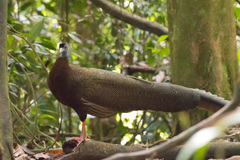
The great argus or greater argus (Argusianus argus) is a large species of pheasant native to the jungles of Borneo, Sumatra and the Malay Peninsula in southeast Asia. It is known for its impressive plumage and courtship behavior. It is not to be confused with the two species of closely related crested argus, genus Rheinardia.

Carl Linnaeus gave the great argus its specific name (from which its common name and genus name are derived) because of the intricate eye-like patterns on its wings, in reference to Argus, a hundred-eyed giant in Greek mythology. There are two subspecies recognized: Nominate argus of the Malay peninsula and Sumatra, and A. a. grayi of Borneo. William Beebe considered the two races to be distinct species, but they have since been lumped.

The genus Argusianus was introduced in 1849 by the English zoologist George Gray with the great argus as the type species. The double-banded argus (Argusianus bipunctatus), known only from a portion of a single primary flight feather, was long considered a potential second species. It was described in 1871 from this feather piece, found in a millinery shipment imported to London. Its origin... Wikipedia →

Sounds

Recording0:54

Malaysia · 2026

© Raymond Khoo · iNaturalist · CC BY-NC 4.0

Recording0:09

Malaysia · 2019

© Leah Ramsay · iNaturalist · CC BY-NC 4.0

Recording0:14

Thailand · 2023

© Sam Hambly · iNaturalist · CC BY 4.0

Global Distribution

Parks Where Found

# Park Country Daily sighting probability
1 Danum Valley Conservation Area 🇲🇾 Malaysia
~40%
2 Khao Luang National Park 🇹🇭 Thailand
~20%
3 Gunung Leuser National Park 🇮🇩 Indonesia
~20%
4 Taman Negara National Park 🇲🇾 Malaysia
~20%
5 Sepilok 🇲🇾 Malaysia
<5%
6 Khao Sok National Park 🇹🇭 Thailand
<5%
7 Kinabatangan Wildlife Sanctuary 🇲🇾 Malaysia
<5%
8 Kinabalu Park 🇲🇾 Malaysia
<5%

Zoos & Centres Where Found

# Zoo / Centre Country
1 Disney's Animal Kingdom 🇺🇸 United States In captivity
2 San Diego Zoo 🇺🇸 United States In captivity
3 Pairi Daiza 🇧🇪 Belgium In captivity
4 ZooParc de Beauval 🇫🇷 France In captivity
5 Copenhagen Zoo 🇩🇰 Denmark In captivity
6 Zlín-Lešná Zoo 🇨🇿 Czechia In captivity
7 Zoo Miami 🇺🇸 United States In captivity
8 San Diego Zoo Safari Park 🇺🇸 United States In captivity
9 Taipei Zoo 🇹🇼 Taiwan In captivity
10 Safari West 🇺🇸 United States In captivity
11 Bronx Zoo 🇺🇸 United States In captivity
12 Badoca Safari Park 🇵🇹 Portugal In captivity
13 Omaha’s Henry Doorly Zoo and Aquarium 🇺🇸 United States In captivity
14 Wildlife World Zoo 🇺🇸 United States In captivity
15 Audubon Zoo 🇺🇸 United States In captivity
16 Fonghuanggu Bird and Ecology Park 🇹🇼 Taiwan In captivity
17 Dierenpark Hoenderdaell 🇳🇱 Netherlands In captivity
18 Woodland Park Zoo 🇺🇸 United States In captivity
19 National Zoo of Malaysia 🇲🇾 Malaysia In captivity
20 Fort Worth Zoo 🇺🇸 United States In captivity
21 Gatorland 🇺🇸 United States In captivity
22 Oregon Zoo 🇺🇸 United States In captivity
23 Green World Ecological Farm 🇹🇼 Taiwan In captivity
24 National Zoological Gardens of Sri Lanka 🇱🇰 Sri Lanka In captivity
25 Reid Park Zoo 🇺🇸 United States In captivity
26 Bioparc Fuengirola 🇪🇸 Spain In captivity
27 Johor Zoo 🇲🇾 Malaysia In captivity
28 The Seas with Nemo & Friends 🇺🇸 United States In captivity
29 Adventure Aquarium 🇺🇸 United States In captivity
30 Aquarium Barcelona 🇪🇸 Spain In captivity
31 National Aviary 🇺🇸 United States In captivity
32 Zoo de Lourosa 🇵🇹 Portugal In captivity
33 蘭陽動植物王國 🇹🇼 Taiwan In captivity
34 Blue Planet Aquarium 🇬🇧 United Kingdom In captivity
35 Bird Kingdom 🇨🇦 Canada In captivity
36 Aquarium de Paris 🇫🇷 France In captivity
37 Aquarium of Niagara 🇺🇸 United States In captivity
38 Bird Alliance of Oregon 🇺🇸 United States In captivity
39 Kung Fu Corals 🇺🇸 United States In captivity
40 Mořský svět 🇨🇿 Czechia In captivity
41 Moscow Oceanarium 🇷🇺 Russia In captivity
42 Ogród zoologiczny w Lubinie 🇵🇱 Poland In captivity
43 Vogelpark Bali 🇮🇩 Indonesia In captivity
44 Zoological Wildlife Foundation 🇺🇸 United States In captivity

Before you go

What are the chances of seeing a Great Argus in Danum Valley Conservation Area?

Likely

About 40% of wildlife watchers report a Great Argus sighting in Danum Valley Conservation Area on a given day, based on 748 verified sightings from GBIF citizen-science data from 2019 to 2026. It is the 13th most-seen of the 258 birds we can rate there. Over three days the chance rises to about 80%, and over a week to over 90%, if each day is a fresh chance.

When is the best time to see a Great Argus in Danum Valley Conservation Area?

September

In that month about 60% of wildlife watchers report a Great Argus in Danum Valley Conservation Area on a given day, against about 20% in February, the lowest month.

What time of day is best to see a Great Argus?

Between 4 and 7 am

Across all the parks we cover, that three-hour window holds the most Great Argus sightings with a recorded time, and about half of them come between 6 pm and 6 am: it is most active around dawn and dusk.

Which relatives of the Great Argus live in Danum Valley Conservation Area?

Same family: Phasianidae

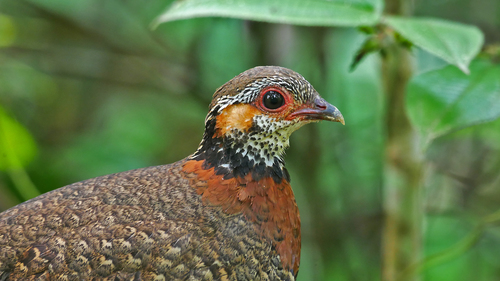
The closest relatives of the Great Argus that you can see in Danum Valley Conservation Area (family Phasianidae, Pheasants, Grouse, and Allies) are Chestnut-necklaced Hill Partridge (about 20%) and Bornean Crested Fireback (about 20%), with each one's daily chance of a sighting.

Where does the Great Argus sighting chance come from?

GBIF citizen-science records

It is estimated from how often the Great Argus is recorded against all the birds logged in Danum Valley Conservation Area (748 verified sightings from 2019 to 2026), calibrated against known sighting rates. Figures are rounded to the nearest 10% because citizen-science data supports honest approximations, not decimals, and months with records from fewer than five people show "—". How it works.

← Back to Danum Valley Conservation Area