Malaysian Flying Frog

Malaysian Flying Frog

Leptomantis rufipes

Silhouette: Jose Carlos Arenas-Monroy · PhyloPic

Daily sighting probability ~10% · With luck
at Danum Valley Conservation Area

In 3 days ~40% in a week ~70%

5 Verified sightings at Danum Valley Conservation Area From 2019 to 2026
5 In 1 park
July Best month
🌙 Nocturnal When it's spotted

About the Malaysian Flying Frog

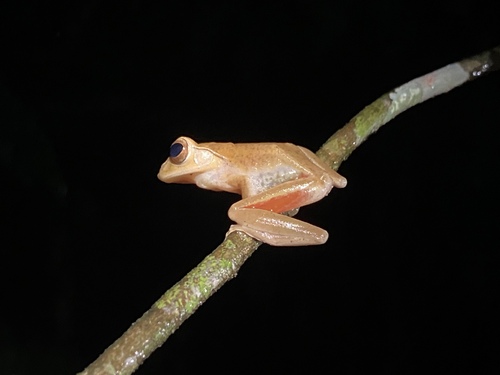
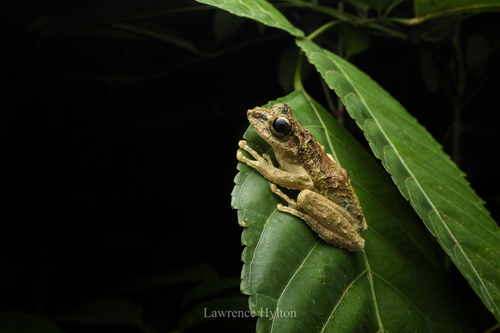
Leptomantis rufipes is a species of frog in the family Rhacophoridae. It is endemic to Borneo and known from isolated locations in south-central Sarawak and eastern Sabah (East Malaysia) and central Kalimantan (Indonesia). Common names Malaysian flying frog and red-legged frog have been coined for this species. The specific name rufipes refers to the red webbing of this frog.

Adult males measure 34–39 mm (1.3–1.5 in) and adult females about 50 mm (2.0 in) in snout–vent length. The body is moderately slender. The snout is sharply pointed. The canthus is sharp. The tympanum is distinct and relatively larger in males than in females. The finger and toe tips are expanded into rounded discs. Both the fingers and the toes are webbed, the toes fully so. The body is pinkish brown above and on the flanks. The back may have dark speckling and irregular spots. A thin, white line runs from the tip of the snout along the canthus to the edge of the eyelid. The throat and chest are yellow-orange. The webbing is deep orange-red.

The male advertisement call is a soft series of chuckles. Leptomantis rufipes occurs in primary lowland rainforests below 250... Wikipedia →

Global Distribution

Parks Where Found

# Park Country Daily sighting probability
1 Danum Valley Conservation Area 🇲🇾 Malaysia
~10%

More parks will be added in future updates.

Before you go

What are the chances of seeing a Malaysian Flying Frog in Danum Valley Conservation Area?

With luck

About 10% of wildlife watchers report a Malaysian Flying Frog sighting in Danum Valley Conservation Area on a given day, based on 5 verified sightings from GBIF citizen-science data from 2019 to 2026. It is the 21st most-seen of the 23 amphibians we can rate there. Over three days the chance rises to about 40%, and over a week to about 70%, if each day is a fresh chance.

When is the best time to see a Malaysian Flying Frog in Danum Valley Conservation Area?

July

In that month about 40% of wildlife watchers report a Malaysian Flying Frog in Danum Valley Conservation Area on a given day, against under 5% in March–June, August–September and December–January, the lowest months.

What time of day is best to see a Malaysian Flying Frog?

Between 6 and 9 pm

Across all the parks we cover, that three-hour window holds the most Malaysian Flying Frog sightings with a recorded time, and nearly all of them come between 6 pm and 6 am: it is mostly seen at night.

Where else can you see a Malaysian Flying Frog?

Only Danum Valley Conservation Area, in our data

Danum Valley Conservation Area is the only park on Wallace's Line with enough records to rate Malaysian Flying Frog sightings: about 10% of wildlife watchers there report one on a given day.

Where does the Malaysian Flying Frog sighting chance come from?

GBIF citizen-science records

It is estimated from how often the Malaysian Flying Frog is recorded against all the amphibians logged in Danum Valley Conservation Area (5 verified sightings from 2019 to 2026), calibrated against known sighting rates. Figures are rounded to the nearest 10% because citizen-science data supports honest approximations, not decimals, and months with records from fewer than five people show "—". How it works.

← Back to Danum Valley Conservation Area