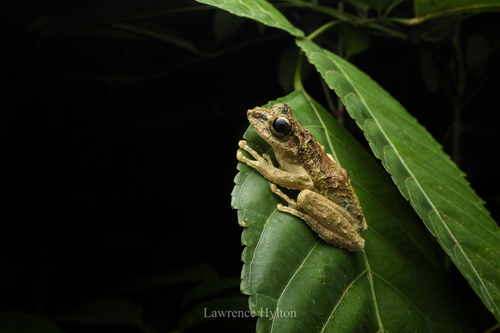
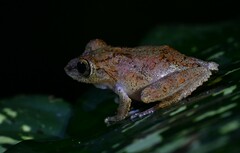
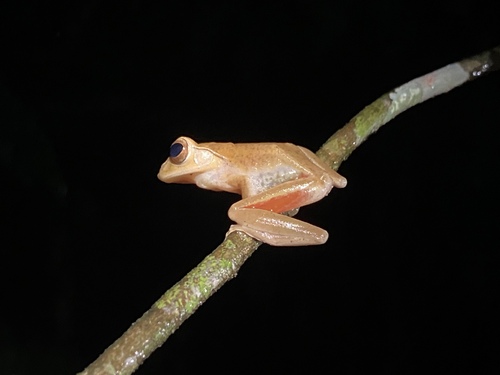
Chasen's Frilled Tree Frog

Chasen's Frilled Tree Frog

Kurixalus chaseni

Silhouette: Jose Carlos Arenas-Monroy · PhyloPic

LCLeast ConcernNTVUENCR
Daily sighting probability ~30% · Possible
at Danum Valley Conservation Area

In 3 days ~70% in a week ~90%

18 Verified sightings at Danum Valley Conservation Area From 2019 to 2026
95 In all 4 parks
April Best month
☀️ Diurnal When it's spotted

About the Chasen's Frilled Tree Frog

Kurixalus chaseni, the frilled tree frog or Malay frilled tree frog, is a species of frog in the family Rhacophoridae. It is endemic to Malaysia, Indonesia, and Thailand, where it has been observed between 0 and 500 meters above sea level.

This frog has been found in forests primary forest and long-growing secondary forest. This frog is known in swampy areas with water stagnant water. Scientists believe this frog can tolerate some level of habitat disturbance. It has been seen by roadsides.

Scientists classify this frog as at least concern of extinction because of its large range, which includes protected parks, and presumed large population. What threat it faces comes from habitat loss associated with deforestation associated with forest concession and palm oil cultivation

Matsui M; Kawahara Y; Eto K; Hamidy A; Ahmad N; Hossman MYB (2018). "Distinct species status of Kurixalus chaseni (Rhacophoridae, Anura) as revealed by mitochondrial phylogeny". Alytes. 36: 170–177. Wikipedia →

Sounds

Recording0:50

Malaysia · 2019

© Matt Clancy · iNaturalist · CC BY-NC 4.0

Recording

Malaysia · 2015

© Marc Anderson · Xeno · CC BY-NC-ND 4.0

Global Distribution

Parks Where Found

# Park Country Daily sighting probability
1 Tanjung Puting National Park 🇮🇩 Indonesia
~40%
2 Kinabatangan Wildlife Sanctuary 🇲🇾 Malaysia
~30%
3 Danum Valley Conservation Area 🇲🇾 Malaysia
~30%
4 Sepilok 🇲🇾 Malaysia
~10%

Before you go

What are the chances of seeing a Chasen's Frilled Tree Frog in Danum Valley Conservation Area?

Possible

About 30% of wildlife watchers report a Chasen's Frilled Tree Frog sighting in Danum Valley Conservation Area on a given day, based on 18 verified sightings from GBIF citizen-science data from 2019 to 2026. It is the 7th most-seen of the 23 amphibians we can rate there. Over three days the chance rises to about 70%, and over a week to about 90%, if each day is a fresh chance.

When is the best time to see a Chasen's Frilled Tree Frog in Danum Valley Conservation Area?

January–February, April and October–November

In those months about 40% of wildlife watchers report a Chasen's Frilled Tree Frog in Danum Valley Conservation Area on a given day, against under 5% in May, July–September and December, the lowest months.

What time of day is best to see a Chasen's Frilled Tree Frog?

Between 1 and 4 pm

Across all the parks we cover, that three-hour window holds the most Chasen's Frilled Tree Frog sightings with a recorded time, and about 9 in 10 of them come between 6 am and 6 pm: it is a daytime animal.

Is Danum Valley Conservation Area the best place to see a Chasen's Frilled Tree Frog?

3rd of 4

Of the 4 parks where we can rate Chasen's Frilled Tree Frog sightings, Danum Valley Conservation Area ranks 3rd at about 30%. The best odds are in Tanjung Puting National Park (Indonesia, about 40%) and Kinabatangan Wildlife Sanctuary (Malaysia, about 30%).

Which relatives of the Chasen's Frilled Tree Frog live in Danum Valley Conservation Area?

Same family: Rhacophoridae

The closest relatives of the Chasen's Frilled Tree Frog that you can see in Danum Valley Conservation Area (family Rhacophoridae, Old World Tree Frogs) are File-eared Tree Frog (about 80%), Brown-Striped Tree Frog (about 60%) and Harlequin Tree Frog (about 50%), with each one's daily chance of a sighting.

Where does the Chasen's Frilled Tree Frog sighting chance come from?

GBIF citizen-science records

It is estimated from how often the Chasen's Frilled Tree Frog is recorded against all the amphibians logged in Danum Valley Conservation Area (18 verified sightings from 2019 to 2026), calibrated against known sighting rates. Figures are rounded to the nearest 10% because citizen-science data supports honest approximations, not decimals, and months with records from fewer than five people show "—". How it works.

← Back to Danum Valley Conservation Area