Brown-Striped Tree Frog

Brown-Striped Tree Frog

Polypedates macrotis

Silhouette: Jose Carlos Arenas-Monroy · PhyloPic

LCLeast ConcernNTVUENCR
Daily sighting probability ~60% · Likely
at Danum Valley Conservation Area

In 3 days ~90% in a week >90%

77 Verified sightings at Danum Valley Conservation Area From 2019 to 2026
157 In all 5 parks
January Best month
☀️ Diurnal When it's spotted

About the Brown-Striped Tree Frog

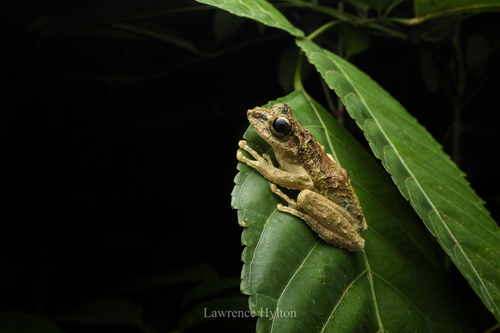
Polypedates macrotis, commonly known as the dark-eared treefrog, as well as the Bongao tree frog, Bongao bubble-nest frog, Baram whipping frog, or brown-striped tree frog, is a species of tree frog (a "true" frog) in the family Rhacophoridae. This species is found on the Malay Peninsula and Southern Thailand, Sumatra and Java (Indonesia), Borneo (including Brunei) and parts of the Philippines, in addition to several smaller islands within the Coral Triangle ecoregion.

Bongao, from the common name "Bongao tree frog", is in reference to Bongao Island, the type locality of Philautus montanus—now synonymized with Polypedates macrotis. Additionally, "Baram whipping frog" is referencing Baram, a district in Sarawak, East Malaysia (Borneo), and is also the name of the type locality of P. macrotis.

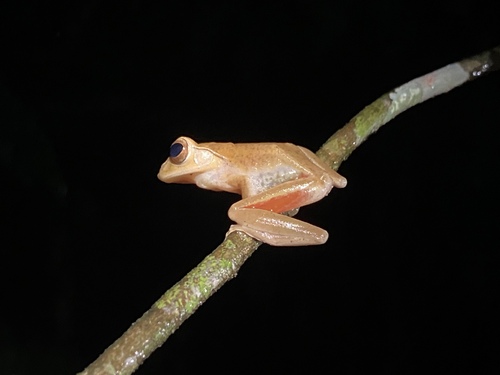
Male Polypedates macrotis grow to a snout–vent length of about 60 mm (2.4 in) and females to 85 mm (3.3 in). Tadpoles are up to 60 mm (2.4 in) in length. Dorsum is brown with a darker band behind the eye that covers the tympanum, tapering along the side.

Polypedates macrotis is similar to Polypedates leucomystax but differs from it slightly in colouration and body proportions.... Wikipedia →

Global Distribution

Parks Where Found

# Park Country Daily sighting probability
1 Danum Valley Conservation Area 🇲🇾 Malaysia
~60%
2 Sepilok 🇲🇾 Malaysia
~30%
3 Kinabalu Park 🇲🇾 Malaysia
~20%
4 Bako National Park 🇲🇾 Malaysia
~20%
5 Kinabatangan Wildlife Sanctuary 🇲🇾 Malaysia
~20%

Before you go

What are the chances of seeing a Brown-Striped Tree Frog in Danum Valley Conservation Area?

Likely

About 60% of wildlife watchers report a Brown-Striped Tree Frog sighting in Danum Valley Conservation Area on a given day, based on 77 verified sightings from GBIF citizen-science data from 2019 to 2026. It is the 2nd most-seen of the 23 amphibians we can rate there. Over three days the chance rises to about 90%, and over a week to over 90%, if each day is a fresh chance.

When is the best time to see a Brown-Striped Tree Frog in Danum Valley Conservation Area?

January

In that month about 80% of wildlife watchers report a Brown-Striped Tree Frog in Danum Valley Conservation Area on a given day, against about 30% in February, the lowest month.

What time of day is best to see a Brown-Striped Tree Frog?

Between 1 and 4 pm

Across all the parks we cover, that three-hour window holds the most Brown-Striped Tree Frog sightings with a recorded time, and about 9 in 10 of them come between 6 am and 6 pm: it is a daytime animal.

Is Danum Valley Conservation Area the best place to see a Brown-Striped Tree Frog?

Yes

Of the 5 parks where we can rate Brown-Striped Tree Frog sightings, Danum Valley Conservation Area has the highest daily chance: about 60%. Next come Sepilok (Malaysia, about 30%) and Kinabalu Park (Malaysia, about 20%). All parks ranked.

Which relatives of the Brown-Striped Tree Frog live in Danum Valley Conservation Area?

Same genus: Polypedates

The closest relatives of the Brown-Striped Tree Frog that you can see in Danum Valley Conservation Area (genus Polypedates, whipping frogs) are File-eared Tree Frog (about 80%) and Common Tree Frog (about 10%), with each one's daily chance of a sighting.

Where does the Brown-Striped Tree Frog sighting chance come from?

GBIF citizen-science records

It is estimated from how often the Brown-Striped Tree Frog is recorded against all the amphibians logged in Danum Valley Conservation Area (77 verified sightings from 2019 to 2026), calibrated against known sighting rates. Figures are rounded to the nearest 10% because citizen-science data supports honest approximations, not decimals, and months with records from fewer than five people show "—". How it works.

← Back to Danum Valley Conservation Area