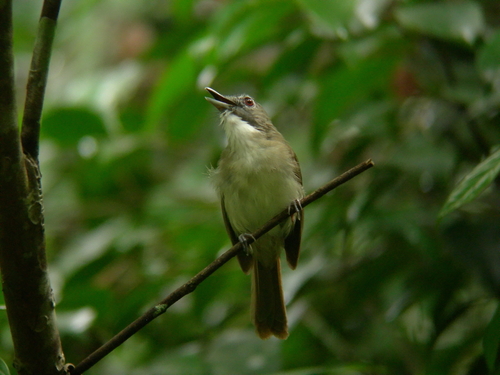
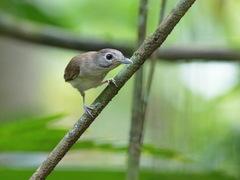
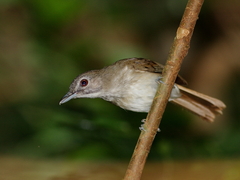
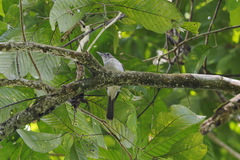

Moustached Babbler

Moustached Babbler

Malacopteron magnirostre

Silhouette: Sheatherius · PhyloPic

LCLeast ConcernNTVUENCR
Daily sighting probability ~20% · Possible
at Danum Valley Conservation Area

In 3 days ~50% in a week ~80%

279 Verified sightings at Danum Valley Conservation Area From 2019 to 2026
880 In all 6 parks
October Best month
☀️ Diurnal When it's spotted

About the Moustached Babbler

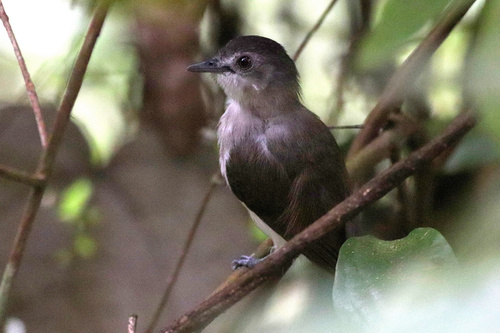
The moustached babbler (Malacopteron magnirostre) is a species of bird in the ground babbler family Pellorneidae. The species is also known as the brown-headed babbler or brown-headed tree-babbler. The specific name magnirostre comes from the Latin magnus for big and rostris for billed. The name for the subspecies cinereocapilla comes from the Latin cinereus for ash/ashy and capillus for headed.

The moustached babbler is found in Sundaland. The nominate race is found in southern Myanmar and Thailand through Peninsular Malaysia and Sumatra, and the subspecies M. m. cinereocapilla is endemic to Borneo. Formerly, it could be found in the forests of Singapore, but it is now likely extinct there.

Its natural habitat is tropical moist primary lowland forests, peatswamp forest, secondary forest, logged forests and old rubber plantations, from 915 m (3,002 ft), rarely to 1,200 m (3... Wikipedia →

Sounds

Song0:32

Indonesia · 2026

© Kim Chuah Lim · XC1175517 · CC BY-NC-SA 4.0

Call1:06

Malaysia · 2026

© Ding Li Yong · XC1093494 · CC BY-NC-ND 4.0

Uncertain0:10

Malaysia · 2023

© Lim Ying Hien · XC863216 · CC BY-NC-ND 4.0

Global Distribution

Parks Where Found

# Park Country Daily sighting probability
1 Khao Luang National Park 🇹🇭 Thailand
~30%
2 Taman Negara National Park 🇲🇾 Malaysia
~30%
3 Danum Valley Conservation Area 🇲🇾 Malaysia
~20%
4 Way Kambas National Park 🇮🇩 Indonesia
~10%
5 Khao Sok National Park 🇹🇭 Thailand
<5%
6 Kinabalu Park 🇲🇾 Malaysia
<5%

Before you go

What are the chances of seeing a Moustached Babbler in Danum Valley Conservation Area?

Possible

About 20% of wildlife watchers report a Moustached Babbler sighting in Danum Valley Conservation Area on a given day, based on 279 verified sightings from GBIF citizen-science data from 2019 to 2026. It is the 77th most-seen of the 258 birds we can rate there. Over three days the chance rises to about 50%, and over a week to about 80%, if each day is a fresh chance.

When is the best time to see a Moustached Babbler in Danum Valley Conservation Area?

October

In that month about 30% of wildlife watchers report a Moustached Babbler in Danum Valley Conservation Area on a given day, against about 10% in June and December–February, the lowest months.

What time of day is best to see a Moustached Babbler?

Between 9 am and noon

Across all the parks we cover, that three-hour window holds the most Moustached Babbler sightings with a recorded time, and about 9 in 10 of them come between 6 am and 6 pm: it is a daytime animal.

Is Danum Valley Conservation Area the best place to see a Moustached Babbler?

3rd of 6

Of the 6 parks where we can rate Moustached Babbler sightings, Danum Valley Conservation Area ranks 3rd at about 20%. The best odds are in Khao Luang National Park (Thailand, about 30%) and Taman Negara National Park (Malaysia, about 30%).

Which relatives of the Moustached Babbler live in Danum Valley Conservation Area?

Same genus: Malacopteron

The closest relatives of the Moustached Babbler that you can see in Danum Valley Conservation Area (genus Malacopteron, Malacopteron Babblers) are Sooty-capped Babbler (about 40%), Rufous-crowned Babbler (about 30%) and Scaly-crowned Babbler (about 20%), with each one's daily chance of a sighting.

Where does the Moustached Babbler sighting chance come from?

GBIF citizen-science records

It is estimated from how often the Moustached Babbler is recorded against all the birds logged in Danum Valley Conservation Area (279 verified sightings from 2019 to 2026), calibrated against known sighting rates. Figures are rounded to the nearest 10% because citizen-science data supports honest approximations, not decimals, and months with records from fewer than five people show "—". How it works.

← Back to Danum Valley Conservation Area