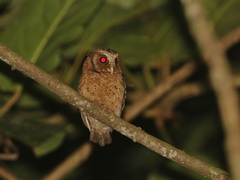
Reddish Scops-Owl

Reddish Scops-Owl

Otus rufescens

Silhouette: Armelle Ansart (photograph), Maxime Dahirel (digitisation) · PhyloPic

LCNTNear ThreatenedVUENCR
Daily sighting probability <5% · Rare
at Danum Valley Conservation Area

In 3 days ~10% in a week ~30%

61 Verified sightings at Danum Valley Conservation Area From 2019 to 2026
276 In all 5 parks
October Best month
🌙 Nocturnal When it's spotted

About the Reddish Scops-Owl

The reddish scops owl (Otus rufescens) is an owl found in southeast Asia, in the countries of Thailand, Malaysia, Indonesia, and Brunei. The reddish scops owl measures 15-18 cm in length and has a body mass of 70-83 g. Body is generally a red-brown, with paler face and ear tufts. Displays black spotting across chest, and white spotting along back and wings; juveniles appear similar to adult individuals, but with less spotting.

The call of the owl is a whistling “hooo," which is repeated in 7-11 second intervals. The calls of this species are able to be reliably sexed, with males having a higher pitched call than females. The reddish scops owl was first described by Thomas Horsfield in 1821 under the binomial Strix rufescens.

O. r. rufescens The reddish scops owl lives in lowland regions including rainforests and swamps. The owl does not migrate, and primarily inhabits a home range of 1.31–2.16 hectares. The reddish scops owl is evaluated by the IUCN as near threatened, and its population is believed to be decreasing. The primary threat to these birds is habitat... Wikipedia →

Sounds

Song1:07

Malaysia · 2026

© Lim Ying Hien 林勇贤 · XC1176120 · CC BY-NC-ND 4.0

Call0:15

Thailand · 2021

© Somkiat Pakapinyo (Chai) · XC645622 · CC BY-NC-SA 4.0

Song0:13

Malaysia · 2023

© Yeap Soon Pin · XC864581 · CC BY-NC-SA 4.0

Global Distribution

Parks Where Found

# Park Country Daily sighting probability
1 Way Kambas National Park 🇮🇩 Indonesia
~20%
2 Kinabatangan Wildlife Sanctuary 🇲🇾 Malaysia
<5%
3 Danum Valley Conservation Area 🇲🇾 Malaysia
<5%
4 Taman Negara National Park 🇲🇾 Malaysia
<5%
5 Sepilok 🇲🇾 Malaysia
<5%

Before you go

What are the chances of seeing a Reddish Scops-Owl in Danum Valley Conservation Area?

Rare

Under 5% of wildlife watchers report a Reddish Scops-Owl sighting in Danum Valley Conservation Area on a given day, based on 61 verified sightings from GBIF citizen-science data from 2019 to 2026. It is the 172nd most-seen of the 258 birds we can rate there. Over three days the chance rises to about 10%, and over a week to about 30%, if each day is a fresh chance.

When is the best time to see a Reddish Scops-Owl in Danum Valley Conservation Area?

October

In that month about 20% of wildlife watchers report a Reddish Scops-Owl in Danum Valley Conservation Area on a given day, against under 5% in November to September, the lowest months.

What time of day is best to see a Reddish Scops-Owl?

Between 7 and 10 pm

Across all the parks we cover, that three-hour window holds the most Reddish Scops-Owl sightings with a recorded time, and about 9 in 10 of them come between 6 pm and 6 am: it is mostly seen at night.

Is Danum Valley Conservation Area the best place to see a Reddish Scops-Owl?

3rd of 5

Of the 5 parks where we can rate Reddish Scops-Owl sightings, Danum Valley Conservation Area ranks 3rd at under 5%. The best odds are in Way Kambas National Park (Indonesia, about 20%) and Kinabatangan Wildlife Sanctuary (Malaysia, under 5%).

Which relatives of the Reddish Scops-Owl live in Danum Valley Conservation Area?

Same family: Strigidae

The closest relatives of the Reddish Scops-Owl that you can see in Danum Valley Conservation Area (family Strigidae, Typical Owls) are Buffy Fish-Owl (about 20%) and Brown Wood Owl (about 10%), with each one's daily chance of a sighting.

Where does the Reddish Scops-Owl sighting chance come from?

GBIF citizen-science records

It is estimated from how often the Reddish Scops-Owl is recorded against all the birds logged in Danum Valley Conservation Area (61 verified sightings from 2019 to 2026), calibrated against known sighting rates. Figures are rounded to the nearest 10% because citizen-science data supports honest approximations, not decimals, and months with records from fewer than five people show "—". How it works.

← Back to Danum Valley Conservation Area