White-fronted Falconet

White-fronted Falconet

Microhierax latifrons

Silhouette: Sheatherius · PhyloPic

LCNTNear ThreatenedVUENCR Endemic
Daily sighting probability ~10% · With luck
at Danum Valley Conservation Area

In 3 days ~30% in a week ~60%

194 Verified sightings at Danum Valley Conservation Area From 2019 to 2026
360 In all 4 parks
February Best month
☀️ Diurnal When it's spotted

About the White-fronted Falconet

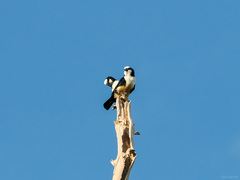
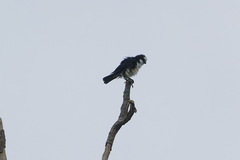
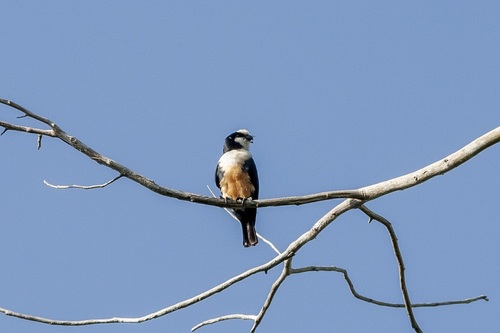
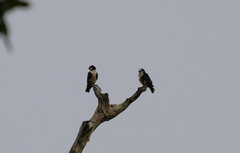
The white-fronted falconet (Microhierax latifrons), also called the Bornean falconet, is a species of bird of prey in the family Falconidae. Described by the British ornithologist Richard Bowdler Sharpe in 1879, it is endemic to Borneo, where it is found in Sarawak, Sabah, and extreme northeastern Kalimantan. An extremely small falcon, it is only 14–17 cm (5.5–6.7 in) long and weighs 35–65 g (1.2–2.3 oz), being the smallest species of falconet. It has glossy bluish-black upperparts, black flanks and outer thighs, and a black mask. The belly and vent are pale yellowish-brown, while the throat, cheeks, and breast are white. The species can be told apart from other falconets by the colour of its crown and forehead, which is white in males and reddish-brown in females. It has no subspecies.

The species inhabits open forests, forest edges, clearings with dead trees, and cultivated regions with interspersed trees, and rarely in mangrove forests. It mainly eats insects, although it has also been reported hunting birds. The breeding season lasts from March to either June or April, with clutches of two eggs being laid in old barbet or woodpecker nest holes. It is classified as being near threatened by the International Union for Conservation of Nature and is also listed on Appendix II of CITES. Threats to the species include deforestation, forest fires, and the cage-bird trade. Wikipedia →
Sounds

Begging call0:16

Malaysia · 2013

© Jason Anderson · XC154326 · CC BY-NC-SA 3.0

Global Distribution

Parks Where Found

# Park Country Daily sighting probability
1 Danum Valley Conservation Area 🇲🇾 Malaysia
~10%
2 Kinabatangan Wildlife Sanctuary 🇲🇾 Malaysia
<5%
3 Sepilok 🇲🇾 Malaysia
<5%
4 Kinabalu Park 🇲🇾 Malaysia
<5%

Closest Relatives at Danum Valley Conservation Area

No species of the same family or order lives in Danum Valley Conservation Area, so these are its closest relatives here: other birds.

Before you go

What are the chances of seeing a White-fronted Falconet in Danum Valley Conservation Area?

With luck

About 10% of wildlife watchers report a White-fronted Falconet sighting in Danum Valley Conservation Area on a given day, based on 194 verified sightings from GBIF citizen-science data from 2019 to 2026. It is the 118th most-seen of the 258 birds we can rate there. Over three days the chance rises to about 30%, and over a week to about 60%, if each day is a fresh chance.

When is the best time to see a White-fronted Falconet in Danum Valley Conservation Area?

February, July and September–October

In those months about 20% of wildlife watchers report a White-fronted Falconet in Danum Valley Conservation Area on a given day, against under 5% in April to June, the lowest months.

What time of day is best to see a White-fronted Falconet?

Between 3 and 6 pm

Across all the parks we cover, that three-hour window holds the most White-fronted Falconet sightings with a recorded time, and about 8 in 10 of them come between 6 am and 6 pm: it is a daytime animal.

Is Danum Valley Conservation Area the best place to see a White-fronted Falconet?

Yes

Of the 4 parks where we can rate White-fronted Falconet sightings, Danum Valley Conservation Area has the highest daily chance: about 10%. Next come Kinabatangan Wildlife Sanctuary (Malaysia, under 5%) and Sepilok (Malaysia, under 5%).

Where does the White-fronted Falconet sighting chance come from?

GBIF citizen-science records

It is estimated from how often the White-fronted Falconet is recorded against all the birds logged in Danum Valley Conservation Area (194 verified sightings from 2019 to 2026), calibrated against known sighting rates. Figures are rounded to the nearest 10% because citizen-science data supports honest approximations, not decimals, and months with records from fewer than five people show "—". How it works.

← Back to Danum Valley Conservation Area