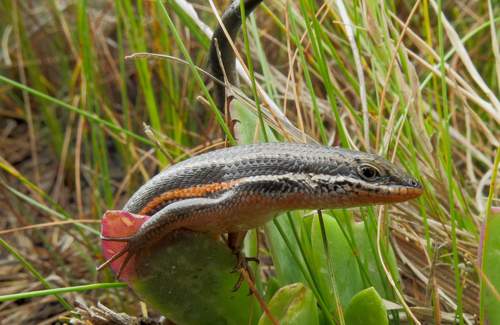
Common Slug-eater

Common Slug-eater

Duberria lutrix

Silhouette: SeismicShrimp · PhyloPic

LCLeast ConcernNTVUENCR
Daily sighting probability ~20% · Possible
at De Hoop Nature Reserve

In 3 days ~40% in a week ~80%

6 Verified sightings at De Hoop Nature Reserve From 2019 to 2026
521 In all 3 parks
July Best month
☀️ Diurnal When it's spotted

About the Common Slug-eater

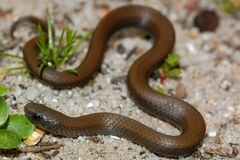
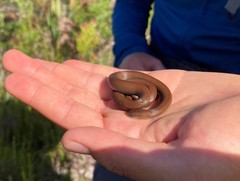
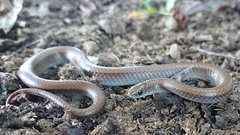
Duberria lutrix, or the common slug eater, is a small, ovoviviparous, molluscivorous, non-venomous snake, which is endemic to Africa. Adults can be up to thirty to forty cm (approximately twelve to sixteen inches). The common slug eater's colour can vary, but they typically have an olive green to brown or russet back, grey flanks, a yellowish or cream belly, and a black, more or less complete, vertebral stripe.

This species is found in Burundi, Democratic Republic of the Congo, Eswatini, Ethiopia, Kenya, Mozambique, Rwanda, South Africa, Tanzania, Uganda, and Zimbabwe. Six subspecies are recognized, including the nominotypical subspecies.

Duberria lutrix abyssinica (Boulenger, 1894) Duberria lutrix atriventris Sternfeld, 1912 Duberria lutrix basilewskyi Skelton-Bourgeois, 1961 Duberria lutrix currylindahli Laurent, 1956 Duberria lutrix lutrix (Linnaeus, 1758)

Duberria lutrix rhodesiana Broadley, 1958 As the name implies, the common slug eater is a specialised predator and feeds on snails and slugs, mostly finding its prey through chemoreception, using its tongue. It swallows its prey quickly before too much defensive... Wikipedia →

Global Distribution

Parks Where Found

# Park Country Daily sighting probability
1 Garden Route National Park 🇿🇦 South Africa
~20%
2 Table Mountain National Park 🇿🇦 South Africa
~20%
3 De Hoop Nature Reserve 🇿🇦 South Africa
~20%

Cities Where Found

# City Country Daily sighting probability
1 Cape Town 🇿🇦 South Africa
~20%

Closest Relatives at De Hoop Nature Reserve

No species of the same family or order lives in De Hoop Nature Reserve, so these are its closest relatives here: other reptiles.

Before you go

What are the chances of seeing a Common Slug-eater in De Hoop Nature Reserve?

Possible

About 20% of wildlife watchers report a Common Slug-eater sighting in De Hoop Nature Reserve on a given day, based on 6 verified sightings from GBIF citizen-science data from 2019 to 2026. It is the 15th most-seen of the 18 reptiles we can rate there. Over three days the chance rises to about 40%, and over a week to about 80%, if each day is a fresh chance.

When is the best time to see a Common Slug-eater in De Hoop Nature Reserve?

July and September–October

In those months about 30% of wildlife watchers report a Common Slug-eater in De Hoop Nature Reserve on a given day, against under 5% in November to June, the lowest months.

What time of day is best to see a Common Slug-eater?

Between 1 and 4 pm

Across all the parks we cover, that three-hour window holds the most Common Slug-eater sightings with a recorded time, and about 9 in 10 of them come between 6 am and 6 pm: it is a daytime animal.

Is De Hoop Nature Reserve the best place to see a Common Slug-eater?

Among the best

Of the 3 parks where we can rate Common Slug-eater sightings, De Hoop Nature Reserve ranks 3rd at about 20%, level with the leaders once rounded. The best odds are in Garden Route National Park (South Africa, about 20%) and Table Mountain National Park (South Africa, about 20%).

Where does the Common Slug-eater sighting chance come from?

GBIF citizen-science records

It is estimated from how often the Common Slug-eater is recorded against all the reptiles logged in De Hoop Nature Reserve (6 verified sightings from 2019 to 2026), calibrated against known sighting rates. Figures are rounded to the nearest 10% because citizen-science data supports honest approximations, not decimals, and months with records from fewer than five people show "—". How it works.

← Back to De Hoop Nature Reserve