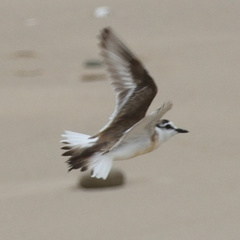
White-Fronted Plover

White-Fronted Plover

Charadrius marginatus

LCLeast ConcernNTVUENCR
Daily sighting probability ~40% · Likely
at De Hoop Nature Reserve

In 3 days ~70% in a week >90%

75 Verified sightings at De Hoop Nature Reserve From 2019 to 2026
2,386 In all 9 parks
January Best month
☀️ Diurnal When it's spotted

About the White-Fronted Plover

The white-fronted plover or white-fronted sandplover (Anarhynchus marginatus) is a small (45-50 g) shorebird of the family Charadriidae that inhabits sandy beaches, dunes, mudflats and the shores of rivers and lakes in sub-saharan Africa and Madagascar. It nests in small shallow scrapes in the ground and lays clutches of one to three eggs. The species is monogamous and long-lived, with a life expectancy of approximately 12 years. The vast majority of pairs that mate together stay together during the following years of breeding and retain the same territory. The white-fronted plover has a similar appearance to the Kentish plover, with a white fore crown and dark bands connecting the eyes to the bill.

Wikipedia →

Sounds

Call0:11

Madagascar · 2021

© Ken Behrens · XC624791 · CC BY-NC-SA 4.0

Song0:15

South Africa · 2024

© Nick Talbot · XC947060 · CC BY-NC-SA 4.0

Call0:12

South Africa · 2019

© Frank Lambert · XC521375 · CC BY-NC-ND 4.0

Global Distribution

Parks Where Found

# Park Country Daily sighting probability
1 West Coast National Park 🇿🇦 South Africa
~60%
2 De Hoop Nature Reserve 🇿🇦 South Africa
~40%
3 Gonarezhou National Park 🇿🇼 Zimbabwe
~40%
4 iSimangaliso Wetland Park 🇿🇦 South Africa
~30%
5 Addo Elephant National Park 🇿🇦 South Africa
~20%
6 Garden Route National Park 🇿🇦 South Africa
~20%
7 Table Mountain National Park 🇿🇦 South Africa
~10%
8 Namib-Naukluft National Park 🇳🇦 Namibia
~10%
9 Kruger National Park 🇿🇦 South Africa
~10%

Cities Where Found

# City Country Daily sighting probability
1 Maputo 🇲🇿 Mozambique
~20%
2 Durban 🇿🇦 South Africa
~10%
3 Cape Town 🇿🇦 South Africa
<5%

Before you go

What are the chances of seeing a White-Fronted Plover in De Hoop Nature Reserve?

Likely

About 40% of wildlife watchers report a White-Fronted Plover sighting in De Hoop Nature Reserve on a given day, based on 75 verified sightings from GBIF citizen-science data from 2019 to 2026. It is the 45th most-seen of the 193 birds we can rate there. Over three days the chance rises to about 70%, and over a week to over 90%, if each day is a fresh chance.

When is the best time to see a White-Fronted Plover in De Hoop Nature Reserve?

January

In that month about 60% of wildlife watchers report a White-Fronted Plover in De Hoop Nature Reserve on a given day, against under 5% in April, June–July and November, the lowest months.

What time of day is best to see a White-Fronted Plover?

Between 9 am and noon

Across all the parks we cover, that three-hour window holds the most White-Fronted Plover sightings with a recorded time, and about 9 in 10 of them come between 6 am and 6 pm: it is a daytime animal.

Is De Hoop Nature Reserve the best place to see a White-Fronted Plover?

2nd of 9

Of the 9 parks where we can rate White-Fronted Plover sightings, De Hoop Nature Reserve ranks 2nd at about 40%. The best odds are in West Coast National Park (South Africa, about 60%). All parks ranked.

Which relatives of the White-Fronted Plover live in De Hoop Nature Reserve?

Same genus: Charadrius

The closest relatives of the White-Fronted Plover that you can see in De Hoop Nature Reserve (genus Charadrius, Holarctic Ringed Plovers and Allies) are Three-Banded Plover (about 20%), Kittlitz's Plover (about 20%) and Common Ringed Plover (about 10%), with each one's daily chance of a sighting.

Where does the White-Fronted Plover sighting chance come from?

GBIF citizen-science records

It is estimated from how often the White-Fronted Plover is recorded against all the birds logged in De Hoop Nature Reserve (75 verified sightings from 2019 to 2026), calibrated against known sighting rates. Figures are rounded to the nearest 10% because citizen-science data supports honest approximations, not decimals, and months with records from fewer than five people show "—". How it works.

← Back to De Hoop Nature Reserve