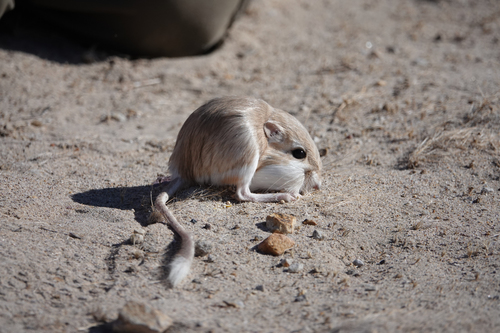


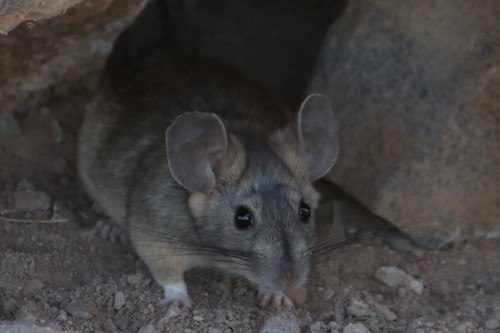
Desert Kangaroo Rat

Desert Kangaroo Rat

Dipodomys deserti

Silhouette: PhyloPic

LCLeast ConcernNTVUENCR
Daily sighting probability ~10% · With luck
at Death Valley National Park

In 3 days ~40% in a week ~70%

12 Verified sightings at Death Valley National Park From 2019 to 2026
12 In 1 park
January Best month
☀️ Diurnal When it's spotted

About the Desert Kangaroo Rat

The desert kangaroo rat (Dipodomys deserti) is a rodent species in the family Heteromyidae that is found in desert areas of southwestern North America. It is one of the large kangaroo rats, with a total length greater than 12 inches (300 mm) and a mass greater than 3.2 ounces (91 g).

The desert kangaroo rat is found in arid parts of southwestern North America, including Death Valley, the Great Basin, the Mojave Desert, and portions of the Sonoran Desert. Though kangaroo rats persist in a variety of soils, desert kangaroo rats live exclusively in areas with loose sand, often dune terrain. The places on this list constitute some of the most extreme deserts in the United States including Death Valley, which has the record for the hottest place on the continent.

Desert kangaroo rats are denizens of desert areas with sandy soil; vegetation is typically sparse and consists of creosote bush, a variety of grasses, and cacti. Desert kangaroo rats live in burrow systems under slight mounds of soil 6-9m across; they sleep in a den, which is sealed off at extreme temperatures, during the day. Groups of 6-12 widely spaced burrows may constitute a colony of this species... Wikipedia →

Global Distribution

Parks Where Found

# Park Country Daily sighting probability
1 Death Valley National Park 🇺🇸 United States
~10%

More parks will be added in future updates.

Zoos & Centres Where Found

# Zoo / Centre Country
1 Burgers' Ocean 🇳🇱 Netherlands In captivity
2 Royal Burgers' Zoo 🇳🇱 Netherlands In captivity
3 Ralph Perkins II Wildlife Center and Woods Garden 🇺🇸 United States In captivity

Before you go

What are the chances of seeing a Desert Kangaroo Rat in Death Valley National Park?

With luck

About 10% of wildlife watchers report a Desert Kangaroo Rat sighting in Death Valley National Park on a given day, based on 12 verified sightings from GBIF citizen-science data from 2019 to 2026. It is the 9th most-seen of the 16 mammals we can rate there. Over three days the chance rises to about 40%, and over a week to about 70%, if each day is a fresh chance.

When is the best time to see a Desert Kangaroo Rat in Death Valley National Park?

January and November

In those months about 30% of wildlife watchers report a Desert Kangaroo Rat in Death Valley National Park on a given day, against under 5% in July–October and December, the lowest months.

What time of day is best to see a Desert Kangaroo Rat?

Between 7 and 10 am

Across all the parks we cover, that three-hour window holds the most Desert Kangaroo Rat sightings with a recorded time, and about 8 in 10 of them come between 6 am and 6 pm: it is a daytime animal.

Where else can you see a Desert Kangaroo Rat?

Only Death Valley National Park, in our data

Death Valley National Park is the only park on Wallace's Line with enough records to rate Desert Kangaroo Rat sightings: about 10% of wildlife watchers there report one on a given day.

Which relatives of the Desert Kangaroo Rat live in Death Valley National Park?

Same order: Rodentia

The closest relatives of the Desert Kangaroo Rat that you can see in Death Valley National Park (order Rodentia, Rodents) are White-tailed Antelope Squirrel (about 30%) and Desert Woodrat (about 10%), with each one's daily chance of a sighting.

Where does the Desert Kangaroo Rat sighting chance come from?

GBIF citizen-science records

It is estimated from how often the Desert Kangaroo Rat is recorded against all the mammals logged in Death Valley National Park (12 verified sightings from 2019 to 2026), calibrated against known sighting rates. Figures are rounded to the nearest 10% because citizen-science data supports honest approximations, not decimals, and months with records from fewer than five people show "—". How it works.

← Back to Death Valley National Park