Kit Fox

Kit Fox

Vulpes macrotis

Silhouette: PhyloPic

LCLeast ConcernNTVUENCR
Daily sighting probability ~30% · Possible
at Death Valley National Park

In 3 days ~60% in a week ~90%

38 Verified sightings at Death Valley National Park From 2019 to 2026
49 In all 2 parks
November Best month
☀️🌙 Day & Night When it's spotted

About the Kit Fox

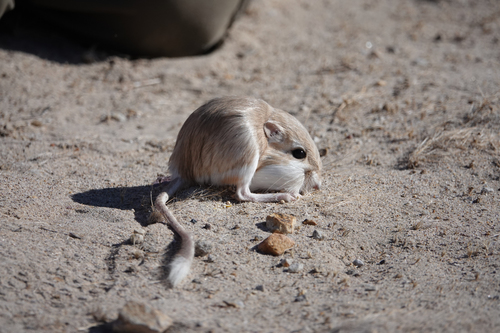
The kit fox (Vulpes macrotis) is a fox species that inhabits arid and semi-arid regions of the Southwestern United States and northern and central Mexico. These foxes are the smallest of the four species of Vulpes occurring in North America and are among the smallest of the vulpines worldwide. It has also been called a North American counterpart of the fennec fox due to its large ears.

Some mammalogists classify it as conspecific with the swift fox, V. velox, but molecular systematics indicate that the two species are distinct. Interbreeding between the two species does occur where their ranges overlap (eastern New Mexico and western Texas), but this hybridization is quite restricted in scope.

Subspecific designations for the species are not fully addressed. As many as eight subspecies have been recognized, although further analyses have not found support for any subspecies differentiation. However, although there is a clear need for more subspecific clarification, most available data suggest that kit foxes in the San Joaquin Valley of California are likely to warrant a subspecific designation, V. m. mutica, due to geographical isolation, and that any other kit foxes... Wikipedia →

Global Distribution

Parks Where Found

# Park Country Daily sighting probability
1 Death Valley National Park 🇺🇸 United States
~30%
2 Joshua Tree National Park 🇺🇸 United States
~10%

Zoos & Centres Where Found

# Zoo / Centre Country
1 Living Desert Zoo and Gardens 🇺🇸 United States In captivity
2 California Living Museum 🇺🇸 United States In captivity
3 Big Bear Alpine Zoo 🇺🇸 United States In captivity
4 Orange County Zoo 🇺🇸 United States In captivity

Before you go

What are the chances of seeing a Kit Fox in Death Valley National Park?

Possible

About 30% of wildlife watchers report a Kit Fox sighting in Death Valley National Park on a given day, based on 38 verified sightings from GBIF citizen-science data from 2019 to 2026. It is the 5th most-seen of the 16 mammals we can rate there. Over three days the chance rises to about 60%, and over a week to about 90%, if each day is a fresh chance.

When is the best time to see a Kit Fox in Death Valley National Park?

November

In that month about 60% of wildlife watchers report a Kit Fox in Death Valley National Park on a given day, against about 20% in February–April, June–July and September–October, the lowest months. That is one of Death Valley National Park's driest months, with about 10 mm of rain against 30 mm in March.

What time of day is best to see a Kit Fox?

Between 7 and 10 pm

Across all the parks we cover, that three-hour window holds the most Kit Fox sightings with a recorded time, and about half of them come between 6 am and 6 pm: it is seen both by day and at night.

Is Death Valley National Park the best place to see a Kit Fox?

Yes

Of the 2 parks where we can rate Kit Fox sightings, Death Valley National Park has the highest daily chance: about 30%. Next come Joshua Tree National Park (United States, about 10%).

Which relatives of the Kit Fox live in Death Valley National Park?

Same family: Canidae

The closest relatives of the Kit Fox that you can see in Death Valley National Park (family Canidae, Canids) are Coyote (about 70%) and Gray Fox (about 10%), with each one's daily chance of a sighting.

Where does the Kit Fox sighting chance come from?

GBIF citizen-science records

It is estimated from how often the Kit Fox is recorded against all the mammals logged in Death Valley National Park (38 verified sightings from 2019 to 2026), calibrated against known sighting rates. Figures are rounded to the nearest 10% because citizen-science data supports honest approximations, not decimals, and months with records from fewer than five people show "—". How it works.

← Back to Death Valley National Park