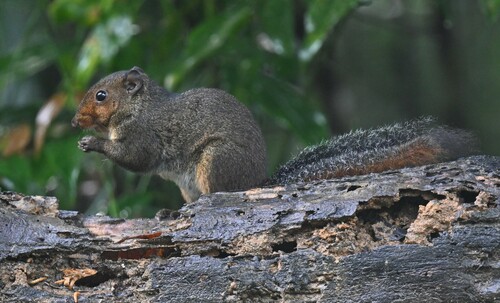
Himalayan Striped Squirrel

Himalayan Striped Squirrel

Tamiops mcclellandii

Silhouette: Xavier A. Jenkins · PhyloPic

LCLeast ConcernNTVUENCR
Daily sighting probability ~40% · Likely
at Doi Inthanon National Park

In 3 days ~80% in a week >90%

48 Verified sightings at Doi Inthanon National Park From 2019 to 2026
307 In all 5 parks
January Best month
🌅 Crepuscular When it's spotted

About the Himalayan Striped Squirrel

The Himalayan striped squirrel (Tamiops mcclellandii), also known as western striped squirrel or Burmese striped squirrel, is a species of rodent in the family Sciuridae. It lives in a variety of forest from tropical to subtropical in Bhutan, Cambodia, China, India, Laos, Malaysia, Myanmar, Nepal, Thailand, and Vietnam. This species is diurnal, arboreal and feeds on fruit, vegetable matter, and insects. It often seen in small groups and uses tree holes for shelter.

The rapid uplift of the Himalayas is believed to have caused the diversification of the three main Tamiops lineages. Multiple divergences from 5.8 to 1.7 mya likely led to the formation of modern Tamiops species. Wikipedia →

Sounds

Call0:52

Malaysia · 2019

© Marc Anderson · XC1041870 · CC BY-NC-ND 4.0

Recording0:04

Thailand · 2024

© Daan Drukker · XC971037 · CC BY-NC-SA 4.0

Recording0:51

Thailand · 2026

© Scott Olmstead · XC1105181 · CC BY-NC-SA 4.0

Global Distribution

Parks Where Found

# Park Country Daily sighting probability
1 Kaeng Krachan National Park 🇹🇭 Thailand
~50%
2 Doi Inthanon National Park 🇹🇭 Thailand
~40%
3 Manas National Park 🇮🇳 India
~40%
4 Khao Luang National Park 🇹🇭 Thailand
~40%
5 Khao Sok National Park 🇹🇭 Thailand
~30%

Cities Where Found

# City Country Daily sighting probability
1 Bangkok 🇹🇭 Thailand
<5%

Zoos & Centres Where Found

# Zoo / Centre Country
1 Tier- und Freizeitpark Thüle 🇩🇪 Germany In captivity
2 Northumberland Zoo 🇬🇧 United Kingdom In captivity

Before you go

What are the chances of seeing a Himalayan Striped Squirrel in Doi Inthanon National Park?

Likely

About 40% of wildlife watchers report a Himalayan Striped Squirrel sighting in Doi Inthanon National Park on a given day, based on 48 verified sightings from GBIF citizen-science data from 2019 to 2026. It is the most-seen of the 5 mammals we can rate there. Over three days the chance rises to about 80%, and over a week to over 90%, if each day is a fresh chance.

When is the best time to see a Himalayan Striped Squirrel in Doi Inthanon National Park?

January

In that month about 60% of wildlife watchers report a Himalayan Striped Squirrel in Doi Inthanon National Park on a given day, against under 5% in April–May and September, the lowest months. That is one of Doi Inthanon National Park's driest months, with about 45 mm of rain against 340 mm in August.

What time of day is best to see a Himalayan Striped Squirrel?

Between 2 and 5 am

Across all the parks we cover, that three-hour window holds the most Himalayan Striped Squirrel sightings with a recorded time, and about 6 in 10 of them come between 6 pm and 6 am: it is most active around dawn and dusk.

Is Doi Inthanon National Park the best place to see a Himalayan Striped Squirrel?

2nd of 5

Of the 5 parks where we can rate Himalayan Striped Squirrel sightings, Doi Inthanon National Park ranks 2nd at about 40%. The best odds are in Kaeng Krachan National Park (Thailand, about 50%). All parks ranked.

Which relatives of the Himalayan Striped Squirrel live in Doi Inthanon National Park?

Same family: Sciuridae

The closest relatives of the Himalayan Striped Squirrel that you can see in Doi Inthanon National Park (family Sciuridae, Squirrels) are Pallas's Squirrel (about 20%) and Asian Red-cheeked Squirrel (about 10%), with each one's daily chance of a sighting.

Where does the Himalayan Striped Squirrel sighting chance come from?

GBIF citizen-science records

It is estimated from how often the Himalayan Striped Squirrel is recorded against all the mammals logged in Doi Inthanon National Park (48 verified sightings from 2019 to 2026), calibrated against known sighting rates. Figures are rounded to the nearest 10% because citizen-science data supports honest approximations, not decimals, and months with records from fewer than five people show "—". How it works.

← Back to Doi Inthanon National Park